

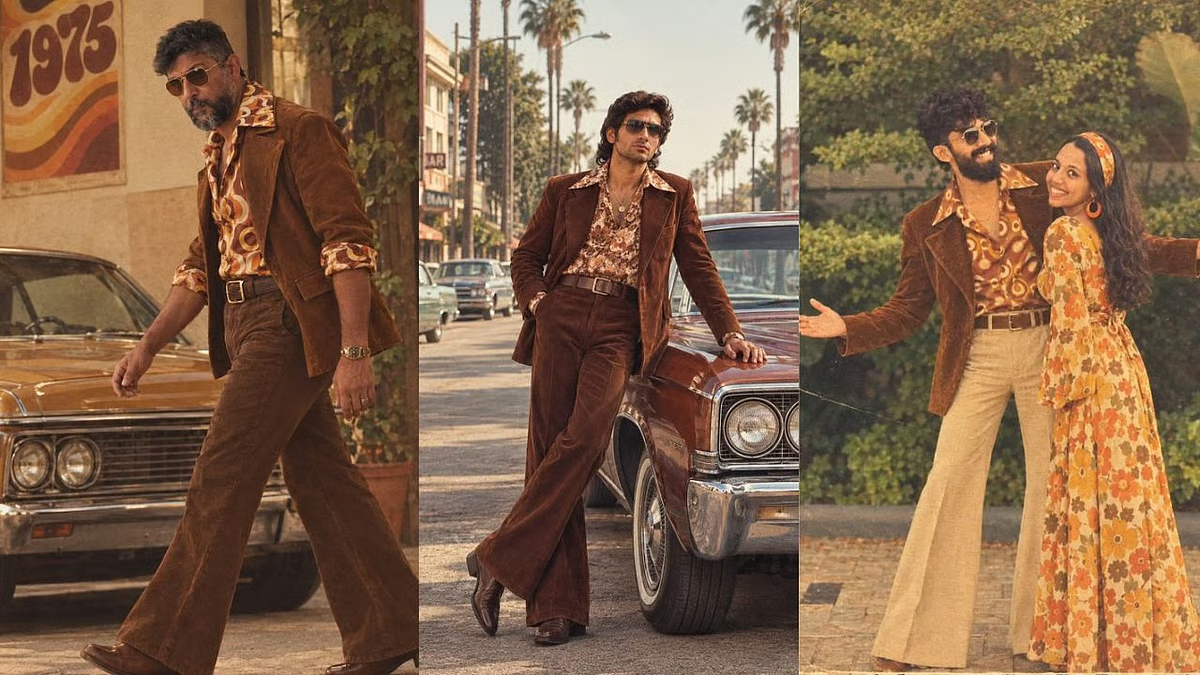
The 70s India AI photo trend is bringing an imagined version of the country’s past back to social media. Young users are using AI image-generation tools to transform ordinary photographs into detailed 1970s-style scenes featuring vintage clothing, analogue textures and familiar Indian settings.
70s India AI Photo Trend Takes Over Social Media
A new 70s India AI photo trend is gaining attention on social media as users turn present-day photographs into images inspired by everyday life in 1970s India. Instead of simply adding a sepia filter, users are using generative AI to recreate an entire visual setting around themselves.
The trend was highlighted by The Indian Express on October 6, with examples showing users imagining themselves in settings such as department stores, optical shops, railway platforms, rooftops and neighbourhoods from the 1970s.
AI-generated images created through tools such as Google Gemini can alter clothing, surroundings, lighting, colours and photographic texture while keeping the person recognisable. Users can describe the period and setting they want, giving the AI instructions about the mood, environment and camera style.
The result is designed to look less like a modern photograph with a filter and more like an old picture discovered in a family album.
Why 1970s India Is Becoming the New AI Aesthetic
The appeal of the trend comes largely from nostalgia, even among people who were not alive during the 1970s.
For younger users, the decade exists mostly through photographs, films, family stories, old advertisements, music and memories shared by parents and grandparents. AI gives them a way to visually place themselves inside that imagined past.
The visual language of the 1970s also makes the trend immediately recognisable. Muted colours, film grain, faded textures, imperfect exposure, period clothing and older interiors help distinguish the images from contemporary digital photography.
There is also an element of curiosity. A young person can take an ordinary selfie and ask what they might have looked like on an Indian railway platform in the 1970s or inside a department store during that period.
That combination of personal identity and historical imagination makes the format highly shareable.
From Vintage Filters to Full AI-Generated Scenes
Retro photography is not new on social media. Instagram users have been applying grain, faded colours and old-camera effects to photographs for years.
Generative AI changes the process because it can modify much more than the appearance of the original picture.
A user can upload a photograph and describe a completely different environment. The AI can generate period-specific clothing, architecture, furniture, lighting and other visual details around the subject.
For example, a modern portrait can be reimagined as a 1970s railway-platform photograph, while another image can place the subject inside an old Indian optical shop.
The October 6 trend report from The Indian Express included prompts built around specific imagined moments from the decade, including a 1973 department-store escalator scene and a 1977 rooftop photography class.
This makes the trend more interactive than a standard filter. Users are not just choosing an aesthetic. They are describing a scenario and asking AI to construct it.
Why Gen Z Is Drawn to Digital Nostalgia
For Gen Z and younger millennials, nostalgia on social media does not always mean remembering something personally.
It can also mean discovering an era through older generations.
This is visible in the way younger users engage with retro fashion, old Bollywood aesthetics, vintage music and photographs from previous decades. AI adds another layer by allowing them to participate in that culture visually.
A similar phenomenon appeared with the 1980s AI photo trend in September. Users transformed selfies into imagined 1980s portraits, with retro hairstyles, clothing, colours and photography styles becoming popular across social platforms.
The 70s trend takes that idea further by focusing on an Indian setting rather than simply reproducing a generic Western vintage look.
That distinction matters. A railway platform, old neighbourhood, rooftop or local shop can feel more culturally familiar to Indian users than a generic retro studio.
Regional Details Make the Trend More Relatable
One reason the trend has potential beyond major metropolitan audiences is its ability to recreate ordinary Indian environments.
Retro AI images do not have to centre on celebrities or glamorous locations. A user can imagine themselves at a railway station, in a classroom, at a local market or outside a neighbourhood shop.
That makes the format particularly relevant to audiences in Tier-2 and Tier-3 cities, where family photographs and stories from the 1970s can provide a strong connection to local history.
The visual references can also vary by region. Clothing, architecture, shopfronts, transport, signage and household settings looked different across India, meaning users can ask AI for more specific regional environments.
However, these images should be understood as creative reconstructions rather than genuine historical photographs.
AI Nostalgia Is Creative, Not Historical Evidence
The popularity of the trend also raises an important question about authenticity.
AI-generated photographs can look convincing enough to resemble genuine archival pictures. But an image created through generative AI does not become historical evidence simply because it contains period clothing or realistic-looking surroundings.
AI systems generate images based on patterns learned from existing data and the instructions provided by the user. They can produce convincing visual details while still getting historical or cultural elements wrong.
A recreated 1970s shop, for instance, may contain a mixture of details from different periods. Clothing, vehicles, architecture, typography or objects could appear plausible without actually being accurate to a particular year or location.
This is particularly important when AI images are shared without context. A fictional reconstruction can easily be mistaken for a genuine old photograph if viewers are not told that it was generated.
The Bigger Social Media Appeal of AI Trends
The 70s India AI trend is part of a broader shift in how people use generative AI for self-expression.
Earlier social media trends often depended on filters, editing applications or professionally created templates. Generative AI allows users to create much more personalised visual concepts through text prompts.
The 1980s trend demonstrated how quickly this format can spread. Bollywood celebrities including Kiara Advani, Sidharth Malhotra and Parineeti Chopra participated in retro AI imagery, while public figures also joined the trend.
The appeal is simple: users can create an image that would have been difficult, expensive or impossible to photograph in real life.
For social media platforms, these trends also encourage participation. Once users see one version of a concept, they can create their own interpretation and share it with friends and followers.
What the 70s AI Trend Says About Nostalgia
The popularity of the 70s India AI photo trend shows that nostalgia is not limited to people who actually experienced a particular decade.
Younger audiences are increasingly using technology to explore periods they know through family memories, popular culture and archived photographs.
AI turns that interest into a personalised experience. Instead of looking at someone else’s old photograph, users can imagine themselves inside a recreated version of the past.
That is what separates this trend from a conventional vintage filter.
At the same time, the trend highlights the need to distinguish creative storytelling from historical documentation. An AI-generated photograph can capture the feeling of a particular era without necessarily representing how that era actually looked in a specific place or year.
For now, that balance between nostalgia, personalisation and technology is what makes the 70s India AI photo trend so appealing to young social media users.
Key Takeaways
- The 70s India AI photo trend uses generative AI to recreate modern photographs as imagined scenes from 1970s India.
- Users are creating visuals inspired by railway platforms, shops, rooftops, neighbourhoods and other everyday settings.
- Gen Z interest is driven by nostalgia, personalisation and curiosity about earlier generations.
- AI recreations can look realistic but should not be treated as authentic historical photographs.
FAQ
What is the 70s India AI photo trend?
It is a social media trend in which users use generative AI tools to transform modern photographs into imagined scenes inspired by 1970s India.
Which AI tools are being used for retro photographs?
Recent examples of the trend have focused on AI image-generation tools such as Google Gemini. Other generative AI platforms can also create retro-style images depending on their available image-generation features.
Why are young people interested in 1970s-style AI photos?
The trend combines nostalgia, curiosity and personalisation. Younger users can explore an era they may know mainly through family photographs, stories, films and popular culture.
Are these AI-generated 1970s photographs historically accurate?
Not necessarily. They are creative reconstructions. AI can produce realistic-looking period details, but an image should not be treated as genuine historical evidence unless it comes from a verified historical source.







Leave a comment