

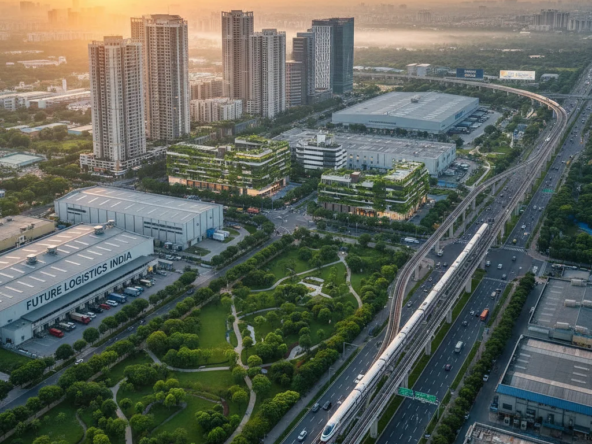
What small industrial hubs in Tier-2 cities need to attract post-budget tech investment is no longer a theoretical discussion. After the Union Budget, capital is actively scanning beyond metros, but only specific regions will convert intent into actual investment by aligning infrastructure, policy execution, and industry readiness.
The topic is time-sensitive in context because post-budget capital deployment follows clear signals. The tone here is analytical with a reporting lens, focused on what industrial hubs must do now to stay investable.
Post Budget Investment Signals and Why Tier-2 Cities Matter
What small industrial hubs in Tier-2 cities need to attract post-budget tech investment starts with understanding investor behaviour. Budgets do not create capital, they redirect it. Growth signals tracked by business channels and market analysts point toward manufacturing-linked tech, applied AI, logistics, energy, and deep tech as priority areas.
Tier-2 industrial hubs sit at the intersection of land availability, lower operating costs, and proximity to supply chains. Investors are looking for regions where scale can happen without metro cost inflation. However, capital is selective. It flows where execution friction is low and timelines are predictable. Industrial hubs that still operate on paper-driven approvals and fragmented utilities get filtered out early.
Infrastructure Readiness Beyond Basic Connectivity
One of the first filters for post-budget tech investment is infrastructure depth, not just presence. Roads and power are assumed. What matters now is reliability and integration.
Industrial hubs must offer uninterrupted power, high-quality data connectivity, last-mile logistics access, and plug-and-play industrial spaces. Tech investors increasingly back companies that blend software with hardware, manufacturing, or logistics. These companies cannot function in environments where basic utilities are unstable.
Common infrastructure facilities, testing labs, and shared warehousing reduce startup capital expenditure. Hubs that proactively build these attract faster commitments because they shorten go-live timelines. Infrastructure today is not a public works topic. It is an investment conversion lever.
Policy Execution Speed as a Competitive Advantage
Post-budget capital is impatient. Funds and corporates operate on defined deployment windows. Tier-2 hubs that can approve land allotments, factory licenses, and environmental clearances within weeks stand out.
Policy announcements mean little without on-ground execution. Single-window systems must actually work, not exist as portals that redirect founders to offline desks. Investors now conduct execution diligence before financial diligence.
States and cities that empower local officers to make decisions rather than escalate files signal seriousness. This is one of the strongest growth indicators tracked by market observers. Capital prefers predictable governance over incentives.
Talent Availability and Industry Linked Skilling
What small industrial hubs in Tier-2 cities need to attract post-budget tech investment also depends on talent realism. Investors no longer expect hubs to match metro talent density, but they do expect skill alignment.
Industrial hubs must work with local engineering colleges, ITIs, and private training institutes to create job-ready pipelines. Applied skills matter more than degrees. Robotics technicians, PLC programmers, AI model operators, and data engineers with domain exposure are in demand.
Retention improves when jobs exist locally. Hubs that demonstrate stable talent supply reduce execution risk for startups and growth-stage firms. This directly influences capital allocation decisions.
Ecosystem Density and Anchor Presence
Capital prefers clusters, not isolated units. One major reason some Tier-2 hubs outperform others is ecosystem density. When suppliers, service providers, testing agencies, and logistics partners co-exist, startups scale faster.
Anchor companies play a critical role. A large manufacturer, IT services firm, or defence unit creates demand gravity. Smaller tech firms then plug into supply chains.
Industrial hubs should actively court anchors rather than chasing multiple small tenants. One anchor often attracts ten startups. Investors track this multiplier effect closely.
Access to Early Customers and Procurement Pathways
Post-budget tech investment increasingly favours startups with early revenue visibility. Industrial hubs that enable access to government and PSU procurement gain an edge.
Startups working in energy management, smart manufacturing, logistics tech, and industrial AI benefit when hubs facilitate pilot deployments. Procurement-friendly regions shorten sales cycles.
This matters because investors now prioritise revenue-backed growth over speculative expansion. A hub that helps startups land first customers accelerates fundability.
Capital Interface and Visibility Gaps
Many Tier-2 industrial hubs fail not due to capability but due to invisibility. Investors cannot back what they cannot see. Regular demo days, investor tours, and industry showcases matter.
Hubs should maintain updated data on land availability, utilities, policy timelines, and startup pipelines. This information must be accessible and credible.
Growth signals tracked by financial media often originate from regions that communicate consistently. Silence is interpreted as stagnation.
What Industrial Hubs Must Do Immediately
Post-budget windows close fast. Industrial hubs that want tech capital must act within quarters, not years. The playbook is execution-heavy, not announcement-driven.
Clear timelines, empowered local governance, integrated infrastructure, and visible ecosystems convert budget intent into actual capital inflow. The hubs that move now will define the next decade of regional tech growth.
Takeaways
Post-budget tech capital prioritises execution-ready Tier-2 industrial hubs
Infrastructure reliability matters more than incentives or announcements
Fast policy execution and local decision-making attract investors
Ecosystem density and early customer access drive capital confidence
FAQs
Why is post-budget investment critical for Tier-2 industrial hubs?
Because budgets redirect capital flows, and early movers capture investor attention before funds get deployed elsewhere.
Do incentives matter more than infrastructure for investors?
No. Investors value predictable execution, utilities, and timelines more than tax incentives.
What sectors are investors watching in Tier-2 industrial hubs?
Manufacturing-linked tech, logistics, energy systems, industrial AI, defence tech, and applied deep tech.
How can smaller hubs improve visibility to investors?
By showcasing execution data, hosting investor engagements, and maintaining transparent ecosystem metrics.












Leave a comment