

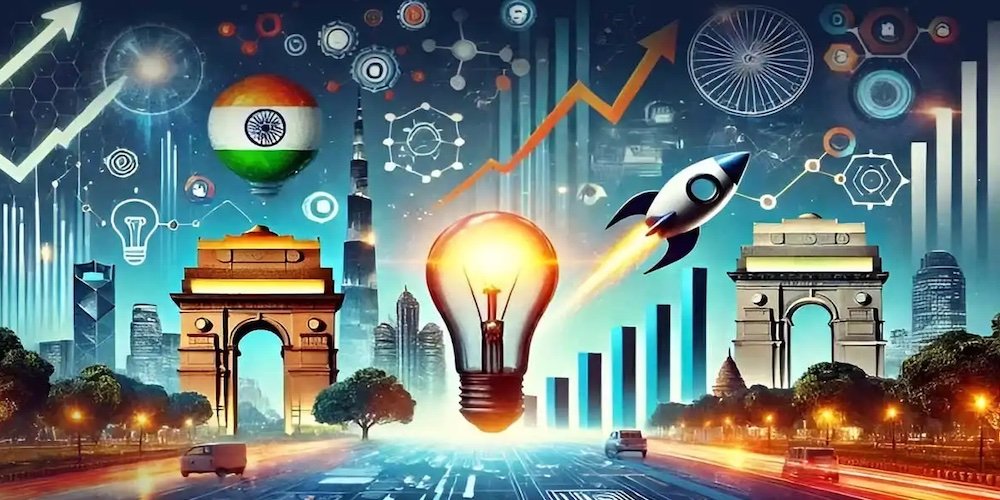
Startup India at 10 marks a defining shift in India’s entrepreneurial journey, moving from just four recognised ventures to over 125 unicorns spread far beyond Bengaluru and Mumbai. The programme has reshaped how innovation, capital, and ambition flow across Bharat’s Tier-2 and Tier-3 cities.
Understanding Startup India at 10 and Its Intent
Startup India at 10 is an informational and analytical topic, not time-sensitive news. It reflects on a decade-long policy and ecosystem transformation that continues to evolve.
Launched with the aim of formalising and supporting entrepreneurship, Startup India began at a time when venture creation was largely confined to metro cities. Access to capital, mentorship, and markets was limited outside a few urban clusters. Ten years later, the landscape looks markedly different.
The growth from four recognised startups to more than 125 unicorns is not just a numerical milestone. It signals a structural shift in where ideas originate, where companies scale, and who gets to participate in India’s innovation economy.
How Startup India Changed the Early Ecosystem
In its early years, Startup India focused on reducing friction for new ventures. Simplified registration, tax incentives, compliance relaxations, and access to government-backed funding mechanisms created a formal pathway for entrepreneurs.
This foundation mattered most to first-generation founders in non-metro regions. For many, formal recognition unlocked bank accounts, investor conversations, and partnerships that were previously inaccessible.
Incubation centres and state-level startup missions played a key role in decentralisation. Universities and local institutions became launchpads for ventures solving regional problems, from agri-tech to logistics and local language platforms.
Bharat Beyond Bengaluru and Mumbai
The most visible impact of Startup India at 10 is the rise of Bharat as an innovation base. Cities like Jaipur, Indore, Kochi, Coimbatore, Surat, Bhubaneswar, and Nagpur now host active startup communities.
These ecosystems differ from metro-driven models. Founders focus more on profitability, local demand, and operational efficiency. Customer acquisition costs are lower, and retention is often stronger due to deep local understanding.
Unicorn creation is no longer limited to software-first companies. Manufacturing, fintech for underbanked users, education technology, and health services rooted in regional needs are driving scale from smaller cities.
Capital Flow and the Changing Investor Lens
Initially, venture capital followed geography. Bengaluru and Mumbai attracted the bulk of funding due to proximity and familiarity. Over time, Startup India’s signalling effect altered investor behaviour.
Funds now actively scout Tier-2 and Tier-3 markets, often partnering with local accelerators. Digital infrastructure and remote due diligence have reduced the need for physical proximity.
Importantly, capital deployment has diversified. While mega rounds still cluster in metros, early and growth-stage funding increasingly reaches Bharat-based founders. This shift has expanded the unicorn pipeline beyond traditional hubs.
Sectoral Diversification Driving Unicorn Growth
The journey from four ventures to 125 plus unicorns reflects sectoral breadth. Consumer internet and fintech led the first wave, but later years saw deep tech, SaaS, climate solutions, defence technology, and enterprise platforms emerge.
Many of these sectors benefit from distributed talent pools. Engineering colleges and industrial clusters across India supply skilled workers at sustainable cost structures.
Regional startups often solve globally relevant problems from local contexts. This has improved export potential and positioned India as a product innovation hub rather than just a services economy.
Role of State Governments and Local Policy
Startup India’s success is closely tied to state-level execution. Competitive federalism pushed states to launch their own startup policies, incentives, and funding programmes.
States invested in innovation parks, seed funds, and procurement access. For Bharat-based startups, local government contracts often became the first large customer, enabling early validation and scale.
This alignment between central vision and local action reduced dependency on metro ecosystems and allowed regional founders to build without relocation pressure.
Challenges That Still Remain
Despite progress, gaps persist. Late-stage capital remains concentrated, forcing many Bharat startups to seek metro connections for scaling. Mentorship depth and global exposure are uneven across regions.
Talent migration to metros still occurs, particularly in specialised roles. Infrastructure constraints and slower policy implementation in some states can delay growth.
However, these challenges are evolutionary rather than structural. The base has been built. The next decade will focus on strengthening depth, not just breadth.
What Startup India at 10 Signals for the Next Decade
Startup India at 10 demonstrates that entrepreneurship in India is no longer geography-bound. Innovation now reflects local needs, regional strengths, and national ambition.
The next phase will likely see more global category leaders emerging from non-metro India. As capital, talent, and policy continue to align, Bharat’s role in India’s startup story will only deepen.
This is not the end of a journey. It is proof that decentralised innovation is both possible and scalable.
Takeaways
Startup India enabled entrepreneurship to spread beyond metro cities
Bharat-based startups now contribute significantly to unicorn creation
Capital and policy alignment reduced regional entry barriers
The next decade will focus on depth, scale, and global impact
FAQs
What does Startup India at 10 signify?
It marks a decade of structured policy support that transformed India from a metro-centric startup ecosystem to a nationwide innovation network.
Are unicorns now emerging from Tier-2 and Tier-3 cities?
Yes. Several high-growth startups with roots outside major metros have scaled into unicorns or near-unicorn valuations.
How did Startup India help non-metro founders?
Through formal recognition, compliance ease, incubation support, and improved access to funding and government programmes.
Will metros still dominate the startup ecosystem?
Metros will remain important, but they no longer monopolise innovation, talent, or scale opportunities.








Leave a comment