

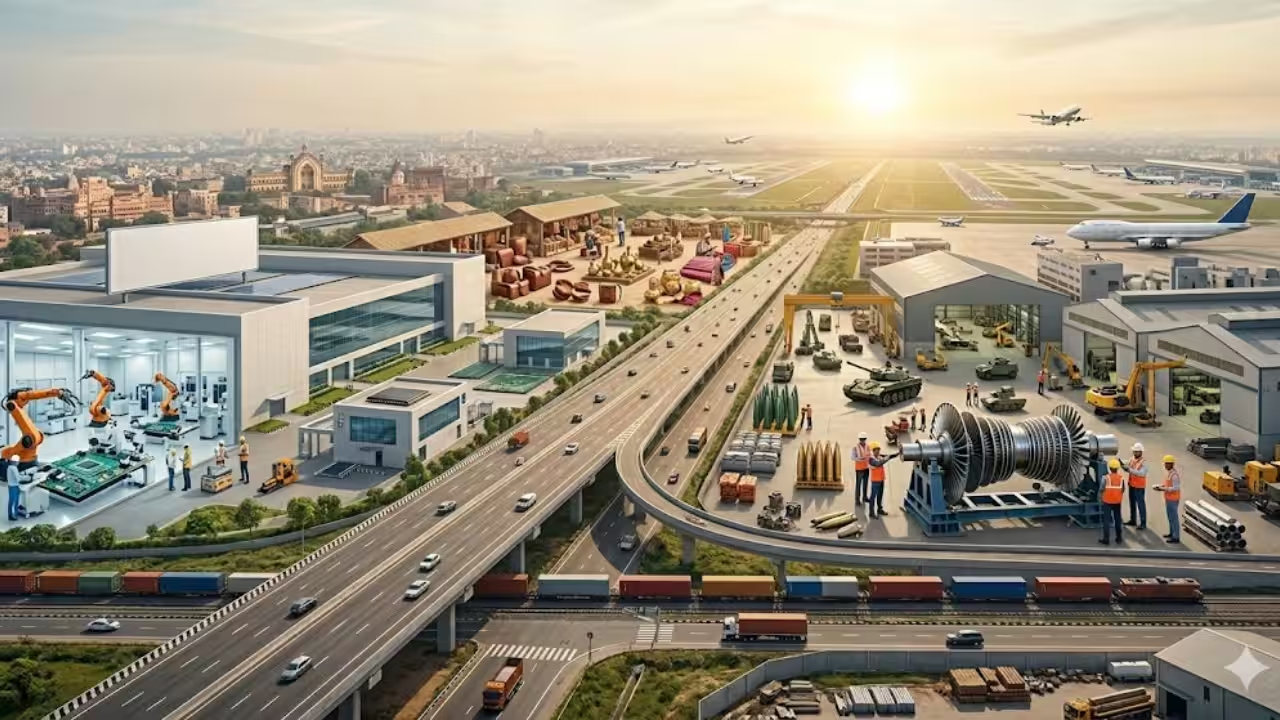
India’s growing focus on regional manufacturing beyond metro cities is reshaping the country’s industrial landscape. Government incentives, infrastructure development, and rising investments in Tier 2 and Tier 3 cities are creating new employment opportunities, strengthening supply chains, and supporting balanced economic growth across multiple states.
India’s growing focus on regional manufacturing beyond metro cities has become one of the country’s most significant industrial trends. This is an evergreen topic with ongoing policy relevance, although it is supported by recent developments under initiatives such as Make in India, the Production Linked Incentive (PLI) scheme, industrial corridor projects, and state-level manufacturing policies. The shift reflects a long-term economic strategy rather than a single breaking news event.
Why Manufacturing Is Expanding Beyond Metro Cities
For decades, India’s largest manufacturing facilities were concentrated around metropolitan regions such as Mumbai, Chennai, Bengaluru, Pune, Delhi NCR, and Ahmedabad. These cities offered established industrial ecosystems, skilled labor, ports, and reliable infrastructure.
However, several factors have encouraged companies to look beyond these traditional manufacturing hubs.
Rising land prices, increasing labor costs, traffic congestion, and pressure on urban infrastructure have made expansion within metro cities more expensive. At the same time, improvements in highways, logistics parks, freight corridors, airports, and digital connectivity have made smaller cities increasingly attractive for industrial investment.
Government initiatives have further accelerated this transition by encouraging companies to establish manufacturing units in emerging industrial clusters across multiple states.
Government Policies Supporting Regional Manufacturing Growth
India’s manufacturing strategy is closely linked with national programs designed to strengthen domestic production.
The Make in India initiative continues to encourage investments across sectors including electronics, automobiles, defense, pharmaceuticals, renewable energy, and textiles. The Production Linked Incentive (PLI) scheme has attracted investments by rewarding manufacturers that expand production within India.
In addition, industrial corridor projects such as the Delhi Mumbai Industrial Corridor, Chennai Bengaluru Industrial Corridor, Amritsar Kolkata Industrial Corridor, and other regional logistics networks are improving connectivity between factories, suppliers, and export markets.
Many state governments are also introducing attractive industrial policies that include subsidized land, tax incentives, faster approvals, and infrastructure support to attract manufacturers into smaller cities and districts.
These combined efforts are helping distribute industrial growth more evenly across the country.
Tier 2 and Tier 3 Cities Are Emerging as Manufacturing Hubs
Several Tier 2 and Tier 3 cities are witnessing significant industrial expansion.
Cities such as Indore, Aurangabad, Nagpur, Coimbatore, Hosur, Rajkot, Surat, Lucknow, Kanpur, Bhubaneswar, Visakhapatnam, Mysuru, Belagavi, Tirupati, and Vadodara are strengthening their industrial ecosystems through new factories, supplier networks, and logistics facilities.
Electronics manufacturing has expanded into Uttar Pradesh and Tamil Nadu, while automotive components continue growing in Maharashtra, Gujarat, Karnataka, and Tamil Nadu. Textile production remains strong across Gujarat, Tamil Nadu, and Telangana, while renewable energy manufacturing is expanding in several western and southern states.
Food processing, pharmaceuticals, engineering goods, and consumer electronics are also creating new opportunities in regional industrial clusters.
This diversification reduces dependence on a handful of metro cities while improving regional economic resilience.
Infrastructure Development Is Playing a Key Role
Modern infrastructure has become one of the biggest drivers behind regional manufacturing growth.
The expansion of national highways, expressways, dedicated freight corridors, multimodal logistics parks, inland container depots, and upgraded railway networks has reduced transportation costs for manufacturers.
Improved power supply, industrial parks, warehousing facilities, and digital infrastructure have further increased investor confidence.
Projects under PM Gati Shakti aim to integrate roads, railways, ports, airports, and logistics planning through coordinated infrastructure development.
Faster movement of raw materials and finished goods allows manufacturers located in smaller cities to compete effectively with factories operating near traditional metropolitan centers.
Employment and Local Economic Benefits
The growth of regional manufacturing creates employment opportunities beyond major urban centers.
Factories generate direct jobs for engineers, technicians, machine operators, quality inspectors, warehouse staff, and administrative professionals. They also support indirect employment through transportation, hospitality, maintenance services, packaging, retail, and local suppliers.
This industrial expansion can reduce migration pressure on metropolitan cities by allowing skilled workers to find employment closer to their hometowns.
Higher incomes also stimulate local businesses, increase demand for housing, improve educational opportunities, and encourage the development of healthcare and commercial services.
Balanced regional development remains one of the key long-term advantages of decentralizing manufacturing.
Challenges That Still Need Attention
Despite strong progress, regional manufacturing faces several challenges.
Skill development remains uneven across many districts, requiring continued investment in vocational training and industry partnerships.
Some regions still need better urban planning, water management, industrial waste treatment, and last-mile logistics connectivity.
Small and medium enterprises often require easier access to finance, technology adoption, and global supply chains to compete effectively.
Policy consistency, quicker regulatory approvals, and sustainable industrial practices will also be important as manufacturing continues expanding across India.
Addressing these issues will determine how successfully regional manufacturing contributes to India’s long-term economic ambitions.
The Road Ahead for India’s Manufacturing Future
India’s manufacturing strategy is gradually moving from a metro-centric model toward a more geographically balanced industrial ecosystem. As infrastructure improves, supply chains become stronger, and government incentives continue supporting investment, regional manufacturing is expected to play an increasingly important role in economic growth.
Emerging industrial cities are no longer serving only as support centers. They are becoming production hubs capable of attracting domestic and international investment across multiple sectors.
If this momentum continues alongside investments in skills, logistics, and sustainable infrastructure, regional manufacturing could become one of the strongest drivers of employment, exports, and inclusive economic development over the coming decade.
Key Takeaways
- India’s manufacturing growth is increasingly expanding into Tier 2 and Tier 3 cities.
- Government initiatives such as Make in India, PLI schemes, and industrial corridors are driving investment.
- Better infrastructure and lower operating costs make regional cities attractive for manufacturers.
- Balanced industrial development can create jobs, strengthen local economies, and reduce dependence on metro cities.
Frequently Asked Questions
Q1. Why are manufacturers moving beyond metro cities in India?
Companies are seeking lower land costs, improved infrastructure, government incentives, and access to emerging industrial clusters while reducing operating expenses.
Q2. Which sectors are leading regional manufacturing growth?
Electronics, automobiles, pharmaceuticals, textiles, renewable energy, food processing, engineering goods, and consumer products are among the fastest-growing sectors.
Q3. How does regional manufacturing benefit Tier 2 and Tier 3 cities?
It creates employment, attracts investment, strengthens local businesses, improves infrastructure, and promotes balanced regional economic development.
Q4. What challenges remain for regional manufacturing?
Skill shortages, infrastructure gaps in some areas, financing for MSMEs, environmental sustainability, and regulatory efficiency remain important areas for improvement.










Leave a comment