

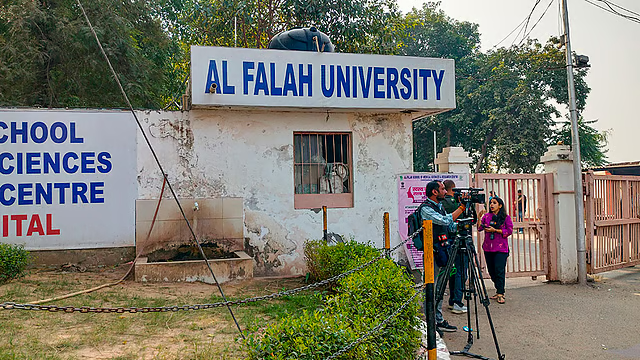
The intensified probe into staffers at Al Falah University after the Red Fort blast has pushed the issue of security awareness into national focus. The incident has renewed conversations around monitoring vulnerable institutions in smaller towns, where gaps in vigilance and rapid response remain common. This article examines what the evolving investigation suggests for other semi urban regions.
Why investigators widened the net around university staff
The initial phase of the Red Fort blast investigation focused on suspected external operatives. As digital trails and communication records were examined, agencies began looking at proximity links around the primary suspects. This led investigators to scrutinise a few staffers at Al Falah University due to reported interactions and possible exposure to individuals later linked to the conspiracy. Officials stated that the examination was precautionary, but the move indicated that institutions in smaller towns can become unwitting access points for radical networks if local vigilance stays weak.
Universities located outside major metros often lack structured security protocols, especially around visitor management, digital monitoring and staff verification. While metro campuses usually follow routine audits, background checks and periodic safety reviews, many semi urban institutions rely on informal systems. The current probe is a reminder that campuses can become blind spots in intelligence mapping if preventive frameworks are not standardised across regions.
How smaller town institutions become vulnerable points of contact
Smaller towns have expanded rapidly in the last decade, attracting educational institutions, coaching centres and training hubs. This growth has also increased footfall from multiple states. Security experts note that such environments are vulnerable when record keeping is inconsistent or outdated. For example, guest lecturers, temporary staff and external contractors often move in and out without a digital trail. This makes it difficult to detect suspicious patterns early.
In the Al Falah University context, investigators are examining whether any staffer unknowingly provided logistical help or shared resources that could have aided movement or communication. Even if unintentional, gaps like unsecured wifi access, unmonitored hostel entries or lack of ID verification can become indirect facilitators. The larger message is that institutions outside metro cities need the same baseline of monitoring that central and state agencies recommend nationally.
Why the incident has triggered conversations about small town policing
The Red Fort blast has highlighted the stress that policing systems in smaller districts face. Many rely on limited manpower and outdated forensic capabilities. When an incident of national security importance arises, local police must coordinate with central agencies, but delays can occur because records, CCTV archives or communication data are not centralised. In the current probe, agencies had to retrieve and rebuild several logs manually.
For tier 2 and tier 3 regions, security preparedness often depends on individual district officers rather than institutional frameworks. With universities, hospitals, malls and industrial parks growing in these towns, the need for integrated security planning is escalating. The Al Falah episode has added urgency to proposals calling for district intelligence units to be strengthened with better training and digital tools.
The broader learning for universities beyond metros
The probe has created a template for discussions across multiple institutions. Administrators are reviewing whether their campuses track visitor entries digitally, whether staff backgrounds are verified periodically and whether there is adequate CCTV coverage. Cybersecurity is emerging as a parallel concern, since encrypted messaging apps and open wifi networks have become common across hostels and libraries.
Universities in semi urban belts can strengthen security without creating fear among students. Regular drills, awareness campaigns and guidelines for identifying suspicious activity can build a culture of responsibility. The Red Fort investigation is reminding education administrators that national security is not solely a metro issue. Smaller towns are now deeply connected to national mobility, and threats can pass through unnoticed unless systems stay updated.
Takeaways
Smaller town institutions need structured digital monitoring and staff verification.
The Al Falah University probe highlights campus level vulnerabilities outside metros.
Local policing systems require upgraded tools for faster coordination with central agencies.
Security awareness must become a routine part of campus administration in semi urban regions.
FAQs
Why did investigators examine staffers at Al Falah University?
Because some communication and proximity patterns required verification. The examination was precautionary and aimed at closing potential information gaps.
Are universities in smaller towns more vulnerable to security lapses?
They can be, mainly due to informal monitoring systems, limited audits and inconsistent visitor or staff verification processes.
Does this mean the university was directly involved?
There is no confirmed claim of direct involvement. The probe is a routine part of tracing all possible links around suspects.
What should institutions outside metros do now?
Strengthen digital logs, improve CCTV coverage, conduct periodic staff checks and run awareness programmes to help spot early warning signs.











Leave a comment