

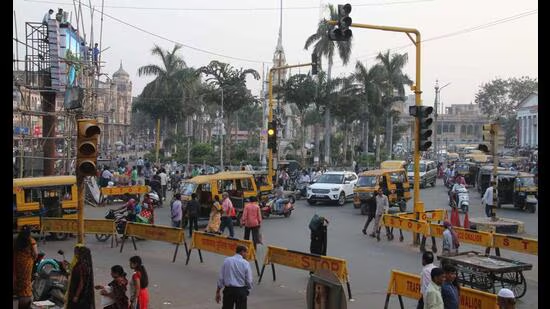
The recent surge in auto sales across Punjab, especially in smaller cities and semi-urban belts, is creating a blueprint that Tier-3 towns and Union Territories can study. Growth is driven by rising affordability, festive demand and improved supply chains — and the implications extend to local jobs, mobility infrastructure and regional policy.
Strong growth signals and what is driving it
Auto sales in Punjab posted double-digit volume gains during the recent festive season, with passenger vehicles rising roughly 11 % by volume and two-wheelers nearly 37 % in smaller city/urban belts. This suggests that affordability, expanding credit and emerging semi‐urban demand are real. For Tier-3 towns, this means that growth is no longer confined to big metros. Key supports include festive consumer sentiment, rationalised GST or tax relief, and improving access to dealerships. This creates a growth platform for mobility access in smaller towns.
Why smaller cities are leading the surge
Smaller cities in Punjab benefit from a combination of urbanising periphery, rising incomes, and catch-up demand. Households that deferred vehicle purchases in past years are now buying. Additionally, outreach by OEMs and dealer networks into non-metro zones is stronger. For Tier-3 towns elsewhere, the lesson is clear: logistical reach plus localised financing matter. Availability of credit, accessible service network, and timely delivery can unlock latent demand. Also, two-wheelers show outsized growth because they cater to first-time buyers and semi-urban purchasing patterns.
Employment and local economic spill-over
When auto demand climbs, local employment in sales, service, financing and logistics follows. In Punjab’s smaller towns, this means more showroom establishments, parts supply chains, and service garages. Tier-3 towns can replicate this by aligning local vocational training to automotive servicing, encouraging local entrepreneurship in spare-parts supply and improving readiness for aftermarket growth. Besides direct jobs, mobility growth stimulates ancillary sectors: fuel stations, vehicle financing offices, insurance offices — all of which can deepen local economies.
Infrastructure and policy implications for Tier-3 towns
Rapid vehicle growth in smaller towns brings infrastructure demands: new roads, parking, traffic management, fuel/filling stations, and electric vehicle (EV) readiness. For Tier-3 towns wanting to capitalise, they must plan ahead — avoid bottlenecks of saturation and congestion. Policy-wise, subsidies or tax relief for first-time buyers, simplified financing and support for local dealers can accelerate the cycle. Moreover, towns should consider sustainable mobility: encourage electric two-wheelers or three-wheelers, provide charger infrastructure early, and integrate mobility with public transport options.
Risks to watch and how smaller towns can respond
Unchecked growth can lead to congestion, air-quality degradation and service network strain. Smaller towns must anticipate these risks. They should coordinate with transport departments to implement registrations, emissions checks, and promote clustered service zones rather than ad-hoc expansions. For Tier-3 towns, embedding mobility growth within broader urban planning is essential: allocate zones for vehicle sales/service, ensure traffic impact assessments, and plan for shift to EVs and shared mobility.
Takeaways
- Punjab’s double-digit auto growth in smaller city belts shows semi-urban demand is unlocking.
- Tier-3 towns can tap this by improving dealer reach, financing access and local service ecosystems.
- Growth creates jobs beyond vehicle sales — in finance, service, logistics and infrastructure.
- Planning ahead for infrastructure and sustainable mobility is critical to avoid negative spill-overs.
FAQs
Q. What does “double-digit growth” mean in this context?
It means vehicle sales volumes are rising by more than 10 % year-on-year in specific segments or regions, signalling strong demand growth rather than marginal uptick.
Q. Why are smaller cities or semi-urban areas seeing stronger growth than metros?
Because metros already have higher vehicle penetration while smaller cities are still catching up. Rising incomes, better financing and local dealer networks make them growth hotspots.
Q. How should a Tier-3 town prepare for spill-over job opportunities?
By aligning training programmes for automotive servicing, encouraging parts supply shops, facilitating local dealerships and making licensing or regulatory processes smoother for entrepreneurs.
Q. What policy measures help sustain healthy growth rather than chaotic expansion?
Measures include incentivising electric vehicles, laying out clear zones for vehicle commerce, strengthening service networks, regulating traffic/parking in advance and integrating mobility with local urban planning.











Leave a comment