

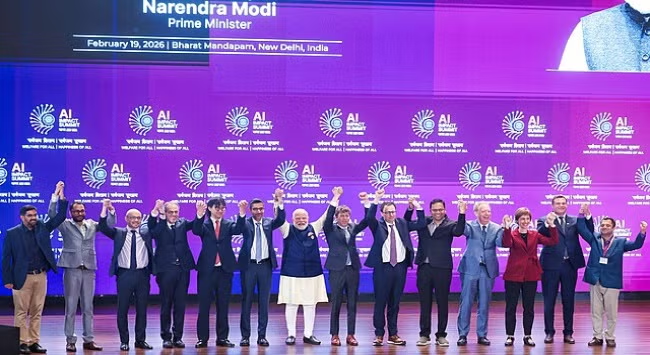
State-level reactions to India AI Summit 2026 indicate a clear push to decentralize artificial intelligence growth beyond metro cities. From new policy signals to startup incentives, smaller cities are positioning themselves to attract AI investments and talent following the national discussions.
India AI Summit 2026 has become a focal point for states seeking to align their technology strategies with national priorities. The summit’s emphasis on responsible AI, digital public infrastructure and skill development has triggered immediate responses from multiple state governments. This is a time sensitive development, as policy announcements and MoUs are unfolding in real time. For Tier-2 and Tier-3 cities, the real question is how these high-level commitments translate into jobs, funding and ecosystem growth.
Policy Signals from State Governments
In the aftermath of India AI Summit 2026, several states have reiterated or updated their artificial intelligence policies. States such as Karnataka, Tamil Nadu, Maharashtra and Telangana already have IT and startup policies that include AI incentives. Others are drafting focused AI roadmaps tied to skilling and industry collaboration.
For smaller cities within these states, policy clarity is crucial. When state governments announce AI centers of excellence, research grants or startup incubation funds, the location of these facilities determines regional growth patterns. Districts with established engineering colleges and industrial clusters are often first in line.
Some state officials have publicly emphasized that AI growth should not remain confined to Bengaluru, Hyderabad or Mumbai. Instead, expansion into cities like Mysuru, Coimbatore, Nagpur and Warangal is being framed as a strategic priority.
Opportunities for Tier-2 Tech Hubs
The most immediate opportunity emerging from India AI Summit 2026 lies in the expansion of AI driven startups into Tier-2 cities. Lower operating costs, improving digital infrastructure and availability of engineering graduates make these cities attractive alternatives to saturated metros.
Local tech hubs can leverage summit momentum to attract pilot projects in sectors such as agritech, healthtech and smart manufacturing. For example, AI based crop advisory systems are particularly relevant in states with large agricultural economies. Similarly, AI tools for diagnostics and telemedicine can find strong use cases in semi urban healthcare networks.
State reactions have included proposals to integrate AI with existing industrial corridors and electronics manufacturing clusters. If implemented effectively, this can help smaller cities host applied AI projects rather than only back office operations.
Skill Development and AI Education Initiatives
Another major theme emerging from India AI Summit 2026 is skill development. States are focusing on incorporating AI modules into university curricula, polytechnic courses and online training platforms.
In Tier-2 cities, public and private engineering colleges play a central role in building talent pipelines. Several state education departments have indicated plans to collaborate with industry partners to offer certification programs in machine learning, data analytics and cloud computing.
Such initiatives can prevent brain drain by equipping local students with market relevant skills. When graduates see viable career paths within their own region, migration pressure to metros may reduce over time.
Moreover, linking AI skilling with state employment exchanges and startup missions can create structured pathways from training to placement.
Digital Public Infrastructure and Governance
India AI Summit 2026 also highlighted the role of artificial intelligence in governance. States are exploring AI applications in traffic management, land record digitization, healthcare analytics and grievance redressal systems.
For smaller cities, this opens dual benefits. First, local startups may secure government contracts to build AI solutions tailored to district needs. Second, improved digital governance can enhance ease of doing business, making the city more attractive to investors.
Several states have already experimented with AI driven chatbots and predictive analytics in public service delivery. Scaling these projects beyond capitals into district headquarters is the next logical step.
If funding commitments announced after the summit are distributed equitably, Tier-2 cities could become implementation centers for public sector AI pilots.
Investment Climate and Startup Funding
State-level reactions also include discussions on attracting venture capital and corporate investment into regional innovation clusters. Many AI startups in smaller cities struggle with access to early stage funding.
Post summit, some state startup missions have indicated plans to expand seed funding schemes and co investment programs. Dedicated AI innovation challenges and hackathons are being proposed to identify promising ventures.
For investors, diversification beyond metros reduces cost pressures and competition. For founders, operating in Tier-2 cities allows longer runway due to lower salaries and rental costs.
The challenge will be ensuring that announced schemes move beyond press statements and translate into accessible funding mechanisms.
Infrastructure and Data Readiness
Artificial intelligence growth requires reliable power supply, high speed internet and access to computing resources. State governments responding to India AI Summit 2026 are emphasizing data centers and cloud partnerships.
Some states are actively courting data center investments, which can create ancillary demand for AI services. Smaller cities located near industrial or logistics hubs may benefit if infrastructure upgrades accompany policy announcements.
However, digital divides remain. Without stable connectivity and affordable cloud access, local tech hubs may struggle to compete. Sustained infrastructure investment will determine whether summit commitments yield tangible outcomes.
Takeaways
State reactions to India AI Summit 2026 show intent to decentralize AI growth beyond metros
Tier-2 tech hubs can benefit from AI startup expansion and applied sector projects
Skill development programs are central to retaining talent in smaller cities
Infrastructure and funding execution will decide the real impact on local ecosystems
FAQs
What is the significance of India AI Summit 2026 for states?
It sets national priorities on artificial intelligence, prompting states to align policies, funding and skilling initiatives accordingly.
How can smaller cities benefit from AI policy announcements?
Through new centers of excellence, startup funding schemes, public sector AI projects and expanded training programs.
Will AI jobs move to Tier-2 cities?
If infrastructure and talent pipelines are strengthened, companies may expand operations into lower cost regional hubs.
What challenges remain for local tech ecosystems?
Access to funding, advanced computing resources and consistent policy implementation remain key hurdles.









Leave a comment