

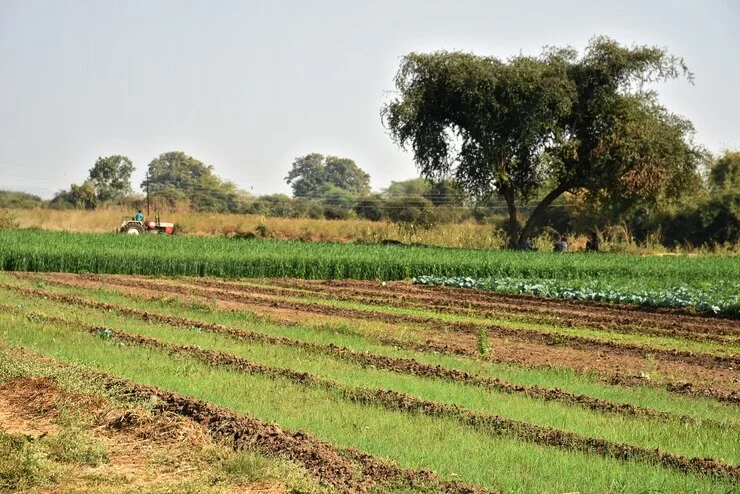
The latest data shows that rabi sowing has reached over 306 lakh hectares as of 21 November 2025, a significant rise from last year. This uptick in area sown holds key implications for agrarian towns in Maharashtra and neighbouring states, especially in terms of income, input demand and local business cycles.
What the numbers tell us
The Ministry of Agriculture has reported that total rabi crop area stands at 306.31 lakh hectares, up from 272.78 lakh hectares a year ago. The growth is driven by stronger area coverage in wheat (128.37 lakh ha vs 107.09 lakh ha), pulses (73.36 lakh ha vs 68.15 lakh ha), oilseeds (76.64 lakh ha) and coarse cereals (19.69 lakh ha). This higher sowing level signals favourable agro-climatic conditions, improved confidence among farmers and perhaps better input availability.
Why agrarian towns in Maharashtra & nearby states should care
In Maharashtra’s agrarian towns—the likes of Vidarbha, Marathwada and parts of the Western-Ghat fringe—a higher sowing area gives several ripple effects. First, when more land is sown, demand for seeds, fertilisers, labour and machinery picks up locally. This means input dealers, local service providers and labour markets in small towns see a boost. Second, more extensive crop area provides a cushion against shocks: when farmers expand sowing, they show increased risk appetite and adaptability. Third, with more sowing comes the prospect of stronger harvests next season, potentially improving cash flows into local economies (agri-services, shops, transport, warehousing) in Tier-2 and Tier-3 towns.
Input market and rural value-chain dynamics
When sowing areas expand, inputs are the first beneficiaries. Seed companies register higher off-take; fertiliser consumption rises; custom-hiring centres and tractor services get busier. In agrarian towns, this means local employment in service centres and logistics. When pulses and oilseeds area rises—as the numbers show—it also implies rotation of crops and inter-cropping patterns changing, benefiting local agro-enterprises. For towns serving as procurement or aggregation centres, increased sowing means greater expected volumes for storage, transport and grading services. That opens business opportunities beyond the farm gate.
Income flows and rural demand in smaller towns
Assuming normal weather and operations, a larger sown area typically leads to higher volumes at harvest. For small-town economies, this means the following chain: farmers have saleable produce, they spend on local goods and services, wages are paid to labour, and rural demand for non-farm services rises. In Maharashtra’s agrarian belt, where non-farm rural incomes are still linked to farm cycles, this can translate into stronger offline retail, local finance activity and even hiring in support services. The boost in rabi sowing thus isn’t confined to fields—it feeds the broader rural town economy.
Risks and caveats for agrarian-town stakeholders
While the sowing area has increased, the actual yield outcomes will matter. Inputs, weather, pest attacks, water availability and market linkages all determine harvest success. In Maharashtra, regions with late monsoon withdrawal or irrigation constraints could face yield risk even if sowing expands. For agrarian towns, a disappointing harvest could reverse local demand. Also, increased sowing means pressure on local infrastructure—seed supply, fertiliser stocks, custom-hiring machines—and if these are constrained in smaller towns, cost inflation or input scarcity could reduce margins. Furthermore, expanded sowing must be matched with good harvesting, storage and market access for the advantage to materialise.
Strategic implications for agrarian-town businesses and policymakers
Local businesses in agrarian towns should prepare for higher rural demand by stocking relevant inputs, offering value-added services (custom-hiring, storage, logistics) and aligning credit/finance options for farmers. Policymakers and district-level administrations need to ensure timely seed/inputs delivery, strengthen local warehousing and ensure procurement centres are ready. Given bigger sowing, extension agencies should focus on supporting best practices (crop rotation, fertiliser use, pest management) especially in smaller towns lacking technical support. For agrarian-town stakeholders, the window is now to convert the sowing boost into sustainable rural-town economic growth.
Takeaways
- Expanded sowing area (306 lakh ha+) signals stronger rural activity and sets up downstream demand in agrarian towns.
- Input and service markets in smaller towns stand to gain from higher custom-hiring, seeds, fertilisers and logistics needs.
- Rural income flows tied to harvest cycle amplify when sowing grows—potentially boosting local non-farm demand.
- Risk remains: yield outcomes, infrastructure constraints and market access will determine whether the expanded sowing translates into economic benefit for agrarian towns.
FAQs
Q: Does higher sowing area guarantee a good harvest?
No. While an expanded sowing area improves potential, actual harvest depends on inputs, weather, irrigation, pests and market access. Poor conditions can negate area gains.
Q: How quickly will agrarian-town economies feel the impact of increased sowing?
Some effects (input demand, labour hiring) appear almost immediately. Others (harvest revenues, local spending) materialise only after crop maturity and sale, typically several months later.
Q: Why is this particular figure relevant for Maharashtra and nearby states?
Because these states hold large agrarian-town populations dependent on rabi crops. When sowing expands nationally, regions including Maharashtra benefit through higher local activity and income flows.
Q: Should businesses in smaller towns invest now based on this data?
Yes, but with caution. Investing in inventory, services or hiring makes sense, but businesses should monitor local input supply, farmer demand signals, and weather/irrigation conditions to avoid overextension.












Leave a comment