

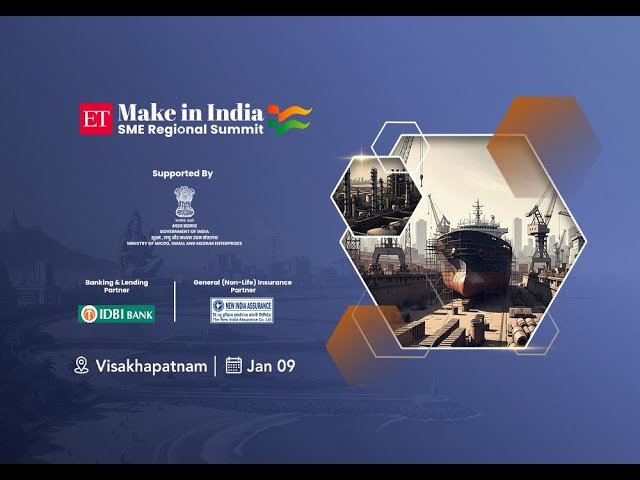
The ET Make in India SME Summit in Visakhapatnam highlighted how small and medium enterprises are becoming central to India’s regional economic growth. The event focused on manufacturing resilience, export readiness, digital adoption, and why Tier-2 coastal cities are emerging as serious business hubs.
Visakhapatnam’s Strategic Rise in India’s SME Landscape
The ET Make in India SME Summit in Visakhapatnam underscored why the city is gaining attention among policymakers and entrepreneurs. With its deep-water port, industrial corridors, and improving logistics, Visakhapatnam is positioned as a manufacturing and export gateway for eastern and southern India. Speakers repeatedly pointed to reduced logistics costs and faster access to global markets as decisive advantages for SMEs operating from the region.
The summit also reflected a broader national shift. SME growth is no longer concentrated around metros like Mumbai, Delhi, or Bengaluru. Instead, policy incentives, infrastructure spending, and state-level industrial missions are redirecting attention toward Tier-2 cities. Visakhapatnam stood out as a practical case study rather than an aspirational pitch.
Manufacturing, Exports, and the Make in India Push
A key takeaway from the summit was the renewed emphasis on manufacturing-led SME growth. Industry leaders stressed that domestic demand alone is insufficient for long-term scale. Export readiness, compliance with global standards, and quality certifications were presented as essential next steps for Indian SMEs.
Participants discussed how Make in India is entering a more execution-focused phase. Rather than incentives alone, the focus is now on supply chain integration, vendor development, and cluster-based manufacturing. For SMEs, this means aligning with larger manufacturers, defence suppliers, shipbuilding units, and renewable energy projects already present in and around Visakhapatnam.
The discussion made it clear that SMEs that fail to modernize processes or meet international benchmarks risk being sidelined, even with supportive policy frameworks in place.
Digital Transformation and MSME Competitiveness
Digital adoption emerged as another dominant theme at the summit. SME growth is increasingly tied to technology-driven efficiency rather than just capacity expansion. Experts highlighted how cloud accounting, GST automation, digital inventory management, and AI-driven demand forecasting are no longer optional tools.
The summit also emphasized digital compliance. With tightening tax scrutiny and evolving regulatory requirements, SMEs adopting integrated digital systems are seeing fewer disruptions and faster access to formal credit. This shift is particularly relevant for Tier-2 businesses that traditionally relied on manual processes and informal financing.
Importantly, digital transformation was positioned as a growth enabler rather than a cost burden, especially for export-oriented and manufacturing SMEs.
Access to Credit and Policy Execution Challenges
While government-backed credit schemes and priority sector lending were acknowledged, speakers highlighted persistent gaps in last-mile execution. Many SMEs still struggle with delayed disbursements, documentation complexity, and collateral requirements.
The summit discussions revealed a growing consensus that financial institutions need region-specific risk assessment models. SMEs operating in industrial clusters like Visakhapatnam often have stable order books but limited balance sheet history. Traditional credit evaluation methods fail to capture this reality.
Policy experts suggested closer coordination between banks, state governments, and industry associations to improve credit flow. Without this alignment, SME growth risks being uneven despite strong demand and infrastructure support.
Why Tier-2 Cities Matter for the Next SME Cycle
One of the strongest signals from the summit was the strategic importance of Tier-2 cities in India’s next growth phase. Rising costs, congestion, and talent competition in metros are pushing entrepreneurs to look beyond traditional hubs.
Visakhapatnam was presented as an example of how industrial land availability, port connectivity, and skilled technical manpower can coexist without metro-level cost pressures. The city’s ecosystem is particularly attractive for sectors like food processing, chemicals, light engineering, defence manufacturing, and renewable energy components.
This shift is not just geographic but structural. SME growth in Tier-2 cities is increasingly linked to global value chains rather than local consumption alone.
Regional Business Pulse and Forward Outlook
The ET Make in India SME Summit made it clear that regional ecosystems will shape India’s SME trajectory over the next decade. Growth will depend on execution, not announcements. SMEs that invest early in technology, quality standards, and export readiness are likely to outperform peers who rely solely on domestic demand.
Visakhapatnam’s emergence reflects a broader national pattern where infrastructure-led development is creating new business centers outside metros. For SMEs, the opportunity is real, but so are the expectations. The next phase of growth will reward discipline, adaptability, and long-term planning.
Takeaways
Visakhapatnam is emerging as a serious SME manufacturing and export hub, not just a regional city
Make in India is shifting from incentives to execution, quality, and supply chain integration
Digital adoption is becoming critical for SME competitiveness and credit access
Tier-2 cities are central to India’s next SME growth cycle
FAQs
What was the main focus of the ET Make in India SME Summit in Visakhapatnam?
The summit focused on manufacturing-led SME growth, export readiness, digital transformation, and the role of Tier-2 cities in India’s industrial expansion.
Why is Visakhapatnam important for SME growth?
Its port connectivity, industrial infrastructure, and lower operational costs make it attractive for manufacturing and export-oriented SMEs.
How does digital adoption impact SMEs discussed at the summit?
Digital tools improve compliance, efficiency, access to credit, and competitiveness, especially for SMEs targeting larger supply chains and exports.
What challenges for SMEs were highlighted at the event?
Access to timely credit, compliance complexity, and the need to meet global quality standards were identified as ongoing challenges.










Leave a comment