

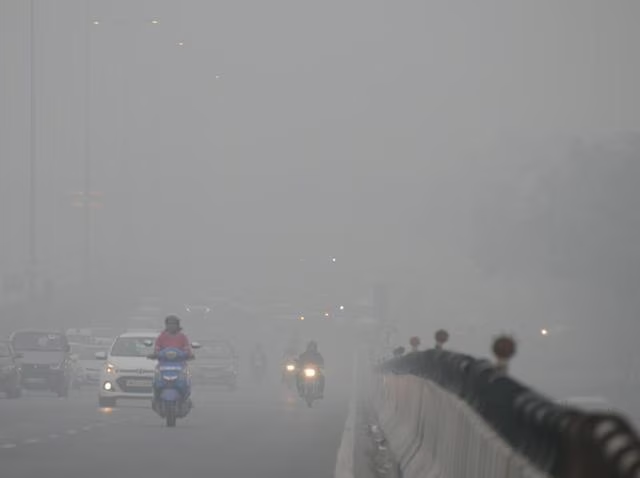
Delhi-NCR is facing a smog emergency driven by hazardous air quality levels, forcing health advisories, restrictions, and public safety warnings. This situation is not unique to the capital region and offers clear, actionable lessons for Tier-2 cities in North India that are increasingly vulnerable to similar pollution spikes.
Smog Emergency in Delhi-NCR Signals a Wider Risk Pattern
The smog emergency in Delhi-NCR has once again highlighted how quickly air quality can deteriorate when multiple risk factors converge. Seasonal stubble burning, vehicular emissions, construction dust, low wind speeds, and winter inversion conditions have combined to push pollution levels into the severe category. Schools have issued advisories, outdoor activity has been curtailed, and hospitals are reporting higher cases of respiratory distress.
For Tier-2 cities like Lucknow, Kanpur, Patna, Jaipur, Ludhiana, Meerut, and Rohtak, the conditions are not very different. Many of these cities already record high particulate matter levels during winter months but lack the real time response mechanisms seen in Delhi-NCR. The capital’s crisis shows that pollution spikes are no longer rare events but predictable seasonal outcomes.
Air Quality Monitoring Gaps in Tier-2 Cities
One of the biggest lessons from the Delhi-NCR smog emergency is the importance of dense and reliable air quality monitoring. Delhi has multiple monitoring stations that allow authorities to issue timely health advisories and impose graded response measures. In contrast, many Tier-2 cities rely on limited stations that often do not reflect neighborhood-level exposure.
Secondary keywords like air quality monitoring and pollution data transparency become critical here. Without accurate data, local administrations cannot justify restrictions on traffic, construction, or industrial activity. Citizens also remain unaware of the severity of exposure, delaying precautionary behavior such as mask usage or reduced outdoor movement.
Public Health Advisories and Local Preparedness
Delhi-NCR’s health advisories during smog emergencies are widely circulated through schools, workplaces, and digital platforms. These advisories recommend avoiding outdoor exercise, using air purifiers indoors, and protecting vulnerable groups such as children and the elderly.
Tier-2 cities can learn from this structured communication approach. Health advisories should not be reactive announcements after conditions worsen. They must be pre-drafted, localized, and automatically triggered when pollution crosses defined thresholds. Hospitals in smaller cities often face sudden patient surges during pollution episodes, and early warnings can help reduce avoidable exposure.
Urban Planning and Emission Control Failures
The smog emergency also exposes long-term planning failures. Rapid urbanization in North Indian Tier-2 cities has increased vehicle density without corresponding investment in public transport. Construction activity often operates with weak dust control norms. Industrial clusters near residential areas continue to function with outdated emission standards.
Secondary keywords such as vehicular pollution control and construction dust management are not abstract concepts anymore. Delhi-NCR’s experience shows that emergency measures alone cannot compensate for weak enforcement during the rest of the year. Tier-2 cities still have a window to integrate pollution control into urban planning before conditions become unmanageable.
Economic and Social Costs Beyond Health
While health impacts dominate headlines, the smog emergency also disrupts daily life and local economies. Reduced mobility affects small businesses, street vendors, delivery services, and informal workers. Schools shifting to hybrid or restricted schedules add pressure on working families.
Tier-2 cities often have a higher dependence on daily wage employment. A sudden pollution emergency without social cushioning can deepen economic stress. Delhi-NCR’s experience underlines the need for local governments to factor pollution disruptions into disaster preparedness frameworks, not treat them as isolated environmental events.
Early Action Is the Only Sustainable Strategy
The central takeaway from the Delhi-NCR smog emergency is that prevention is cheaper and more effective than crisis response. Pollution patterns are now predictable by season. Tier-2 cities must act before air quality reaches emergency levels.
This includes enforcing cleaner fuel transitions, expanding green buffers, regulating construction timing, and coordinating with neighboring districts on agricultural residue management. Waiting until air quality becomes hazardous limits policy options and public compliance.
Takeaways
- Smog emergencies are no longer limited to metro cities and Tier-2 cities are next in line
- Real time air quality monitoring is essential for timely health advisories and action
- Public communication and hospital preparedness reduce avoidable health damage
- Early prevention through planning and enforcement costs less than emergency response
FAQs
Is the Delhi-NCR smog emergency a seasonal issue or a permanent risk?
It is seasonal in intensity but permanent in risk. Winter conditions make pollution spikes predictable every year.
Can Tier-2 cities avoid reaching Delhi-level pollution severity?
Yes, if they act early with monitoring, enforcement, and urban planning reforms.
Are health advisories effective during pollution spikes?
They are effective only when issued early and communicated clearly to the public.
What is the biggest gap in Tier-2 city pollution management?
Lack of reliable data and delayed response mechanisms are the biggest gaps.










Leave a comment