

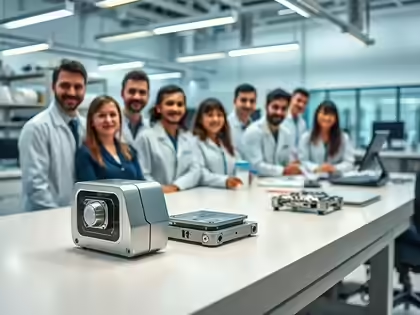
India’s deep tech and manufacturing startups are increasingly emerging from smaller cities rather than traditional metro hubs. Lower operating costs, local industrial clusters, and strong engineering talent are encouraging founders to build innovation driven companies beyond major startup ecosystems.
Deep tech and manufacturing startups in smaller cities are becoming a significant part of India’s evolving startup ecosystem. Over the past decade, most technology companies were concentrated in major urban hubs such as Bengaluru, Hyderabad, and Delhi NCR. However, a growing number of founders are now launching deep tech ventures and manufacturing driven startups from Tier 2 and Tier 3 cities.
This shift is driven by a combination of factors including access to technical talent, lower infrastructure costs, and proximity to industrial supply chains. As India expands its manufacturing ambitions and technology innovation capabilities, smaller cities are increasingly positioned to support the next generation of startups.
The trend suggests that India’s startup growth may become more geographically distributed in the coming years.
Rise of Deep Tech Innovation Outside Metro Startup Hubs
Deep tech innovation in India traditionally relied on metropolitan ecosystems that offered venture capital, research networks, and technology infrastructure. Today, however, smaller cities are building similar innovation environments through universities, incubators, and government supported research programs.
Cities such as Pune, Coimbatore, Ahmedabad, Bhubaneswar, and Jaipur have developed strong engineering education systems that produce skilled graduates every year. Many of these engineers prefer launching startups locally rather than relocating to crowded metropolitan markets.
Deep tech startups often focus on advanced technologies such as artificial intelligence, robotics, semiconductor design, and industrial automation. These sectors require technical expertise and research collaboration rather than expensive marketing driven business models.
As a result, founders in smaller cities can build deep tech ventures with relatively lower capital requirements compared to consumer technology startups.
The availability of technical universities and engineering talent is helping smaller cities become attractive innovation centers.
Manufacturing Ecosystems Supporting Hardware Startups
Manufacturing clusters in India play a critical role in enabling hardware and industrial startups. Several Tier 2 cities already host established manufacturing industries ranging from automotive components to electronics production.
For example, Coimbatore is known for engineering manufacturing, Pune has strong automotive supply chains, and cities such as Rajkot and Ludhiana specialize in industrial equipment and machine tools.
Startups developing hardware products benefit from being close to suppliers, machine shops, and fabrication units. This proximity allows founders to prototype, test, and refine products quickly without relying on distant production facilities.
Manufacturing ecosystems also provide access to experienced technicians and industry experts who understand production processes.
As India promotes domestic manufacturing through national industrial initiatives, startups operating in hardware technology and industrial innovation are finding opportunities in these established regional clusters.
Cost Advantages Encouraging Startup Formation
Lower operational costs in smaller cities provide a major advantage for deep tech and manufacturing startups. Unlike software companies, hardware and research driven startups often require laboratories, prototyping facilities, and testing infrastructure.
Establishing such facilities in metropolitan areas can be expensive due to high real estate prices and operational costs. Smaller cities offer affordable land, lower rents, and access to industrial zones that support manufacturing activities.
This cost efficiency allows founders to allocate more resources toward research and product development rather than administrative expenses.
Additionally, many smaller cities have supportive local ecosystems including engineering colleges, startup incubators, and regional innovation centers.
These resources help early stage startups access mentorship, funding opportunities, and technical guidance while maintaining manageable operational costs.
The financial advantage can significantly extend the survival time of early stage companies during product development phases.
Government Policies Promoting Industrial Innovation
Government policies supporting manufacturing and technology innovation have strengthened opportunities for startups outside major metros. Several national programs encourage domestic technology development and advanced manufacturing.
Initiatives promoting electronics manufacturing, semiconductor design, and industrial automation are attracting entrepreneurs interested in building technology driven products.
Government supported incubators in universities and technology institutes are also expanding across the country. These incubators provide infrastructure, research support, and networking opportunities for founders working on complex technologies.
State governments are also competing to attract technology startups by offering incentives such as subsidized land, tax benefits, and research grants.
These policy initiatives aim to reduce India’s dependence on imported technologies while strengthening domestic innovation capabilities.
For startups focusing on deep technology and manufacturing solutions, smaller cities often provide the ideal environment to build and test products.
Future Outlook for India’s Distributed Startup Innovation
The future of India’s startup ecosystem may increasingly rely on innovation emerging from multiple regions rather than a few metropolitan centers. As digital connectivity improves and industrial infrastructure expands, geographical limitations for startups continue to decline.
Deep tech and manufacturing ventures often require close collaboration between research institutions, production facilities, and engineering teams. Smaller cities with strong technical universities and industrial clusters can provide this environment effectively.
Investors are also beginning to recognize opportunities in these emerging ecosystems. Venture capital firms and angel investors are gradually expanding their networks to identify promising founders outside traditional startup hubs.
If current trends continue, India’s next generation of breakthrough technology companies may originate from cities that were previously overlooked in the startup landscape.
Smaller cities may become crucial contributors to India’s ambition of building a globally competitive innovation economy.
Takeaways
• Deep tech and manufacturing startups are increasingly emerging from smaller Indian cities.
• Engineering universities and industrial clusters support innovation outside metro hubs.
• Lower operational costs allow startups to focus more on research and product development.
• Government policies promoting manufacturing and technology innovation are accelerating this trend.
FAQs
What are deep tech startups in India?
Deep tech startups focus on advanced scientific and engineering technologies such as artificial intelligence, robotics, semiconductor design, and industrial automation.
Why are smaller cities attracting manufacturing startups?
Smaller cities often have established industrial clusters, lower operational costs, and access to skilled technical workers, which benefit hardware focused companies.
Do investors fund startups from Tier 2 cities?
Yes. Investors are increasingly exploring opportunities outside metro hubs as innovation ecosystems develop across India.
How can government policies support deep tech startups?
Government programs can provide funding support, research infrastructure, and manufacturing incentives that help startups develop complex technology products.








Leave a comment