

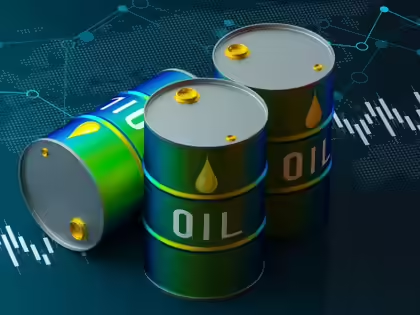
Rising oil prices crossing $100 per barrel are beginning to affect small businesses across Tier-2 cities in India. Increased fuel and logistics costs are putting pressure on margins, forcing local enterprises to adjust pricing, operations, and supply chains.
Rising oil prices crossing $100 have become a critical concern for small businesses in Tier-2 cities, where cost sensitivity is higher and margins are already tight. The impact is visible across sectors such as retail, transport, manufacturing, and food services, where fuel-linked expenses directly influence daily operations.
Fuel Cost Surge and Its Immediate Business Impact
The most immediate effect of rising oil prices on Tier-2 businesses is the increase in fuel costs. Petrol and diesel prices are closely linked to global crude rates, and any sustained rise translates into higher transportation expenses.
For small businesses that rely on daily logistics, including kirana stores, wholesalers, and local suppliers, this increase directly raises operating costs. Delivery charges have already started to climb in many cities, affecting both businesses and end consumers.
Transport-dependent sectors such as construction and agriculture-linked trade are particularly vulnerable. Higher diesel prices increase the cost of moving raw materials and finished goods, reducing overall profitability.
Supply Chain Disruptions and Cost Inflation
Rising oil prices also impact supply chains in Tier-2 cities, where businesses depend heavily on road transport. As freight costs increase, suppliers pass on the burden to retailers, leading to a chain reaction of price hikes.
This inflationary pressure is visible in everyday goods, including food items, packaged products, and essential commodities. Small retailers often face a dilemma between absorbing costs or increasing prices, both of which carry risks.
In highly competitive markets, passing on costs can reduce customer demand. On the other hand, absorbing costs reduces already thin margins. This balancing act is becoming increasingly difficult for small business owners.
Impact on Local Retail and Consumer Demand
Local retail businesses in Tier-2 cities are seeing early signs of reduced consumer spending due to rising oil prices. As fuel costs increase, household budgets tighten, leaving less disposable income for non-essential purchases.
Sectors such as apparel, electronics, and dining are particularly affected. Consumers are prioritising essential spending, which shifts demand patterns and affects revenue for small retailers.
Even in essential categories, customers are becoming more price-sensitive. This forces businesses to offer discounts or smaller packaging options to maintain sales volume.
The ripple effect of oil price increases extends beyond operational costs and directly influences consumer behaviour.
Pressure on MSMEs and Manufacturing Units
Micro, small, and medium enterprises in Tier-2 cities are facing compounded pressure due to rising oil prices. Manufacturing units that rely on transportation for both raw materials and distribution are experiencing increased input costs.
In addition to logistics, energy costs also play a role. While electricity tariffs are not directly tied to crude oil in all cases, broader energy market fluctuations can still influence operational expenses.
Small-scale manufacturers often lack the financial cushion to absorb prolonged cost increases. This may lead to reduced production, delayed expansion plans, or even temporary shutdowns in extreme cases.
The impact is particularly significant in industrial clusters located in smaller cities where MSMEs form the backbone of the local economy.
Adaptation Strategies by Small Businesses
Despite the challenges, many small businesses in Tier-2 cities are adapting to rising oil prices through operational changes. One common approach is optimising delivery routes to reduce fuel consumption.
Some businesses are also shifting toward local sourcing to minimise transportation costs. This not only reduces dependency on long-distance supply chains but also supports local economies.
Digital tools are playing a role as well. Inventory management systems and demand forecasting help businesses avoid overstocking and unnecessary logistics expenses.
In certain sectors, there is also a gradual shift toward electric vehicles for last-mile delivery, although adoption remains limited due to upfront costs.
Broader Economic Implications for Tier-2 Cities
The impact of rising oil prices extends beyond individual businesses and affects the overall economic environment in Tier-2 cities. Increased costs across sectors can slow down local economic activity.
Higher inflation reduces purchasing power, which in turn affects demand across industries. This creates a cycle where businesses earn less while costs continue to rise.
If oil prices remain elevated for an extended period, the cumulative effect could be significant for smaller cities that rely heavily on consumption-driven growth.
For policymakers, this situation highlights the need to support MSMEs and stabilise fuel-related costs where possible.
Takeaways
– Rising oil prices above $100 are increasing fuel and logistics costs for small businesses
– Supply chain expenses are pushing up prices of everyday goods in Tier-2 cities
– Consumer demand is weakening as household budgets adjust to higher fuel costs
– MSMEs are adopting cost-control strategies but remain vulnerable to prolonged price hikes
FAQs
Q1. Why do rising oil prices affect small businesses more?
Small businesses operate on thin margins and are more sensitive to increases in fuel and logistics costs.
Q2. Which sectors are most impacted in Tier-2 cities?
Retail, transportation, manufacturing, and food services are among the most affected sectors.
Q3. How are businesses coping with higher fuel costs?
They are optimising logistics, sourcing locally, and using digital tools to manage expenses.
Q4. Will rising oil prices affect consumers directly?
Yes, higher fuel costs lead to increased prices of goods and services, impacting household budgets.









Leave a comment