

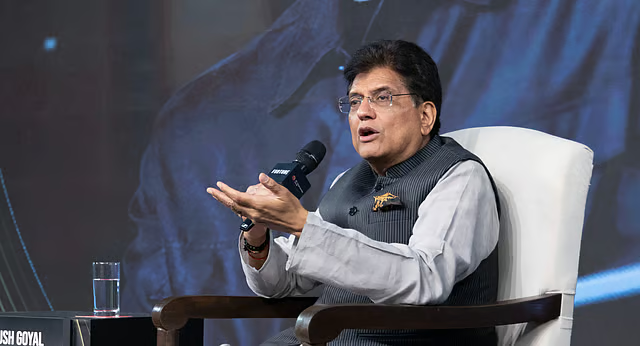
As Startup India completes ten years, the initiative has transformed India’s entrepreneurial landscape. From just a few hundred recognized startups in 2016 to more than 2 lakh today, the ecosystem has expanded beyond major metros, creating jobs, attracting investment, and driving innovation across sectors.
Time-Sensitive News Analysis
This is a time-sensitive news and policy analysis topic because recent government data has confirmed that India now has more than 2 lakh recognized startups under the Startup India initiative. The article follows a news-analysis style while examining the broader impact of this milestone.
The Startup India initiative has reached a significant milestone, with more than 2 lakh startups now officially recognized across the country. Launched in January 2016, the government-backed program aimed to encourage entrepreneurship, simplify regulations, and create an environment where innovative businesses could thrive.
Ten years later, the numbers tell a remarkable story. India has emerged as one of the world’s largest startup ecosystems, producing companies across fintech, edtech, healthtech, agritech, ecommerce, artificial intelligence, and clean energy. What began as an effort to support a small group of entrepreneurs has evolved into a nationwide movement that reaches cities, towns, and emerging business hubs across the country.
How Startup India Changed the Entrepreneurial Landscape
When Startup India was introduced, India’s startup ecosystem was still in its early stages. Entrepreneurial activity was concentrated mainly in Bengaluru, Mumbai, Delhi NCR, and a few other urban centers.
The initiative introduced several measures aimed at reducing barriers for founders. These included simplified registration processes, tax benefits for eligible startups, intellectual property support, funding initiatives, and easier compliance requirements.
Over time, these policy changes helped create a more supportive environment for entrepreneurs. Access to incubation centers improved, universities began promoting innovation programs, and private investors showed increasing interest in early-stage companies.
As a result, thousands of entrepreneurs who previously lacked resources or institutional support were able to launch ventures and pursue scalable business ideas.
Growth Beyond Metro Cities and Emerging Startup Hubs
One of the most important developments over the past decade has been the rise of startups in Tier-2 and Tier-3 cities.
Entrepreneurship is no longer limited to traditional technology hubs. Cities such as Indore, Jaipur, Nagpur, Coimbatore, Bhubaneswar, Kochi, Surat, Lucknow, Chandigarh, and Visakhapatnam have witnessed growing startup activity.
Improved internet connectivity, digital payments infrastructure, and access to online learning have enabled entrepreneurs from smaller cities to compete on a national scale.
Government-supported incubation centers and state startup policies have further strengthened regional ecosystems. Many founders are now building solutions specifically designed for local markets, including agriculture technology, healthcare access, logistics, education services, and regional-language digital platforms.
This decentralization of entrepreneurship has helped spread economic opportunities beyond India’s largest metropolitan areas.
Investment, Innovation and Job Creation
The success of the Startup India ecosystem is not measured solely by the number of registered companies. The broader impact can be seen in innovation, investment inflows, and employment generation.
Indian startups have attracted billions of dollars in domestic and international funding over the past decade. Venture capital firms, angel investors, corporate investors, and global funds have increasingly viewed India as a major growth market.
Startups have also become significant job creators. From software engineers and product designers to sales professionals and logistics workers, startup-driven employment has expanded across multiple sectors.
Innovation has accelerated as companies develop solutions tailored to India’s unique challenges. Fintech platforms have expanded financial inclusion, healthtech startups have improved healthcare access, and agritech companies are helping farmers improve productivity.
The combination of investment and innovation has strengthened India’s position as a global entrepreneurial destination.
Challenges Facing the Next Phase of Growth
Despite impressive achievements, the startup ecosystem still faces several challenges.
Many startups struggle with profitability and sustainable business models. Funding conditions have become more selective in recent years as investors focus on financial discipline rather than rapid expansion.
Access to growth capital remains uneven, particularly for startups operating outside major urban centers. Regulatory compliance, talent acquisition, and global competition continue to pose challenges for emerging companies.
Additionally, sectors such as deep technology, semiconductor manufacturing, advanced artificial intelligence, and scientific research require long-term investment and specialized expertise.
Addressing these challenges will be crucial if India aims to strengthen its position among the world’s leading innovation economies.
What the Future Holds for India’s Startup Ecosystem
The next decade could be even more transformative for Indian entrepreneurship.
Artificial intelligence, climate technology, clean energy, manufacturing innovation, biotechnology, and digital public infrastructure are expected to create new opportunities for founders.
Government initiatives supporting innovation, combined with a growing pool of skilled professionals, may help drive the next wave of startup growth.
The rise of regional entrepreneurship is likely to continue as digital adoption expands across smaller cities and rural areas. Many experts believe the next generation of successful startups will emerge from locations that were previously absent from India’s innovation map.
As Startup India enters its second decade, the ecosystem appears better positioned than ever to contribute to economic growth, technological advancement, and employment creation.
Key Takeaways
- Startup India has helped India surpass 2 lakh recognized startups within a decade.
- Entrepreneurial activity has expanded significantly beyond major metropolitan cities.
- Startups have contributed to innovation, investment attraction, and job creation across sectors.
- Future growth is expected to be driven by AI, climate technology, manufacturing, and regional entrepreneurship.
FAQ
What is Startup India?
Startup India is a government initiative launched in January 2016 to promote entrepreneurship through policy support, funding access, tax benefits, and simplified regulations.
How many startups are recognized under Startup India?
Recent government data shows that India has crossed the milestone of more than 2 lakh officially recognized startups.
Which sectors have benefited the most from Startup India?
Fintech, healthtech, edtech, agritech, ecommerce, software services, artificial intelligence, and clean energy have been among the major growth sectors.
Why are Tier-2 and Tier-3 cities becoming startup hubs?
Improved digital infrastructure, access to funding programs, local incubation centers, and growing entrepreneurial awareness have encouraged startup growth beyond metropolitan regions.












Leave a comment