

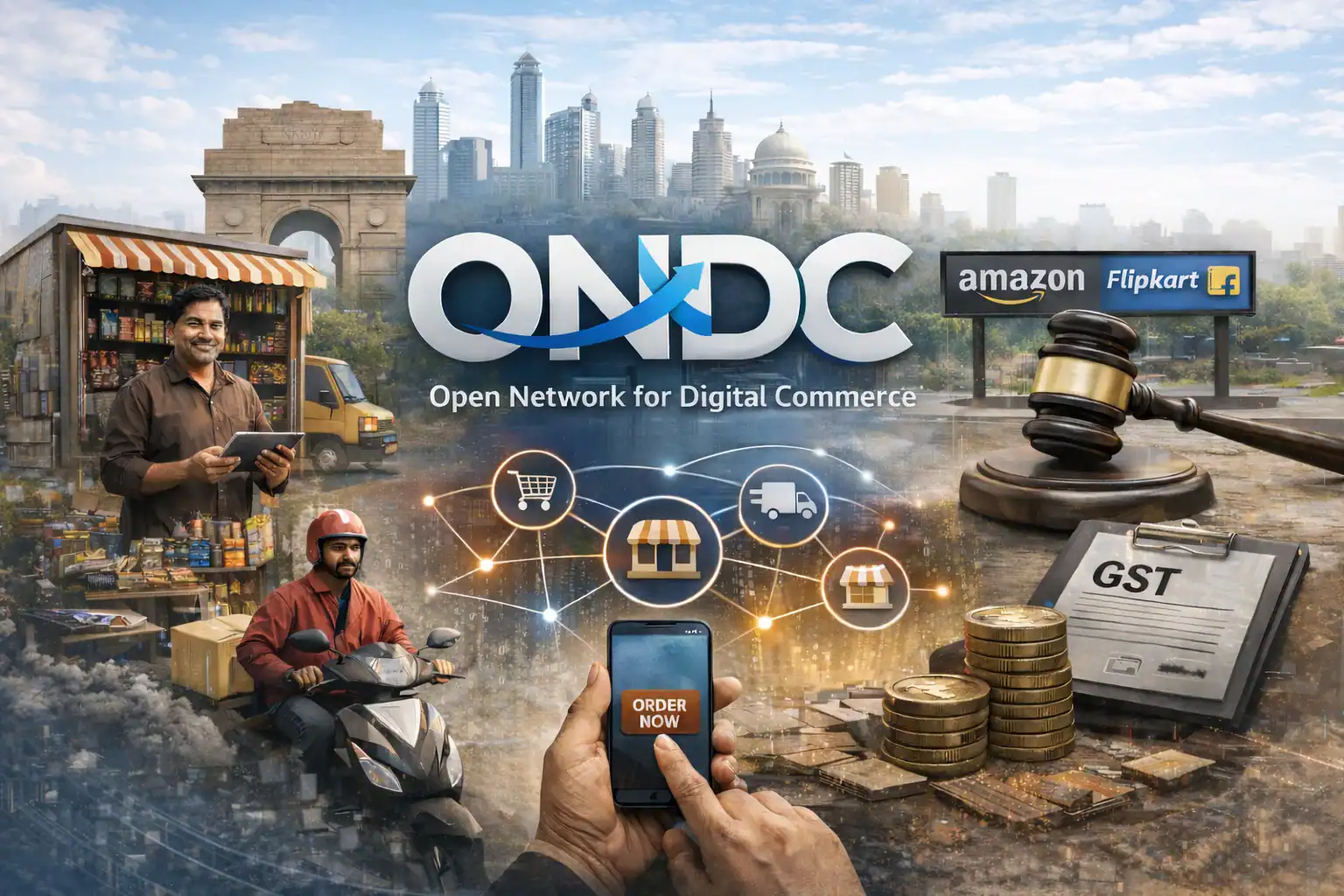
The Open Network for Digital Commerce (ONDC) is reshaping India’s digital marketplace by giving local retailers an opportunity to compete online without depending solely on large e-commerce platforms. Its expansion is helping businesses in Tier 2 and Tier 3 cities reach more customers while reducing barriers to digital commerce.
Topic Classification: Evergreen with ongoing developments
The growth of ONDC has emerged as one of the most important developments in India’s digital commerce ecosystem. Unlike traditional e-commerce marketplaces that operate as closed platforms, ONDC is an open network designed to connect buyers, sellers and service providers through interoperable applications. As the network continues to expand, local retailers across India are finding new ways to increase their online presence, attract customers and participate in the country’s growing digital economy.
Launched by the Government of India’s Department for Promotion of Industry and Internal Trade (DPIIT), ONDC aims to democratize digital commerce by creating a common network where businesses of all sizes can transact. Instead of relying on a single marketplace, merchants can sell through multiple buyer applications connected to the ONDC network, increasing visibility and reducing dependence on one platform.
What Is ONDC and Why Does It Matter?
The Open Network for Digital Commerce was introduced to make online commerce more inclusive. Traditional e-commerce platforms often require sellers to operate within their own ecosystems, where visibility, commissions and customer access are largely controlled by the platform itself. ONDC follows a different approach by creating open digital infrastructure that allows different applications to work together.
This model gives buyers more choices while enabling sellers to reach customers across multiple apps without creating separate storefronts for each platform. A customer using one buyer application can purchase products from a merchant using another seller application, as long as both are connected to the ONDC network.
For small retailers, this interoperability creates opportunities that were previously difficult to access without significant investment in technology or marketing.
Local Retailers Are Reaching More Customers
One of the biggest advantages of ONDC is its potential to help neighbourhood businesses become digitally discoverable. Small grocery stores, fashion retailers, pharmacies, electronics shops and restaurants can now list products through ONDC-enabled seller applications and reach customers beyond their immediate locality.
Retailers in Tier 2 and Tier 3 cities often face challenges such as limited online visibility, high customer acquisition costs and dependence on walk-in traffic. ONDC reduces some of these barriers by allowing merchants to participate in a broader digital network.
For many businesses, joining ONDC requires less investment than developing a dedicated e-commerce website or mobile application. This makes digital commerce more accessible for family-run businesses and first-time online sellers.
Growth Across Multiple Business Categories
Although ONDC initially focused on retail commerce, the network has expanded into several sectors. Today, it supports categories such as food delivery, grocery shopping, mobility services, logistics and financial services through participating network partners.
The expansion of these categories has encouraged more businesses to join the ecosystem. Restaurants can receive orders through ONDC-enabled applications, logistics providers can connect with merchants and buyers, and delivery services can operate across multiple applications.
This open architecture encourages competition and innovation by allowing businesses to choose service providers based on quality, pricing and customer needs rather than being restricted to a single platform.
Why Tier 2 and Tier 3 Cities Stand to Gain
India’s next wave of digital commerce growth is expected to come from smaller cities and towns. Smartphone adoption, affordable internet and digital payment systems such as UPI have already accelerated online transactions in these regions.
ONDC complements this trend by making it easier for local businesses to participate in digital commerce without large upfront investments. Retailers who previously relied only on local customers can now receive online orders from a wider geographic area, depending on logistics availability.
For consumers, ONDC offers increased choice by connecting them with local sellers who may not have been visible on traditional e-commerce platforms. This creates opportunities for regional products, local brands and small manufacturers to expand their customer base.
Challenges That ONDC Still Needs to Address
Despite its rapid growth, ONDC is still evolving. Merchant awareness remains uneven across different regions, and many small businesses require training to understand onboarding, inventory management and digital order processing.
Logistics consistency is another important factor. Timely deliveries, customer support and return management continue to play a critical role in customer satisfaction. Since ONDC operates as a network involving multiple participants, maintaining a smooth experience depends on effective coordination among buyer apps, seller apps and logistics providers.
Competition from established e-commerce companies also remains strong. Large platforms continue to invest heavily in technology, logistics and customer acquisition. ONDC’s long-term success will depend on expanding merchant participation while ensuring reliable customer experiences.
What the Future Looks Like for India’s Open Digital Commerce
Industry experts view ONDC as a significant step toward creating an open digital commerce ecosystem similar to how UPI transformed digital payments. While the two systems serve different purposes, both aim to build interoperable digital infrastructure that encourages participation from multiple businesses rather than concentrating activity within a few platforms.
As more buyer applications, seller platforms and logistics providers join the network, ONDC’s reach is expected to grow further. Continued government support, improvements in digital infrastructure and increasing awareness among small businesses could strengthen adoption across the country.
For local retailers, the opportunity extends beyond simply selling products online. ONDC provides a pathway to compete in India’s expanding digital economy while maintaining greater flexibility over how they conduct business. If adoption continues to rise, the network could become an important driver of inclusive e-commerce growth, especially in Tier 2 and Tier 3 India.
Takeaways
- ONDC enables local retailers to participate in digital commerce through an open and interoperable network.
- Small businesses in Tier 2 and Tier 3 cities can improve their online visibility without depending on a single marketplace.
- The network is expanding beyond retail into food delivery, logistics and other digital services.
- Merchant awareness, logistics quality and customer experience remain important areas for continued improvement.
Frequently Asked Questions
Q1. What does ONDC stand for?
ONDC stands for Open Network for Digital Commerce, an initiative designed to create an open and interoperable digital commerce ecosystem in India.
Q2. Who launched ONDC?
ONDC was launched under the Department for Promotion of Industry and Internal Trade (DPIIT), Government of India.
Q3. How does ONDC help local retailers?
It allows retailers to connect with customers through multiple ONDC-enabled applications, increasing visibility without relying on a single e-commerce platform.
Q4. Is ONDC only for large businesses?
No. ONDC is designed to support businesses of all sizes, including small retailers, neighbourhood stores, startups and regional brands.
(Internal Keywords: ONDC growth, Open Network for Digital Commerce, ONDC India, local retailers India, digital commerce, Tier 2 retail, Tier 3 businesses, Indian e-commerce, DPIIT ONDC, small business digital transformation)








Leave a comment