

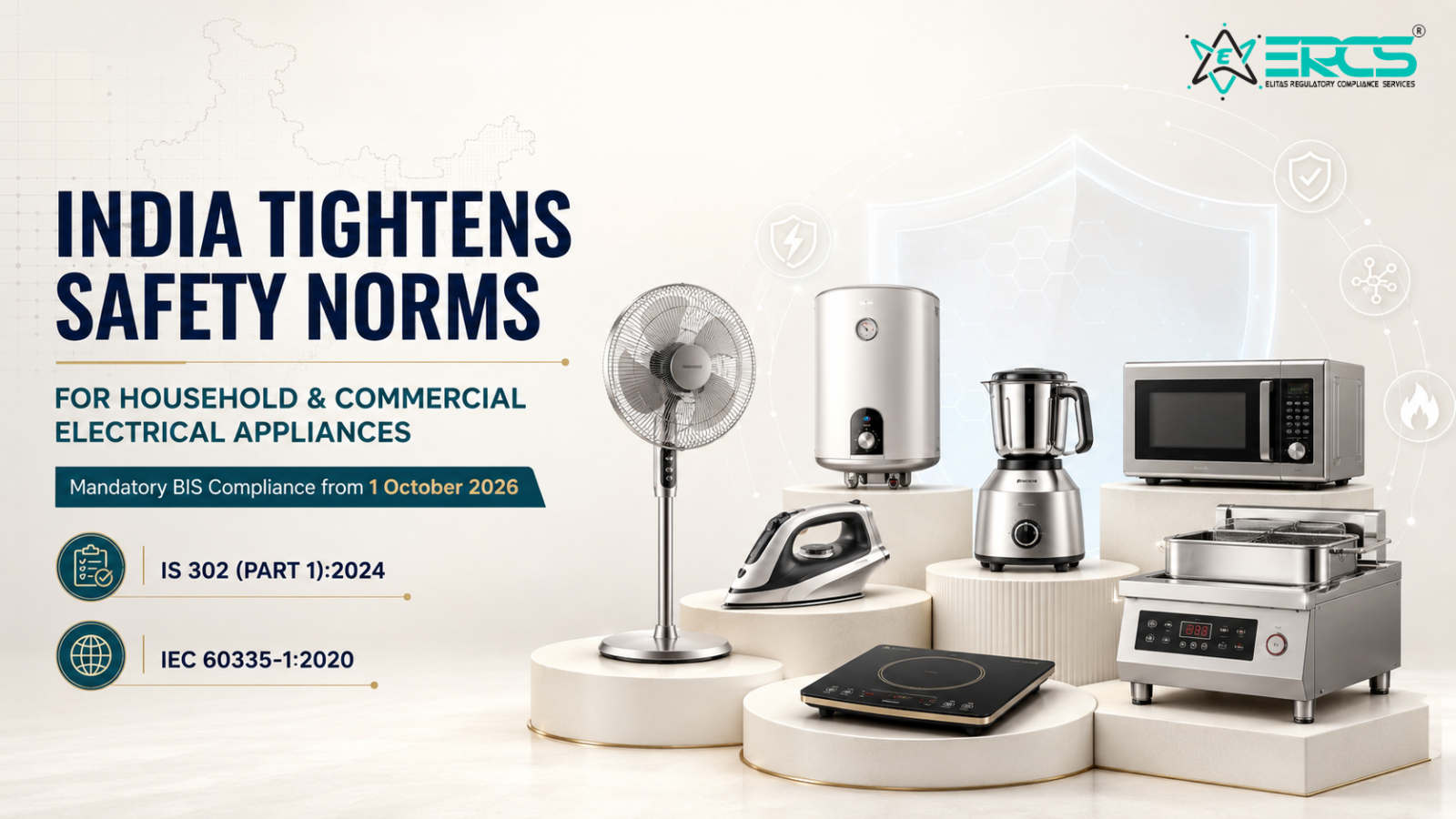
The electrical and electronic appliances sold in India range from a fan in your living room to a water heater in the bathroom, and are very important in our daily lives. India is raising the bar on electrical product safety, and the clock is ticking. This includes enforcing updated Indian Standards such as IS 302 (Part 1: 2024)/IEC 60335-1:2020 and IS 302 Part 2. BIS Certification is mandatory for household and commercial electronic appliances to ensure safety from fire and electric shock risks.
These changes imply that manufacturers, importers, and sellers will need to comply with strict regulations, conduct tests, and obtain certifications to sell their products in the Indian market. The Safety of Household, Commercial, and Similar Electrical Appliances (Quality Control) Order, 2026, makes certification mandatory for over 90 categories of electrical appliances. The order comes into force on October 1, 2026, and all types of electrical appliances with up to 250V (single-phase) or 480V are required to undergo stringent tests before being sold, including AC and battery-operated appliances.
Why is India Strengthening Safety Norms for Household & Commercial Electrical Appliances?
With its new safety regulations, India seeks to strengthen its manufacturing sector by integrating itself into global supply chains, enhancing the protection of its people, and stimulating economic growth. This shift entails adopting a risk-based compliance approach, applying stringent international standards, and harmonising related legislation to enhance product quality and safety.
Improving the regulations helps make the business environment more consistent. Manufacturers that invest in quality and compliance can avoid competitors that produce low-quality or counterfeit goods. Moreover, consumers stand to gain from the improved quality and safety of appliances that meet Indian standards.
What Has Changed under Household & Commercial Electrical Appliances 2026?
You can go through the table to get the complete information regarding changes under the Norms for Household & Commercial Electrical Appliances:
- New safety standard adopted: IS 302 (Part 1):2024 replaces IS 302 (Part 1):2008, aligning India’s requirements with IEC 60335-1:2020.
- Expanded mandatory certification: A much wider range of household and commercial electrical appliances now require an ISI Mark before sale in India.
- Wider product coverage: The QCO applies to appliances for household, commercial, or similar use rated up to 250 V (single-phase) or 480 V (three-phase/DC/battery-operated), unless already covered by another mandatory certification — spanning homes, hotels, restaurants, offices, hospitals, and commercial establishments.
- Transition period: Manufacturers have a window to migrate from the 2008 to the 2024 standard, after which all new applications must comply with the revised standard.
- Revised testing & inspection requirements: Enhanced safety testing, updated factory inspection procedures, new marking rules, and revised certification grouping guidelines for stronger quality control and traceability.
- International alignment: Technical harmonisation with IEC 60335-1:2020 supports global acceptance of certified products alongside improved domestic safety.
- Mandatory ISI Mark: Covered appliances must hold a valid BIS licence and display the ISI Mark before manufacture, import, or sale.
- Enforcement date: Mandatory compliance for covered appliances begins 1 October 2026 — businesses should complete certification well before then.
What It Means for Manufacturers, Importers, & Sellers
Below, you can go through the pointers to know what these important changes mean for Manufacturers, Importers, & Sellers in the Indian market:
- Every kind of electrical device, whether intended for domestic or business use, should be certified under the BIS Certification for electrical appliances (ISI Mark) before production and sale in India.
- The products need to satisfy IS 302 (Part 1):2024 / IEC 60335-1:2020 and the respective product IS.
- It is the responsibility of both manufacturers and importers to ensure that products are tested in BIS-authorized laboratories.
- Compliance inspections will be carried out by BIS through inspections of production zones, audits, and quality testing.
- Documentation should be maintained, product labels and manuals should be renewed, and ISI Mark compliance should be ensured.
- Importers, distributors, dealers, and online dealers should ensure that all products they sell are BIS-certified.
What Do the Norms for Household & Commercial Electrical Appliances Mean for Consumers?
The updated BIS safety regulations aim to ensure that electrical appliances are safer, more reliable, and of better quality for consumers.
- Electrical appliances will undergo rigorous safety testing to mitigate the risks of electric shock, overheating, short circuits, and fires.
- Products with BIS certification are manufactured in accordance with recognised Indian Standards, which guarantee increased durability and reliability.
- The ISI Mark helps consumers find products that meet BIS safety standards.
- The requirement for safety certification enables consumers to make more informed purchases, as they know they are buying tested appliances.
- The regulations help restore trust in the Indian electrical appliance market.
- Certified appliances require fewer repairs and perform better over time.
What are the Benefits of Safety Norms for Household and Commercial Electrical Appliances?
Go through the advantages of tightening the Safety Norms for Household & Commercial Electrical Appliances:
- Safety regulations reduce the risk of injuries from shock, fire, overheating, etc.
- Compliance with BIS regulations ensures the appliance’s reliability and durability.
- Compliance with BIS regulations increases customer trust because customers can be sure of the quality and safety of products.
- Compliance with internationally accepted standards facilitates market integration.
- Quality products that comply with BIS regulations will lower the costs of replacements, repairs, recalls, etc.
Conclusion
Strengthened safety regulations for electrical appliances in India are a vital step in ensuring product quality, safety, and compliance. The Safety of Household, Commercial and Similar Electrical Appliances (Quality Control) Order, and IS 302 (Part 1):2024 will require all manufacturers, importers, and sellers of these products to comply with the new BIS regulations before selling them in India. ERCS Private Limited is a trusted BIS Consultant in India that helps businesses understand and obtain BIS certification as quickly and correctly as possible.











Leave a comment