

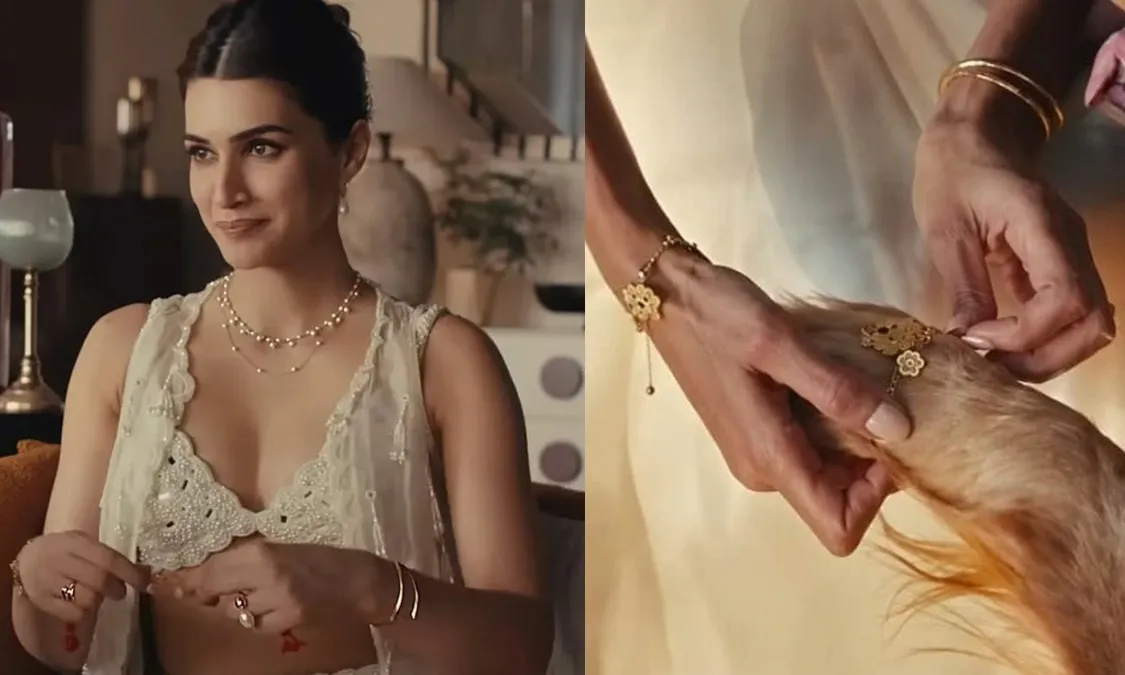
The Raksha Bandhan ad controversy involving actor Kriti Sanon has moved beyond a jewellery campaign, triggering a wider discussion about clothing, cultural traditions, women’s choices and how brands represent Indian festivals. The debate intensified after criticism from public figures and Sanon’s response.
How the Raksha Bandhan ad controversy began
The Raksha Bandhan ad controversy began after Kriti Sanon appeared in a jewellery advertisement released ahead of the festival. The campaign showed her participating in a Raksha Bandhan celebration while wearing an Indo-Western outfit featuring a bralette-style blouse, cape and draped skirt. Some social media users objected to the styling and argued that it did not fit their expectations of a traditional Raksha Bandhan setting.
The advertisement also attracted criticism over another creative choice. Sanon is shown tying a rakhi to a pet dog, which some viewers questioned as part of the festival’s portrayal. The combination of contemporary styling and the depiction of the ritual became the main focus of online reactions.
At that point, the discussion was still largely a social media debate over whether a festival advertisement should follow conventional cultural imagery or present a more modern interpretation.
Kangana Ranaut criticism pushes the debate further
The controversy received wider attention after actor and politician Kangana Ranaut criticised the advertisement. In an Instagram post, she questioned why such an outfit had been chosen for a Raksha Bandhan scene and described the presentation as inappropriate. Her comments gave the existing social media debate a much larger public platform.
The criticism was not simply about fashion. It raised a broader question about how traditional festivals should be represented in commercial advertising.
For critics, Raksha Bandhan carries cultural and emotional associations that should be reflected in the visual language of an advertisement. They argue that brands using festivals to sell products should understand the traditions connected with those occasions rather than relying primarily on contemporary fashion.
Supporters of Sanon, however, viewed the criticism differently. They argued that a woman’s clothing should not be used as a measure of her cultural values, particularly when an advertisement is presenting a modern interpretation of a festival.
Kriti Sanon responds to the backlash
Kriti Sanon eventually addressed the criticism through Instagram Stories. She argued that the essence of festivals lies in the emotions and meaning attached to traditions rather than simply in what someone wears. She also explained her understanding of Raksha Bandhan as a bond of protection and said that she and her sister tie rakhis to each other.
Her response shifted the discussion from the advertisement itself to the larger issue of judging women through their appearance.
Sanon questioned when society would stop telling women what to wear. She also argued that culture and tradition are matters of values and emotional connection rather than something that can be determined by a person’s neckline.
That response became an important second phase of the controversy. Instead of only asking whether the advertisement was appropriate, the conversation began asking who gets to decide what appropriate cultural representation looks like.
Why festival advertising often attracts stronger reactions
Advertising around Indian festivals carries a different sensitivity from ordinary fashion or lifestyle campaigns. Festivals such as Raksha Bandhan, Diwali, Holi and Navratri are not only commercial occasions. They also have religious, family and cultural meanings for millions of people.
That creates a complicated situation for advertisers.
Brands want festival campaigns to appear contemporary and visually distinctive because advertisements compete for attention on television, Instagram, YouTube and other platforms. At the same time, moving too far from familiar cultural imagery can trigger criticism from audiences who expect certain traditions, clothing styles or rituals to be represented in recognisable ways.
The Raksha Bandhan campaign illustrates this tension clearly. The jewellery being promoted fits naturally into a festival associated with gifting and celebration, but the creative presentation became more prominent than the product itself after viewers began debating the outfit and the depiction of the ritual.
This is one of the risks of festival advertising in the social media era. A campaign can quickly become a cultural discussion if audiences believe the creative treatment conflicts with their understanding of the occasion.
The debate is also about women’s clothing
The strongest argument in Sanon’s defence centres on personal choice.
There is an important distinction between criticising an advertisement’s creative strategy and policing an individual’s clothing. A brand can be questioned about whether its campaign effectively represents a festival. That does not automatically establish that an actor’s personal clothing choices are wrong.
Sanon’s response placed this distinction at the centre of the discussion.
The debate also reflects a familiar contradiction in celebrity culture. Actors are often expected to appear fashionable and modern in entertainment and advertising, while the same public figures may face demands to conform to more traditional expectations when associated with cultural festivals.
This does not mean every criticism of a festival advertisement is an attack on women’s freedom. Audiences are entitled to discuss whether an advertisement represents a festival appropriately. The more complicated question is where that criticism ends and personal policing begins.
Rahul Gandhi enters the Raksha Bandhan ad debate
The controversy gained another political dimension when Leader of Opposition in the Lok Sabha Rahul Gandhi publicly backed Sanon.
On August 25, Gandhi shared Sanon’s response and said that what a woman wears, what she does and where she goes is her choice. He also criticised the trolling directed at women exercising personal freedom.
His intervention expanded the controversy beyond Bollywood and advertising.
Once political figures become involved in an entertainment-related debate, the discussion can quickly become more polarised. Supporters may interpret the issue through the lens of women’s rights and personal freedom, while critics may continue to focus on cultural representation and the responsibility of brands.
That makes the campaign a useful example of how social media can transform a commercial advertisement into a much larger public conversation.
Nupur Sanon also defends her sister
Sanon’s sister Nupur Sanon also came out in her defence following the criticism.
Nupur pointed out that she was the person to whom Kriti tied the rakhi in the campaign and questioned why outsiders were taking offence at their representation of the festival. Her response added a personal perspective to a debate that had largely been driven by people commenting from outside the campaign.
Meanwhile, actress Suzanne Bernert also criticised the campaign’s portrayal, arguing that its treatment of clothing and empowerment did not represent what she considered the sentiment of Raksha Bandhan.
The differing reactions demonstrate why the advertisement has remained controversial. There is no single public view on what a modern festival advertisement should look like.
What brands can learn from the controversy
The Raksha Bandhan ad controversy offers a practical lesson for advertisers operating in India’s culturally diverse market.
Brands do not necessarily have to reproduce traditional imagery in every festival campaign. Modern clothing, unconventional storytelling and changing family relationships can all be part of contemporary advertising.
But context matters.
A campaign that deliberately challenges a tradition should understand why the tradition matters to its audience. It should also anticipate that social media users will interpret visual choices differently across generations, regions and communities.
For brands, the challenge is not simply avoiding controversy. It is creating campaigns that have a clear creative purpose and do not unintentionally make the product secondary to an argument about cultural sensitivity.
The controversy also shows that celebrity endorsements can amplify both reach and criticism. Once a well-known actor becomes the face of a campaign, reactions to the creative concept can quickly become associated with the celebrity personally.
When does an advertisement become a social debate?
There is no fixed point at which an advertisement officially becomes a social debate. In practice, it happens when people stop discussing only the product or campaign and begin arguing about the values represented by it.
That is exactly what happened here.
The initial conversation focused on Kriti Sanon’s outfit and the advertisement’s festive styling. It then moved into questions about cultural authenticity, women’s clothing, empowerment, family traditions and personal freedom. Statements from Kangana Ranaut, Sanon, Nupur Sanon, Suzanne Bernert and Rahul Gandhi widened the discussion further.
The episode ultimately shows how quickly advertising can become a mirror for larger social disagreements. In India’s digital environment, a campaign does not remain confined to the brand’s intended message. Audiences reinterpret it, challenge it and attach their own cultural meanings to it.
The lasting question may therefore not be whether a particular outfit was traditional enough. It is whether modern advertising can represent changing Indian identities without dismissing traditional expectations, and whether audiences can disagree with an advertisement without turning that disagreement into judgments about an individual’s personal freedom.
Key Takeaways
- The Raksha Bandhan advertisement featuring Kriti Sanon triggered criticism over its outfit, styling and portrayal of the festival.
- Kangana Ranaut and Suzanne Bernert criticised aspects of the campaign, while Nupur Sanon defended Kriti.
- Kriti Sanon argued that cultural values should not be judged through a woman’s clothing.
- Rahul Gandhi’s support widened the discussion into a broader debate about women’s choice and social media trolling.
FAQ
Why is Kriti Sanon’s Raksha Bandhan advertisement controversial?
The advertisement drew criticism over Sanon’s contemporary outfit and the way the Raksha Bandhan ritual was portrayed. Some viewers felt the presentation did not match their expectations of a traditional festival, while others defended the campaign as a modern interpretation.
What did Kriti Sanon say about the controversy?
Sanon said the essence of festivals lies in the emotions and meaning attached to traditions rather than clothing. She also questioned the practice of telling women what they should wear and argued that cultural values should not be judged by appearance.
What did Kangana Ranaut say about the advertisement?
Kangana Ranaut criticised the advertisement’s styling and questioned why a bikini-style look had been chosen for a Raksha Bandhan scene. Her comments helped bring wider attention to the controversy.
Why did Rahul Gandhi comment on the Raksha Bandhan ad controversy?
Rahul Gandhi publicly defended Sanon and said that a woman’s clothing, actions and choices are her own. His intervention shifted some of the discussion toward women’s autonomy and the issue of trolling.
(Internal keyword suggestions: Kriti Sanon Raksha Bandhan ad controversy, Raksha Bandhan advertisement controversy, Kriti Sanon latest news, Raksha Bandhan ad row 2026, Kriti Sanon outfit controversy, Kangana Ranaut Kriti Sanon, Rahul Gandhi Kriti Sanon, festival advertising India, cultural representation in advertising, women’s clothing debate India)









Leave a comment