

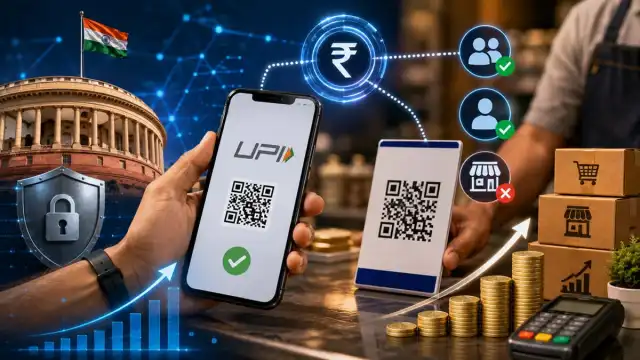
India has opened the door to selective merchant fees on UPI transactions, but the government says ordinary users and person-to-person payments will remain free. The proposed framework is aimed at improving the long-term financial sustainability of India’s digital payments network.
UPI merchant fees are back in focus
UPI merchant fees have become a major policy and business story in India after recent legislative changes created a framework that could allow charges on selected merchant transactions. The development has raised questions among shopkeepers, businesses and consumers who have become accustomed to using UPI without a direct transaction fee.
The important point is that this does not mean UPI payments will suddenly become chargeable for everyone.
Finance Minister Nirmala Sitharaman has said any future Merchant Discount Rate, or MDR, would apply only to a limited category of merchant transactions above a specified threshold. Person-to-person UPI transfers are expected to remain free, while consumers making payments would not directly bear the proposed fee.
The policy debate is primarily about who should pay for the infrastructure behind India’s enormous digital payments ecosystem and how that system can remain financially sustainable.
What is UPI MDR and why does it matter?
Merchant Discount Rate, commonly called MDR, is a fee associated with processing a digital payment. In a typical card transaction, the merchant pays an MDR that is distributed among participants involved in processing the payment.
UPI has operated differently. For ordinary bank-account-to-bank-account UPI payments, the zero-MDR framework has helped make digital payments attractive to both consumers and merchants.
That model has played an important role in UPI’s rapid expansion. India has moved from relatively limited digital payment adoption to an economy where QR codes are common at everything from large retailers to neighbourhood tea stalls.
The issue now is whether the existing funding structure can support the scale of the network.
Reuters reported on August 17 that UPI has grown from around 1 billion monthly transactions to about 24 billion in six years, processing nearly ₹29.87 trillion a month. The network has more than 555 million users.
Will customers have to pay for UPI?
For ordinary users, the immediate answer is no, based on the government’s current position.
The proposed framework is not being presented as a universal consumer charge on UPI. The government has specifically indicated that person-to-person payments will remain free and that the proposed MDR would apply selectively to merchant transactions.
This distinction matters.
If a person sends ₹2,000 to a friend using UPI, that is a person-to-person payment. A purchase at a merchant is different because a business is receiving the money as part of a commercial transaction.
The current policy discussion is focused on the second category.
The government has also said consumers who make the payment will not be charged under the proposed structure. That means users should not interpret the recent legislative developments as an announcement of a new UPI fee for every QR-code payment.
Which merchants could potentially face a fee?
This is where the details become important.
The government has indicated that any future MDR would be limited to certain merchant transactions above a threshold. However, the exact operating framework, including the threshold, applicable merchant categories and the rate, still needs to be established.
Business Standard reported on August 17 that the enabling law does not itself settle all the operational rules that would be required before such charges can actually begin.
Some recent reports have cited a possible threshold of ₹2,000 and a limited set of larger merchants. Reuters’ August 17 analysis reported a proposed structure involving merchant transactions above ₹2,000 for businesses with annual revenue above ₹15 million, with fees reportedly in the range of 0.3% to 0.5%. It said this would affect around 4% of UPI transaction volume.
However, these figures should be treated as reported proposals rather than a universal final tariff.
The precise rules will determine how businesses are ultimately affected.
Why is India considering merchant charges now?
The central argument is financial sustainability.
UPI is a national digital infrastructure that requires banks, payment service providers, technology companies, security systems and data infrastructure to operate continuously.
The volume of transactions has grown dramatically, but the zero-MDR model limits direct transaction revenue from standard merchant payments.
A recent parliamentary discussion highlighted the scale of the funding challenge. Reports citing a parliamentary committee said the annual cost of operating UPI has reached around ₹20,700 crore, while the government allocation is significantly lower. The committee has supported the idea of a more self-reliant revenue model for the network.
The argument from supporters of selective MDR is that a small fee on certain commercial transactions could help fund technology, cybersecurity, infrastructure and continued expansion without affecting everyday users.
The counterargument is that UPI’s zero-cost model has been one of the reasons for its extraordinary adoption, particularly among small businesses.
What could change for small businesses?
For India’s millions of small merchants, the impact will depend heavily on the final rules.
A neighbourhood retailer processing mostly low-value payments could remain outside the proposed fee structure if the final framework focuses on larger transactions and larger businesses.
That would be significant for Tier-2 and Tier-3 cities, where QR-based payments have become common among small shops, food vendors, service providers and local businesses.
However, businesses that fall within the eventual chargeable category may have to account for MDR as a payment-processing expense.
For example, if a merchant receives a large number of qualifying digital payments, even a small percentage fee can become meaningful over time.
That could influence how businesses think about payment acceptance, pricing and payment-provider selection.
At the same time, merchants already deal with different fee structures for cards and certain specialised payment products, so UPI MDR would not introduce the broader concept of transaction costs into digital commerce.
Why payment companies support selective UPI charges
Payment companies have their own reason for supporting a sustainable UPI revenue model.
The current system generates enormous transaction volumes but does not provide the same direct merchant-payment revenue that card networks and payment processors can receive from conventional card transactions.
Recent reports indicate that PhonePe and Razorpay have supported selective charges on larger merchant transactions while maintaining free everyday payments. The broader industry position is that commercial transactions can be treated differently from small consumer payments.
The argument is that a carefully designed fee could provide payment companies with greater financial capacity to invest in technology and customer acquisition.
This could become particularly important as competition among UPI apps remains intense.
Could merchants pass the cost to customers?
This is one of the biggest practical questions.
Even if the government does not charge consumers directly, businesses ultimately decide how to manage their costs.
A merchant facing an additional payment-processing expense could theoretically absorb it, negotiate with a payment provider, change payment preferences or attempt to reflect the cost in pricing.
However, whether merchants are allowed to explicitly add a separate UPI surcharge to customers would depend on the applicable rules and regulations.
For consumers, the distinction between a government-mandated UPI fee and a merchant choosing to charge more for a particular payment method is therefore important.
At present, there is no basis to say that customers will automatically see an additional UPI fee on their bills simply because the MDR framework has been enabled.
What does this mean for Tier-2 and Tier-3 India?
The issue is particularly relevant outside India’s biggest metros.
In cities such as Nagpur, Indore, Jaipur, Lucknow, Surat and many smaller towns, UPI has become part of everyday commerce. Small retailers often display a QR code instead of maintaining card terminals.
That makes the cost of digital payments an important business question.
If future charges remain limited to larger merchants and higher-value transactions, the effect on small businesses could be relatively contained.
If the framework expands over time, however, merchants in smaller cities will need to understand the rules and compare payment-service costs carefully.
For now, the policy direction appears to be selective rather than universal.
UPI’s next phase will be about sustainability
The debate over UPI merchant fees reflects a larger shift in India’s digital-payment story.
The first phase was about adoption. The priority was to make digital payments easy, inexpensive and widely available.
The next phase is about sustainability.
India now operates one of the world’s largest real-time payment ecosystems. Maintaining that scale requires continuous investment in technology, security, fraud prevention and infrastructure.
The challenge for policymakers is to create a revenue model without undermining the affordability and accessibility that helped UPI become a mass-market payment system.
A selective MDR could be one answer, but the details will determine whether it works.
For consumers, the most important takeaway is that there is currently no announcement of a universal charge on ordinary UPI payments. For merchants, the key issue is whether their business falls within the eventual category of transactions subject to MDR.
Key Takeaways
- UPI is not becoming universally chargeable: The government says person-to-person payments will remain free.
- Selective merchant fees are being considered: Any future MDR is expected to apply only to specified merchant transactions above a threshold.
- Small merchants may be protected: Current proposals focus on limiting charges to selected transactions and merchant categories.
- Final rules matter: The exact rate, threshold, eligible merchants and implementation mechanism still need to be established.
FAQ
1. What is UPI MDR?
UPI MDR stands for Merchant Discount Rate. It is a payment-processing fee associated with certain merchant transactions. Under the proposed framework, it would not apply universally to all UPI payments.
2. Will customers be charged for sending money through UPI?
The government’s current position is that person-to-person UPI payments will remain free. The proposed merchant fee is intended for selected commercial transactions, not ordinary transfers between individuals.
3. Will small shops have to pay UPI charges?
Not necessarily. Current proposals indicate that the fee would be limited to selected merchant transactions above a specified threshold. The final rules will determine which merchants are covered.
4. Why is India considering UPI merchant fees?
The main reason is the long-term financial sustainability of the UPI ecosystem. Transaction volumes have grown enormously, creating significant infrastructure and operating costs. A selective merchant fee could provide an additional revenue source while keeping everyday consumer payments free.








Leave a comment