

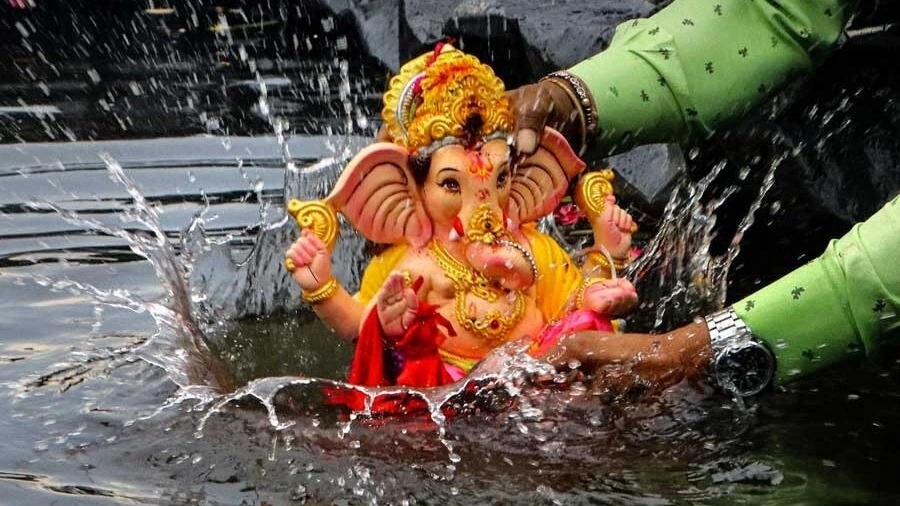
Maharashtra has extended its rules governing Plaster of Paris Ganesh idols ahead of Ganeshotsav 2026. The latest guidelines require POP idols to carry a visible red mark, while prescribing specific immersion arrangements for household, small and large idols.
Maharashtra extends POP idol rules for 2026
The latest development is time-sensitive because Maharashtra is preparing for Ganesh Chaturthi, which will be celebrated on September 15, 2026. On September 3, the state government extended the existing restrictions governing the sale and immersion of Plaster of Paris, or POP, idols until the Bombay High Court delivers its decision on the ongoing matter.
The rules are based on guidelines issued by the Maharashtra Environment and Climate Change Department in 2025 following directions from the Bombay High Court. The original guidelines were applicable to festivals up to March 2026, but the state has now continued them in view of interim court proceedings concerning POP idols.
For buyers and idol makers, the most visible requirement is the red marking system. Every POP idol must have a clearly visible circular red mark painted with oil paint on its back. The purpose is to allow authorities and citizens to identify POP idols and ensure that the appropriate immersion rules are followed.
What the red mark on POP Ganesh idols means
The red mark is not a decorative feature and does not indicate that an idol is eco-friendly. Instead, it identifies an idol as being made from Plaster of Paris.
Under the Maharashtra guidelines, manufacturers and sellers of POP idols must apply a clearly visible circular red symbol using oil paint to the rear of the idol. Local authorities have been directed to communicate the requirement to manufacturers and sellers and ensure compliance.
This distinction matters for people buying Ganesh idols. A buyer should not assume that an idol without an obvious red mark is automatically made from clay or another environmentally preferable material. The marking requirement is specifically intended for POP idols, so buyers can also ask the seller what material has been used.
The latest Nagpur report has highlighted an enforcement problem, with markets reportedly containing POP idols without the required red mark. This creates difficulties for civic authorities trying to identify and regulate such idols before immersion.
Rules for idol makers and Ganesh idol sellers
The extended rules place direct responsibilities on idol makers and sellers. Apart from marking POP idols, manufacturers and sellers are required to maintain a sale register for POP idols.
The Maharashtra guidelines state that local bodies should include this requirement as a condition while granting licences to idol makers and sellers. This creates a record of POP idol sales and gives civic authorities a mechanism to monitor the movement of such idols.
Sellers also have to provide buyers with an information pamphlet explaining the applicable immersion rules when selling a POP idol. The guidelines say local bodies should supply these pamphlets to sellers.
This means the responsibility does not end when an idol is sold. The rules create a chain of accountability involving manufacturers, sellers, buyers, public mandals and local civic authorities.
For idol makers who depend heavily on the Ganesh festival season for their annual income, the requirements make documentation and compliance an important part of the business. Sellers also need to make sure that customers understand where and how their POP idols can be immersed.
Can POP Ganesh idols be immersed in lakes and rivers?
For most household POP idols and POP idols below six feet, the answer is no under the Maharashtra guidelines. Such idols must be immersed only in artificial ponds arranged by the relevant local body.
The same rule applies to POP idols used for household celebrations. Local authorities are responsible for implementing and monitoring the requirement.
The situation is different for large public mandal idols. POP idols belonging to public mandals and measuring more than six feet may be permitted to be immersed in natural water bodies only when no alternative immersion facility is available. Even in such cases, authorities must collect the immersed POP material on the following day.
The guidelines therefore do not establish unrestricted permission for POP idols to be immersed in natural water bodies. They set out a limited arrangement for larger public idols when an alternative facility is unavailable.
Why Maharashtra is pushing artificial immersion ponds
Artificial immersion ponds are central to the state’s approach to POP idol management.
The guidelines require local bodies to construct artificial ponds of appropriate sizes and provide information about their locations through newspapers, websites, social media and other communication channels. Directional signs should also be installed on roads leading to designated immersion ponds.
The reason is practical as well as environmental. POP does not dissolve immediately in water, which means material from immersed idols can remain in natural water bodies. The guidelines therefore seek to keep most smaller POP idol immersion within controlled facilities where the resulting water and sediment can be treated or managed.
In Nagpur, the civic administration is expected to establish more than 400 artificial tanks for Ganesh visarjan this year, according to the latest report. The city is among the Maharashtra urban centres where the practical implementation of the rules will be closely watched during the festival.
What happens to water after POP immersion?
The rules also prescribe what local bodies should do after POP idols are immersed in artificial ponds.
The Maharashtra guidelines state that the water in an artificial pond should be eight to ten times the expected volume required for idol immersion. Within seven days after immersion, the water must be treated with lime or alum at the same location. It should then be sent to a nearby sewage treatment plant or effluent treatment plant for further treatment.
The guidelines specifically say that treated water should not be discharged into a drinking-water source.
Sediment collected in artificial ponds also has to be managed. Local bodies are required to store the sediment in an environmentally appropriate manner for 15 days and take measures for its recycling or reprocessing.
These provisions show that the rules cover more than the moment of immersion. They also prescribe how civic authorities should deal with the material and water generated afterward.
What buyers should check before purchasing a Ganesh idol
For families preparing for Ganeshotsav, the simplest step is to ask the seller about the material used to make the idol.
If a buyer chooses a POP idol, the idol should have the required circular red mark on its back. The seller should also provide the information pamphlet covering immersion requirements.
Buyers should also check the immersion arrangements announced by their local municipal corporation or local authority. A household POP idol or a POP idol below six feet is required to go to an artificial immersion pond under the state guidelines.
Those who specifically want to avoid POP can choose idols made from materials such as traditional clay, subject to the local authority’s applicable arrangements and requirements. Maharashtra’s pollution-control authorities have separately promoted eco-friendly idols and artificial immersion arrangements as part of their festival guidance.
For consumers, the key point is simple: choosing an idol is not only about its appearance or size. The material determines which immersion rules apply.
What the rules mean for idol makers and mandals
The extended rules may require idol makers to change how they prepare, record and sell POP idols. The red marking and sales-register requirements create additional compliance responsibilities, while sellers must also distribute information to customers.
Public Ganesh mandals have additional responsibilities because their idols can be much larger. Local bodies are required to collect information about registered mandals, including whether the installed idol is made from POP, and use that information to prepare immersion arrangements.
The government also encourages mandals installing large idols to use a smaller replica for immersion and preserve the main idol for reuse or reinstallation in subsequent years. This approach can reduce the need to immerse very large POP structures in water.
The implementation will ultimately depend on local civic bodies, which are responsible for providing facilities, spreading awareness and enforcing the guidelines.
Why the issue remains linked to the courts
The POP idol issue in Maharashtra has been shaped by continuing legal proceedings. The state’s latest extension comes against the backdrop of Bombay High Court proceedings concerning POP idol manufacture and immersion.
The Maharashtra government had previously issued its consolidated POP immersion guidelines after directions from the Bombay High Court in 2025. The official document states that the revised guidelines were framed in addition to the Central Pollution Control Board’s May 12, 2020 guidelines.
Because the matter remains before the court, the current rules should not be interpreted as a permanent settlement of the broader dispute over POP idols. The latest state decision keeps the existing framework in force while the legal process continues.
For Ganeshotsav 2026, however, the immediate position is clear. Buyers, sellers, idol makers, mandals and civic authorities are expected to follow the applicable POP identification and immersion requirements currently in force.
Key Takeaways
- Maharashtra has extended its existing POP Ganesh idol rules until the Bombay High Court decides the ongoing matter.
- Every POP idol must carry a clearly visible circular red oil-paint mark on its back, while sellers must maintain sales records and provide buyers with immersion information.
- Household POP idols and POP idols below six feet must be immersed in artificial ponds, while larger public mandal idols have limited provisions for natural water-body immersion when no alternative facility is available.
- Local bodies must manage artificial-pond water and sediment after immersion and promote eco-friendly idol options.
FAQs
What does the red mark on a Ganesh idol mean?
A circular red mark painted with oil paint on the back identifies an idol as being made from Plaster of Paris under Maharashtra’s POP idol guidelines.
Can a household POP Ganesh idol be immersed in a river or lake?
No. Under the current Maharashtra guidelines, POP idols used for household celebrations and POP idols below six feet must be immersed in artificial ponds provided by local authorities.
What should POP idol sellers provide to customers?
Sellers must maintain a register of POP idol sales and provide buyers with an information pamphlet explaining the applicable idol immersion rules.
Can large POP idols be immersed in natural water bodies?
POP idols belonging to public mandals and exceeding six feet may be permitted in natural water bodies only when no alternative immersion facility is available. Authorities must collect the immersed material on the following day and arrange appropriate processing or recycling.
(Internal keyword suggestions: Maharashtra POP Ganesh idol rules 2026, POP Ganesh idol red mark, Ganesh Chaturthi 2026 Maharashtra, POP idol immersion rules, Maharashtra Ganesh idol guidelines, artificial immersion ponds Maharashtra, Ganesh visarjan rules 2026, POP idol makers Maharashtra, Nagpur Ganeshotsav 2026, eco-friendly Ganesh idols)








Leave a comment