

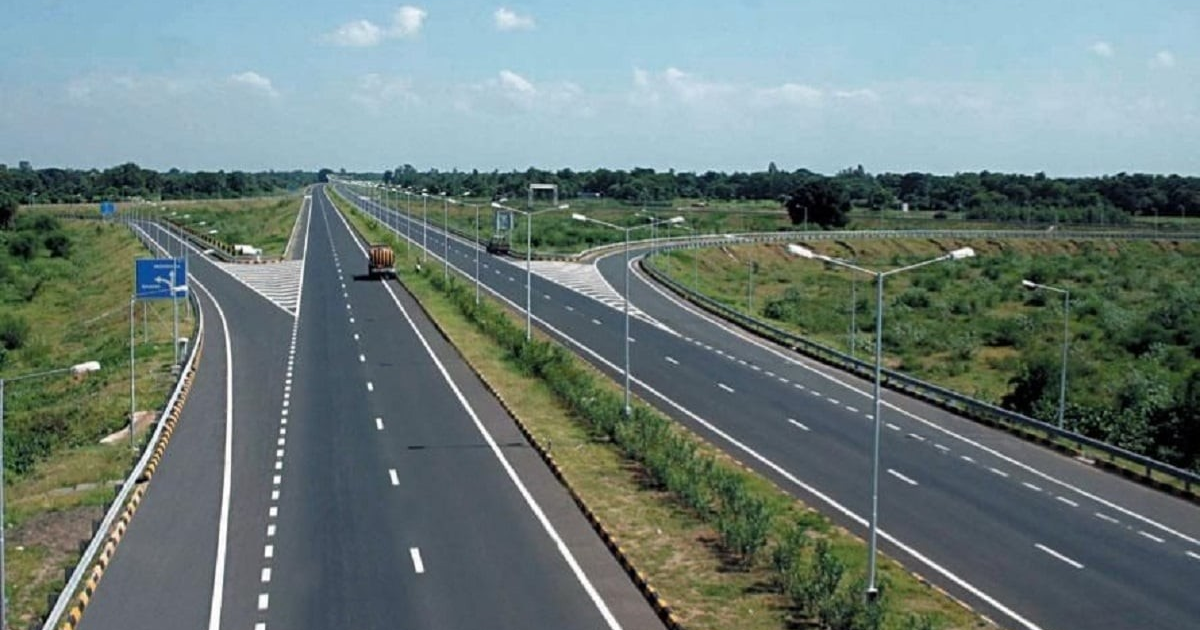
India’s highway infrastructure push is increasingly reaching smaller cities, industrial towns and regional growth centres. New bypasses, economic corridors, access-controlled highways and ring roads are designed not only to reduce travel time but also to improve logistics, attract investment and create new economic opportunities.
India’s Highway Push Enters a New Phase
The highway infrastructure push has gained fresh attention as the Centre and states focus on faster project execution, safer roads and better integration between highways, cities and economic centres.
The Ministry of Road Transport and Highways held Chintan Shivir 2026 on October 5 and 6 in Gujarat, bringing together central and state authorities to discuss future highway development, road safety, toll reforms, green highways and project delivery. The meeting is part of a broader effort to improve coordination between agencies responsible for India’s road network. Press Information Bureau
The emphasis is increasingly shifting from simply adding kilometres of roads to creating corridors that connect manufacturing centres, ports, airports, markets and cities.
For smaller cities, that distinction matters. A new highway can change where businesses locate, how quickly goods reach markets and how easily residents travel for work, education and healthcare.
New Highways Could Improve Regional Connectivity
One of the biggest effects of highway development is improved connectivity between smaller cities and larger economic centres.
The government has identified access-controlled national high-speed corridors, expressways, ring roads and bypasses as important areas for highway development. It has also prioritised connectivity to industrial nodes, ports and airports to improve logistics efficiency. Press Information Bureau
For a Tier-2 city, better highway connectivity can reduce its dependence on a nearby metro for access to suppliers, customers and transport networks.
The effect can be particularly significant for manufacturing and agricultural regions. Faster roads allow goods to move more predictably between production areas, warehouses, wholesale markets and consumption centres.
This can also help smaller cities become distribution points rather than merely transit locations.
Tier-2 Cities Could Become New Economic Nodes
Highway projects can influence where companies choose to build warehouses, factories and service facilities.
The government’s highway strategy specifically includes connectivity to industrial nodes. That means road development is increasingly being considered alongside broader industrial and logistics planning. Press Information Bureau
A smaller city located along an upgraded corridor can become more attractive to businesses because transport costs and travel times may fall.
The Kanpur-Kabrai project is one example. The Cabinet approved a 117.7-kilometre access-controlled greenfield highway in Uttar Pradesh with a capital cost of ₹7,145.14 crore. The corridor is intended to improve connectivity between Kanpur and Kabrai while strengthening links towards Sagar, Bhopal and manufacturing, agricultural and mineral-producing regions. Press Information Bureau
Such corridors can connect different economic regions instead of concentrating growth around one major city.
Ring Roads and Bypasses Can Change City Traffic
For growing Tier-2 cities, the problem is often not a lack of highway access but the fact that national traffic passes directly through urban areas.
Ring roads and bypasses can address this problem by separating long-distance traffic from local movement.
A recent example is the Madurai Ring Road project. The 29.96-kilometre four-lane section of NH-744A was opened to traffic in July 2026. The ₹1,024.66 crore project provides an alternative route for transit traffic between NH-44 and NH-38 and is designed to reduce heavy-vehicle movement through Madurai’s urban centre. Press Information Bureau
This type of infrastructure can benefit smaller cities in two ways. It can reduce congestion inside the city while improving access for commercial vehicles travelling between regions.
However, bypasses can also shift economic activity away from traditional city centres. Shops and businesses that depend heavily on highway traffic may need to adapt as vehicle movement changes.
Maharashtra Projects Show the Wider Regional Impact
Maharashtra offers several examples of how highway development is being planned around regional connectivity.
In May 2026, the Ministry of Road Transport and Highways reviewed several proposed corridors in the state, including the Nagpur-Bhandara section, Nagpur-Amravati section, Nagpur-Hyderabad corridor, Gwalior-Nagpur corridor and Durg-Gadchiroli-Mancherial corridor.
The review also covered nine state BOT projects spanning 527 kilometres, including routes connecting Shirur and Ahilyanagar, Ahilyanagar and Chhatrapati Sambhajinagar, Chhatrapati Sambhajinagar and Jalna, Nanded and Deglur, and Warora, Chandrapur and Bamni. Press Information Bureau
These routes are important because they connect cities that are outside Maharashtra’s biggest metropolitan centres.
For regions such as Vidarbha and Marathwada, improved road connectivity could make movement between district headquarters, industrial areas and agricultural markets easier.
Nagpur Shows How Urban Highway Projects Can Matter
Nagpur provides a useful example of how highway infrastructure can affect an established Tier-2 city.
The Indora Chowk-Dighori Flyover on NH-353D was inaugurated in September 2026. The approximately 8.9-kilometre structure connects the northern and southern parts of Nagpur and was constructed using Ultra High Performance Fibre Reinforced Concrete technology. Press Information Bureau
The project was designed to address congestion along one of the city’s important urban corridors.
Projects of this type show that highway infrastructure is not limited to rural connectivity. In expanding regional cities, national highways increasingly intersect with urban mobility needs.
The challenge is to ensure that highway construction is integrated with public transport, pedestrian movement, service roads and local road networks. A faster highway does not automatically produce better urban mobility if surrounding roads remain congested.
Better Roads Could Lower Logistics Costs
Logistics is one of the most important economic arguments behind India’s highway expansion.
For manufacturers and distributors, transportation costs depend not only on distance but also on travel time, congestion, road quality and predictability.
An access-controlled highway can reduce interruptions caused by local traffic, while bypasses can keep heavy vehicles away from congested city centres.
The government has also linked highway development with ports, airports and industrial nodes as part of its broader logistics strategy. Press Information Bureau
For smaller businesses, better logistics can mean access to larger markets.
A food-processing company in a district town, for example, could potentially send products to a metropolitan market more efficiently if it has reliable highway access. Similarly, manufacturers may find it easier to receive components from other states.
The actual economic benefit, however, depends on more than the road itself. Warehousing, electricity, digital connectivity, financing and industrial land also matter.
Highway Projects Can Create Local Employment
Construction activity creates direct employment, but the longer-term employment impact can extend beyond the building phase.
New roads can increase demand for logistics, vehicle maintenance, roadside services, warehousing, hospitality and commercial facilities.
Industrial corridors can create additional opportunities if manufacturing units establish operations along improved routes.
The government’s highway investment framework also seeks greater private-sector participation. NHAI has identified operational highway assets for monetisation through models such as Toll-Operate-Transfer and Infrastructure Investment Trusts, with the aim of mobilising capital for further infrastructure development. The tentative FY2026-27 list covers 1,692.5 kilometres across nine states. Press Information Bureau
This creates another potential channel for investment in the road network.
Connectivity Alone Does Not Guarantee Growth
There is an important limitation to the highway-led growth model.
A new road can improve access, but economic growth depends on whether businesses and workers can use that connectivity effectively.
Land-use planning, industrial infrastructure, public transport and local roads all influence the outcome.
There are also concerns around land acquisition, environmental impacts, construction quality and maintenance. The Kanpur-Lucknow Expressway faced a technical issue in July 2026 when a section experienced a roughly 300-metre slippage. NHAI ordered restoration and technical assessment and took action against the concessionaire, consultant and concerned officials. Press Information Bureau
The incident highlights why project quality and monitoring are as important as announcing new corridors.
What the Highway Push Could Mean for Smaller Cities
If projects are completed on schedule and maintained properly, India’s highway expansion could strengthen the role of smaller cities in the national economy.
Regional cities could gain better access to large markets, industrial corridors and logistics networks. Local manufacturers could potentially expand their customer base, while agricultural producers could benefit from more efficient transportation.
At the same time, cities will need planning to manage the changes that improved connectivity brings.
The biggest opportunity may not be simply faster travel. It is the possibility of connecting smaller cities to India’s wider production and consumption network.
For Tier-2 and Tier-3 India, that could mean a gradual shift from being peripheral markets to becoming active economic nodes.
Key Takeaways
- India’s highway strategy is increasingly focused on expressways, bypasses, ring roads and connectivity to industrial, port and airport infrastructure. Press Information Bureau
- New corridors could improve logistics and market access for smaller cities and regional manufacturing centres.
- Projects such as the Madurai Ring Road demonstrate how bypasses can divert transit traffic away from busy urban areas. Press Information Bureau
- The long-term benefits will depend on project quality, maintenance, land-use planning and complementary infrastructure, not road construction alone.
FAQ
Why are highways important for smaller cities?
Highways can improve connections between smaller cities, larger markets, industrial areas and logistics hubs. Better connectivity can reduce travel times and make regional businesses more accessible to customers and suppliers.
Can new highways create jobs in Tier-2 cities?
Yes. Construction creates direct employment, while completed highways can support logistics, warehousing, hospitality, vehicle services and industrial activity. The scale of long-term employment depends on whether businesses invest around the new infrastructure.
How do bypasses help smaller cities?
Bypasses can divert long-distance and heavy commercial traffic away from congested urban roads. This can improve local traffic conditions while allowing through-traffic to continue moving efficiently.
Will every smaller city benefit from highway expansion?
Not necessarily. A highway can improve connectivity without automatically creating new industries or jobs. The strongest benefits are likely where road projects are combined with industrial development, logistics facilities, skilled workers, reliable utilities and good local connectivity.








Leave a comment