

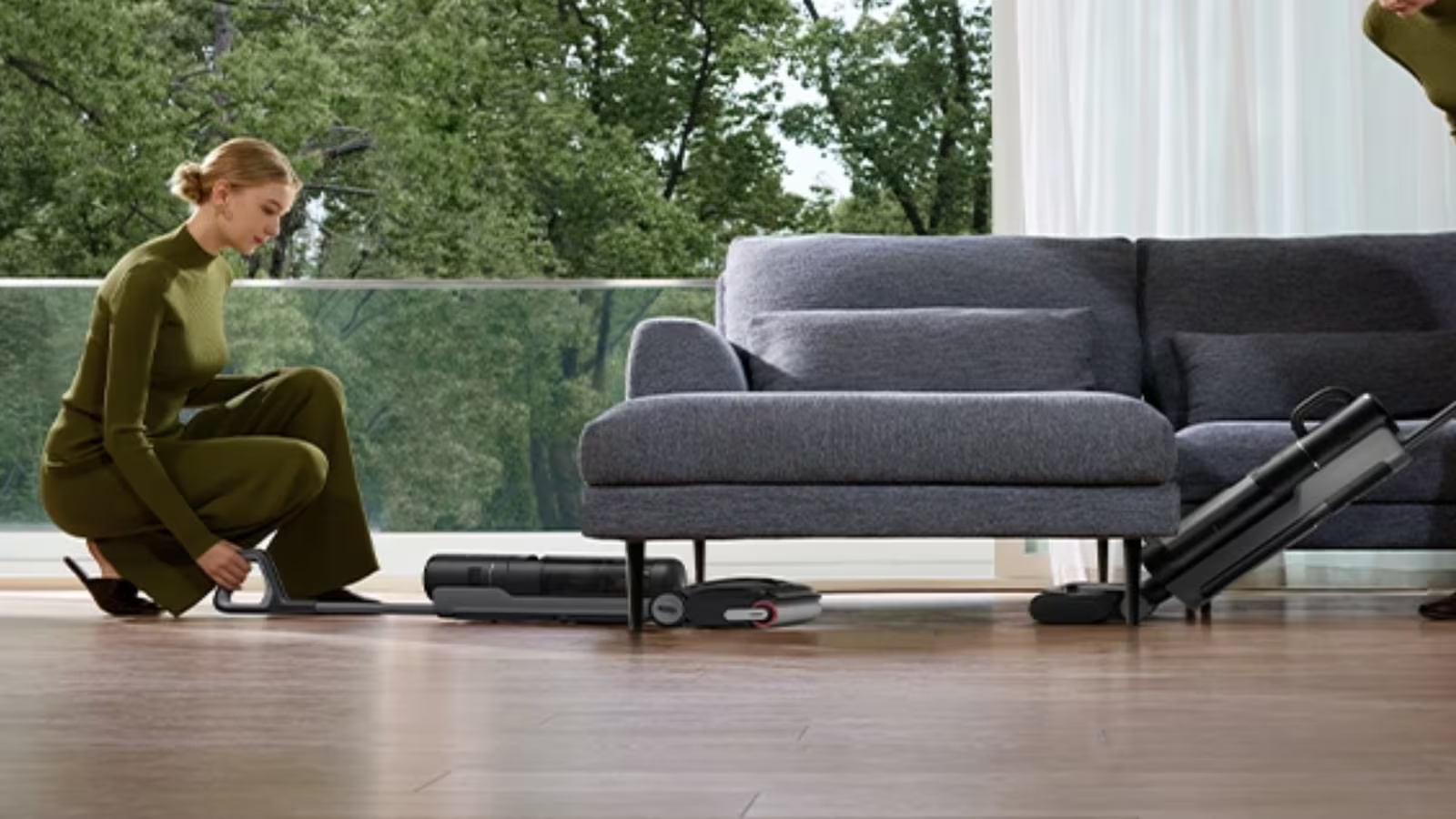
Robot vacuums are no longer limited to India’s biggest metropolitan markets. Rising awareness, wider e-commerce access, improving product features and expanding service networks are helping robotic cleaning devices reach more households in smaller cities. The shift reflects broader changes in India’s premium appliance and smart-home market.
Robot Vacuum Demand Is Entering a Wider Market
The Indian robot vacuum market is still relatively young, but the category is moving beyond its initial urban niche.
Eureka Forbes, one of the established players in India’s home-cleaning appliance market, reported that its robotic vacuum business grew nearly threefold over the last two years. The company said robotic vacuum cleaners accounted for nearly two-thirds of its vacuum cleaner revenue in FY26. It has identified robotics as one of its fastest-growing emerging categories.
The company is targeting a ₹1,000 crore robotics business by FY30, based on its own business projections. That figure is a company ambition, not an independently verified forecast for the entire Indian market.
The broader market remains underpenetrated. Eureka Forbes estimates that the vacuum cleaner category could grow from about ₹509 crore in FY23 to ₹3,000 crore by FY30, representing a projected 29% CAGR. These figures include vacuum cleaners broadly and should not be treated as robot vacuum sales alone.
What is changing is access. Consumers outside the largest cities can now discover, compare and purchase smart home appliances without depending entirely on specialist stores in metros.
Tier-2 and Tier-3 Consumers Are Buying More Online
One reason robot vacuums can move beyond the biggest cities is the expansion of digital commerce.
A Unicommerce report cited by ETBrandEquity found that Tier-2 and Tier-3 cities accounted for 66% of new D2C orders in FY2026, while overall D2C gross merchandise value increased 32%. The report points to a broader shift in online consumption toward smaller cities.
This matters for relatively specialised appliances.
A consumer in Nagpur, Jaipur, Surat, Coimbatore, Lucknow or Bhubaneswar does not necessarily need a large local electronics showroom carrying several robot vacuum brands. Online marketplaces can provide access to product specifications, reviews, demonstrations and different price points.
That reduces one of the traditional barriers to buying smart appliances outside metropolitan markets.
The trend does not mean every Tier-2 or Tier-3 household is ready to buy a robot vacuum. Rather, the addressable customer base is becoming easier for manufacturers and retailers to reach.
Better Technology Is Making Robot Vacuums More Practical
Early robotic vacuum cleaners were largely associated with automated floor cleaning. Newer models are becoming considerably more sophisticated.
Products now commonly compete on features such as LiDAR navigation, mapping, obstacle detection, automated dust collection and wet mopping. Market research on India’s robotic vacuum segment identifies LiDAR, visual SLAM and adaptive mapping as technologies increasingly influencing the category.
Indian manufacturers and brands are also adapting products to local cleaning requirements.
Eureka Forbes, for example, says its newer robotic products include features such as wet mopping, corner and edge cleaning, obstacle detection, mop extension and automated cleaning stations.
This is important because Indian homes can present different cleaning conditions from markets where robot vacuums first became popular. Floor types, furniture layouts, dust levels, hair, food particles and the use of wet cleaning can all influence how useful a robot vacuum is.
The technology is therefore evolving from simple automated vacuuming toward broader floor-care systems.
Working Households Are Looking for Convenience
Convenience is another factor behind the category’s expansion.
Urban Indian households are increasingly using technology to reduce repetitive domestic tasks. This does not mean robot vacuums eliminate the need for manual cleaning. Corners, stairs, furniture surfaces and certain types of stains still require human intervention.
But automated floor cleaning can reduce the frequency of one routine household task.
Eureka Forbes identifies rising urbanisation, increasing incomes, greater health awareness and changing household needs as structural drivers for its health and hygiene categories. Its FY26 report also points to changing domestic-help availability and increased participation of women in the workforce as factors supporting demand for convenience-led products.
These factors are relevant outside major metros too.
Smaller cities have increasingly urban lifestyles, apartment communities and dual-income households. As these patterns spread, demand for appliances that save time can also expand.
Service Networks Are Critical Outside Metros
There is an important difference between selling a robot vacuum in a smaller city and building a sustainable business there.
After-sales service is one of the biggest considerations for an expensive smart appliance.
Robot vacuums contain sensors, motors, batteries, software and moving components. Customers may need replacement parts, repairs, software assistance or routine maintenance. A product that is difficult to service locally can become less attractive, regardless of its features.
Eureka Forbes says its service network includes more than 1,650 business partners and over 9,000 service technicians, covering multiple health and hygiene categories. The company reports approximately 7 lakh customer touchpoints each month.
Such networks can make a difference when brands expand beyond metros.
For consumers in smaller cities, the question is increasingly not only whether a robot vacuum is available, but whether someone can service it after purchase.
Product Prices Are Becoming More Diverse
Price has historically been a major barrier to robot vacuum adoption.
Premium robotic cleaning systems can cost significantly more than conventional vacuum cleaners or manual cleaning equipment. However, the market now contains products across a wider range of specifications and prices.
Eureka Forbes said during its FY26 earnings discussion that its robotics portfolio spans economy to super-premium products and that distribution has expanded into organised retail and independent general trade.
That wider range matters for Tier-2 and Tier-3 markets.
Consumers in smaller cities are not necessarily looking for the most expensive model. Some may prioritise basic vacuuming and mopping, while others may be willing to pay more for self-emptying, advanced mapping or automated maintenance.
As manufacturers offer different configurations, the category can potentially reach households with different budgets.
Festive Shopping Could Give Smart Appliances Another Push
Timing also matters.
India is entering the festive shopping period, when consumers typically spend more on electronics, appliances, home improvement and lifestyle products.
Recent e-commerce data already points to stronger consumption outside major metros. Flipkart has reported increasing demand for several consumer categories beyond traditional big-ticket purchases, with Tier-2 and Tier-3 markets playing an important role in its broader expansion.
Amazon has also reported significant growth for its value-commerce offering in Tier-II and Tier-III cities, highlighting the increasing importance of smaller-city consumers in online retail.
These developments do not specifically prove a corresponding surge in robot vacuum sales. However, they show why appliance companies increasingly view smaller cities as important consumer markets.
For robot vacuums, festive discounts, easier financing and online demonstrations could reduce some of the barriers to first-time adoption.
Indian Homes Still Present Specific Cleaning Challenges
Robot vacuums are not a universal replacement for conventional cleaning.
Indian households can have rugs, floor mats, low furniture, thresholds, cables, wet areas and different flooring materials. Kitchens may also generate heavier food debris than some consumers expect a robot vacuum to handle automatically.
Newer models are attempting to address some of these problems through better obstacle recognition, mapping and mopping systems.
Eureka Forbes says its latest robotics products include small-object detection, mop lifting, edge cleaning and automated mop washing and drying.
But consumers still need to assess whether a particular device fits their home.
A robot vacuum works best when floors are reasonably accessible and obstacles are managed. Buyers also need to consider replacement parts, consumables, battery life, software support and service availability.
Why Smaller Cities Could Become the Next Growth Market
The expansion of robot vacuums into smaller cities fits into a much broader consumer trend.
India’s digital commerce infrastructure has reduced geographical barriers. Smart-home awareness is increasing. Product categories once considered niche are becoming easier to research and purchase online.
At the same time, urbanisation is expanding beyond the biggest metropolitan centres.
Eureka Forbes estimates that 40% of India’s population could live in towns and cities by 2036, compared with 31% in 2011. The company also identifies rising incomes and greater demand for convenience as structural drivers for its addressable categories.
That does not guarantee mass adoption of robot vacuums. Household budgets, apartment sizes, cleaning habits and awareness remain different across cities.
But it creates conditions in which the category can expand beyond its traditional metropolitan customer base.
The Bigger Shift Is Toward Automated Home Cleaning
Robot vacuums are part of a wider change in India’s home-appliance market.
Consumers are increasingly being offered products that automate routine tasks, from robotic floor cleaning to smart air purification and connected water-management systems.
For manufacturers, the opportunity is not simply to sell a machine. It is to build an ecosystem around the product through software, service, accessories and replacement parts.
For consumers, the decision comes down to practical value.
A robot vacuum has to save enough time and effort to justify its purchase and maintenance costs. Better navigation and automated cleaning can improve convenience, but they do not remove the need for occasional manual cleaning.
That calculation will differ from household to household.
What This Means for India’s Smaller Cities
The movement of robot vacuums beyond India’s largest cities reflects the broader premiumisation of consumer demand.
Smaller-city consumers increasingly have access to the same products, online information and payment options available to metro customers. Manufacturers are responding by expanding distribution, service networks and product ranges.
The category remains underpenetrated, so its future size is uncertain. Company forecasts suggest substantial growth potential, but actual adoption will depend on pricing, reliability, service quality and how well products adapt to Indian homes.
For Tier-2 and Tier-3 cities, the important shift is that smart home technology is becoming less geographically restricted.
Robot vacuums may still be a discretionary purchase for many households. But as technology improves and distribution expands, they are increasingly becoming part of the conversation around India’s next phase of consumer appliance growth.
Key Takeaways
- Robot vacuum adoption in India remains relatively low, but companies are reporting rapid growth in their robotics businesses.
- Tier-2 and Tier-3 cities are becoming increasingly important to India’s online and D2C consumer economy.
- Better navigation, mopping, obstacle detection and automated cleaning stations are making newer robot vacuums more suitable for Indian households.
- Service availability, pricing and suitability for individual homes will remain important factors in smaller-city adoption.
FAQs
Why are robot vacuums becoming popular in India?
Growing awareness of smart appliances, demand for convenience, improving technology and wider online distribution are supporting the category. Companies are also expanding their product ranges and service networks.
Are robot vacuums becoming popular in Tier-2 cities?
The available data supports a broader increase in digital and D2C consumption in Tier-2 and Tier-3 cities, but there is limited public city-level data proving the exact scale of robot vacuum adoption. The category is increasingly being marketed and distributed beyond major metros.
Are robot vacuums suitable for Indian homes?
Newer models are designed with features such as mapping, obstacle detection, wet mopping and edge cleaning that can address some Indian household requirements. However, suitability depends on the home’s flooring, furniture, layout and cleaning habits.
What should buyers check before purchasing a robot vacuum?
Buyers should compare navigation technology, vacuum and mopping performance, battery capacity, replacement parts, app support, warranty, service availability and the total ownership cost. Local after-sales support is particularly important for buyers outside major cities.











Leave a comment