

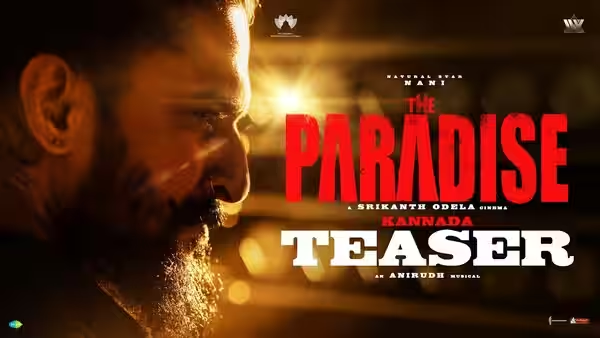
Nani’s The Paradise has released in theatres with strong expectations following his earlier collaboration with director Srikanth Odela in Dasara. Early The Paradise reviews are mixed, with critics praising Nani’s committed performance, the film’s scale and technical presentation while raising concerns about its screenplay, pacing and emotional impact.
The Paradise Arrives After Dasara Expectations
The Paradise is the second collaboration between actor Nani and director Srikanth Odela after Dasara, which released in 2023. The new film arrived in theatres on September 24, 2026, after considerable pre-release attention around the reunion.
Set in 1980s Secunderabad, the film follows Jadal, played by Nani, against the backdrop of the Savari community. The story centres on a marginalised community dealing with oppression, identity and questions of dignity. Jadal becomes increasingly involved in a larger struggle against the existing power structure.
The film has a reported runtime of around 2 hours and 54 minutes and features Nani alongside Mohan Babu, Kayadu Lohar, Sonali Kulkarni and Raghav Juyal.
The central premise has attracted attention because it attempts to combine a period setting, social themes and large-scale action rather than presenting a straightforward commercial action story.
Critics Praise Nani’s Physical Transformation
One of the clearest positive points across early The Paradise reviews is Nani’s performance.
The Indian Express review gave the film 2 out of 5 and specifically highlighted Nani’s physical transformation and commitment to the character. The review noted changes including his hairstyle, beard, body language and gait, while also praising the conviction he brings to the action sequences.
The Times of India also described Nani as a strong presence within the film, while Filmfare noted that his screen presence helps support the movie’s ambitious scale.
This response is significant because Jadal is substantially different from the more familiar urban and romantic roles associated with parts of Nani’s filmography.
The actor’s appearance and mannerisms are designed to establish a character shaped by his surroundings. Critics have generally recognised the effort involved, even when their assessments of the overall film have been less positive.
The Paradise Reviews Question the Screenplay
The main criticism emerging from several reviews concerns the writing.
The Indian Express described the screenplay as relying on a familiar template despite the film’s distinctive setting and visual ambition. Hindustan Times similarly argued that the film carries a sense of déjà vu and does not fully distinguish itself from comparable action dramas.
Filmfare’s review also pointed to a gap between the film’s scale and its storytelling, describing it as a violent mass drama that struggles to find sufficient emotional weight.
The criticism does not mean that reviewers found the premise without potential. Instead, several reviews suggest that the central idea and world-building offer interesting material, but the execution does not consistently develop those elements into a tightly paced narrative.
That distinction is important when looking at the early critical response.
Action and Visual Scale Get Attention
The Paradise has been positioned as a large-scale action drama, and its visual presentation is another aspect that has received recognition.
The film creates a period world based in 1980s Secunderabad and uses that setting as part of the story’s identity. Reviews have acknowledged the ambition behind the world-building and action presentation, even when questioning the narrative structure.
Filmfare described the film as having fury and scale, while Times of India highlighted the world created around the Savari community.
The action is also closely tied to Nani’s performance. Critics who appreciated the physicality of his role have pointed to the preparation and intensity visible on screen.
However, scale by itself has not been enough to resolve concerns about the story.
The recurring criticism is that the film sometimes prioritises spectacle over narrative development.
Second Half Draws Mixed Reactions
The film’s second half has emerged as a specific point of discussion in early audience reactions.
Mid-day reported mixed responses on social media, with viewers praising Nani, Kayadu Lohar, the action, visuals and music while criticising the screenplay, editing and second-half narration.
Hindustan Times also reported that some early viewers on X expressed disappointment with the second half, although social media reactions represent individual audience responses rather than a statistically representative assessment of the film.
This difference between professional reviews and social media reactions is worth keeping in mind.
Critics assess a film using their own review frameworks, while early audience posts can be influenced by expectations, fan communities, premiere experiences and individual preferences.
As more viewers watch the film, the broader audience response may become clearer.
Supporting Cast Adds Different Dimensions
The Paradise features a large supporting cast, including Mohan Babu, Kayadu Lohar, Sonali Kulkarni and Raghav Juyal.
Mohan Babu plays Malik, a powerful figure whose influence extends across the community in which Jadal lives. The conflict between Jadal and Malik forms an important part of the film’s central power struggle.
Sonali Kulkarni plays Sammakka, Jadal’s mother. Before the release, Kulkarni spoke about the character having a distinct story rather than functioning only as the protagonist’s mother. She also learned Telugu for the role.
Raghav Juyal makes his Telugu film debut as an antagonist. His presence generated attention during the promotional campaign, particularly around the film’s action-oriented presentation.
The supporting cast therefore contributes to a film that attempts to give its central conflict a broader social and family dimension.
Anirudh’s Music Is One of the Film’s Talking Points
Music is another area mentioned positively in early coverage.
Anirudh Ravichander has composed the music for The Paradise, and reviews have noted the role of the background score in supporting the film’s action-heavy presentation. Sacnilk’s early review roundup listed Anirudh’s background music among the elements receiving praise, alongside Nani’s screen presence and the film’s subject.
For a film built around large action sequences and an intense period setting, the background score plays an important role in establishing atmosphere.
The response to the music has nevertheless been discussed alongside criticism of the screenplay. In other words, technical and performance elements have generally received more favourable attention than the narrative construction.
Critics Differ on How Well the Story Works
The early reviews do not form a completely uniform picture.
Hindustan Times was particularly critical of the film’s execution and sense of familiarity, giving it a low rating in its review. The Indian Express also gave it 2 out of 5, while describing Nani’s performance as a notable strength.
Times of India rated the film 2.5 out of 5 and described it as a striking world that loses its way. Filmfare also gave it 2.5 out of 5, focusing on the contrast between its ambition and its lack of novelty.
Other Telugu publications have been somewhat more favourable. NTV Telugu gave the film 2.5 out of 5, while 123telugu rated it 2.75 out of 5. Samayam Telugu published a 3 out of 5 review.
This range shows that the critical response is mixed rather than completely uniform.
The Social Theme Remains Central to The Paradise
Beyond the action, The Paradise attempts to tell a story about a marginalised community and its struggle for recognition.
The film’s setting and characters are built around questions of identity, dignity and power. Jadal’s personal journey is connected to the larger situation faced by his community, giving the story a social dimension alongside its commercial action elements.
This aspect has been recognised in reviews that acknowledge the premise as interesting even while criticising its execution.
The challenge for the film is balancing that social theme with the demands of a large-scale commercial action drama.
When those elements work together, the action can strengthen the emotional story. When the narrative becomes less focused, the social themes can feel secondary to spectacle.
That balance is one of the main points emerging from the early critical discussion.
What Early Reviews Say About Nani
The most consistent point across the early reviews is that Nani remains one of the film’s central strengths.
His physical transformation, action performance and screen presence have received positive attention even from reviewers who were critical of the screenplay.
The Indian Express specifically argued that the problem was not Nani’s effort but the material surrounding his performance.
At the same time, the mixed reviews suggest that a strong lead performance cannot completely overcome concerns about pacing, writing and direction.
For audiences deciding whether to watch The Paradise, the early critical response therefore provides a fairly clear picture of what to expect: an ambitious, violent period action drama with a committed lead performance, but one whose storytelling has divided reviewers.
The Paradise Review: Early Critical Picture
The Paradise has generated a mixed critical response on its opening day.
Nani’s transformation and performance are among the most consistently praised elements. The film’s scale, action, visuals and music have also received positive mentions.
The main criticisms focus on the screenplay, pacing, familiarity of certain story elements and the film’s ability to maintain emotional weight across its nearly three-hour runtime.
The ratings published by Indian entertainment outlets currently range from around 2 to 3 out of 5 among the reviews checked for this article. These ratings are individual critics’ assessments and should not be treated as a single definitive measure of the film’s reception.
As the theatrical run continues, audience response and subsequent reviews will provide a broader picture of how The Paradise is ultimately received.
Key Takeaways
- The Paradise released in theatres on September 24, 2026, and is directed by Srikanth Odela, who previously worked with Nani on Dasara.
- Critics have consistently highlighted Nani’s physical transformation, screen presence and commitment to the action-heavy role.
- The screenplay, pacing and second-half narrative have attracted criticism from several reviewers and early viewers.
- Published critic ratings checked for this article range from approximately 2 to 3 out of 5, indicating a mixed early critical response.
FAQs
When was The Paradise released?
The Paradise released theatrically on September 24, 2026. It is a Telugu period action drama directed by Srikanth Odela and starring Nani in the lead role.
What is The Paradise about?
The film is set in 1980s Secunderabad and follows Jadal, played by Nani, as he becomes involved in a struggle involving the marginalised Savari community, identity, power and dignity.
What are critics praising about The Paradise?
Nani’s performance and physical transformation are among the most frequently praised elements. Critics have also highlighted aspects of the film’s visual scale, action sequences and music.
What are the main criticisms of The Paradise?
Several reviews have raised concerns about the screenplay, pacing, familiarity of the narrative and the emotional impact of the second half. The degree of criticism varies between publications.









Leave a comment