

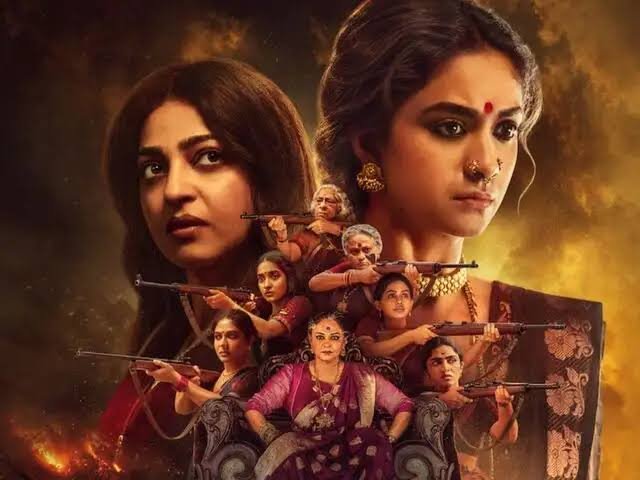
Indian OTT platforms are increasingly exploring stories built around powerful, complex female characters. From Netflix’s Akka to the returning world of Mirzapur, streaming entertainment is creating more space for women who drive conflicts, challenge authority and influence the direction of the story.
Akka and Mirzapur Reflect a Changing OTT Landscape
The Indian OTT industry is witnessing a noticeable shift in the way female characters are written and presented. Women are no longer limited to supporting romantic interests, family members or victims in crime dramas. Increasingly, they are being portrayed as political players, crime leaders, investigators and individuals with complicated ambitions.
Two recent releases offer interesting examples of this changing approach. Netflix’s Akka, which premiered on October 30, 2026, places two powerful women at the centre of a fictional criminal world. Keerthy Suresh plays Bhavani, while Radhika Apte portrays Rudra, whose ambitions threaten the established order.
At the same time, Mirzapur: The Movie has returned to Prime Video after its theatrical release, bringing back familiar characters from the popular crime franchise. Although the story remains centred on the larger power struggle involving its male characters, women such as Beena Tripathi, Golu Gupta and Dimpy Pandit remain important parts of the franchise’s narrative.
These examples reflect different approaches to female representation. Akka builds its central conflict around women, while Mirzapur demonstrates how female characters can influence a predominantly male-led crime universe.
Why Female-Led OTT Shows Are Attracting Attention
One of the strongest reasons behind the growing interest in female-led web series is the opportunity to explore stories that have traditionally received limited attention in mainstream entertainment.
For decades, mainstream Indian cinema frequently presented women through familiar character types. They were often written as romantic partners, mothers, daughters or supporting figures whose decisions revolved around male protagonists.
OTT platforms have created additional opportunities to move beyond these established formats. Longer storytelling formats allow writers to develop characters over multiple episodes, explore their motivations and show how their decisions affect the larger plot.
A female police officer investigating a complicated murder, a businesswoman protecting her company or a criminal leader defending her position can now become the central character of an entire series.
The popularity of such stories also reflects changing audience expectations. Viewers increasingly look for characters who feel believable, unpredictable and emotionally complicated rather than characters who simply fit traditional stereotypes.
Ormax Report Reveals Higher Audience Buzz for Female-Led Shows
The growing attention towards female protagonists is not limited to creative discussions. Audience research has also highlighted their potential in India’s streaming market.
According to an Ormax Media analysis published in June 2026, female-led Hindi web series generated 47% higher average Peak Buzz than series led by male protagonists.
The analysis examined the top 50 most-watched non-franchise Hindi fiction series launched between January 2025 and May 2026. Female-led titles recorded an average Peak Buzz score of 14.1, compared with 9.6 for male-led titles.
Peak Buzz measures the percentage of audiences who can recall a show without assistance when asked about upcoming or recently released streaming content. It helps indicate how strongly a programme captures audience attention around its launch.
The findings are particularly interesting because female-led shows continue to represent a smaller share of streaming releases.
This suggests that stories featuring women in central roles can attract significant attention even in a market where crime franchises, action dramas and male-led narratives have traditionally dominated.
However, higher audience buzz should not automatically be interpreted as higher total viewership, subscription numbers or commercial success. It is an indication of audience recall and interest, rather than a direct measurement of completed viewing.
Akka Gives Women Control Over the Crime Narrative
Netflix’s Akka offers a distinctive approach to female-led storytelling by creating a fictional society where women occupy positions of authority.
Directed and written by Dharmaraj Shetty, the series is set in Pernuru, a fictional kingdom where powerful women control the established order.
The central conflict develops around Bhavani and Rudra, two characters with different ambitions and beliefs. Bhavani wants to protect the legacy and authority of her established clan, while Rudra challenges the existing structure and attempts to build her own influence.
Keerthy Suresh and Radhika Apte bring contrasting personalities to the story. Their conflict is not simply about personal rivalry. It also involves loyalty, family history, control and the consequences of challenging an established power structure.
The presence of actors such as Tanvi Azmi further strengthens the series’ ensemble.
What makes Akka particularly relevant to the current OTT conversation is its decision to make women the primary decision-makers within the fictional criminal world. Their actions determine the direction of the story, rather than simply reacting to decisions made by male characters.
The series also demonstrates how streaming platforms are experimenting with alternative social settings to explore familiar themes such as power, revenge and inheritance.
Mirzapur Shows the Importance of Strong Female Supporting Characters
While Akka places women at the centre of its narrative, Mirzapur offers another perspective on female representation.
The franchise initially became popular for its portrayal of crime, political influence, family rivalries and the struggle for control over the fictional Purvanchal underworld.
However, its female characters have gradually become important parts of its storytelling.
Beena Tripathi, played by Rasika Dugal, is among the most complicated characters in the series. Her position within the Tripathi household exposes the gender inequalities and power struggles operating inside the family.
Golu Gupta, portrayed by Shweta Tripathi Sharma, develops from a relatively conventional student character into someone increasingly involved in the dangerous world of crime and revenge.
Dimpy Pandit, played by Harshita Gaur, also contributes to the wider emotional and family narrative.
These characters demonstrate that women in crime dramas do not necessarily need to become conventional heroes to have narrative importance. They can be ambitious, vulnerable, strategic and morally complicated.
Mirzapur: The Movie, directed by Gurmmeet Singh, returned to the franchise’s established world with its theatrical release on September 4, 2026, followed by its Prime Video streaming premiere on October 30.
Its ensemble includes Rasika Dugal, Sheeba Chadha, Shweta Tripathi Sharma, Shriya Pilgaonkar and Harshita Gaur alongside the returning male cast.
Although the film’s central premise revolves around the struggle for Mirzapur’s throne, the returning female characters remain part of the larger world that has helped establish the franchise.
Streaming Platforms Are Looking Beyond Traditional Female Roles
The growing presence of female protagonists is also visible across other Indian streaming productions.
Shows such as Dabba Cartel, Daldal, Khauf, Mandala Murders and Mrs. Deshpande have explored different kinds of women-led narratives.
These projects cover crime, investigation, psychological drama and social relationships. Their characters are not necessarily designed to be universally likeable. Instead, their decisions and personal conflicts help create tension within the story.
This approach gives writers greater flexibility.
A female protagonist can be a police officer who makes difficult professional decisions, a businesswoman dealing with internal competition or an individual whose personal history becomes central to a criminal investigation.
The increasing variety of roles also creates opportunities for experienced performers and emerging actors to take on characters that offer more than conventional supporting appearances.
For streaming platforms, these stories provide additional ways to differentiate their content catalogues in a crowded market.
Why OTT Platforms Still Have a Representation Challenge
Despite the growing attention towards female-led stories, the Indian streaming industry continues to face a representation gap.
A report by Ormax Media published in November 2025 examined 338 Hindi fiction originals released since 2022. Its findings showed that male-led stories had become significantly more common, with male protagonists outnumbering female protagonists by 3.5 to one in 2025.
This highlights an important contradiction. Female-led series can generate strong audience interest, but platforms have not necessarily increased their production of such stories at the same pace.
Genre selection is one factor. Action, crime and thriller formats account for a significant portion of Hindi streaming fiction. These genres have historically relied heavily on male protagonists, particularly police officers, gangsters and political figures.
There is also the challenge of investment decisions. Streaming companies must consider production budgets, audience retention, subscription growth and the possibility of building successful franchises.
However, the Ormax findings suggest that female-led content deserves serious consideration rather than being treated as a limited experimental category.
The challenge is not simply to produce more stories featuring women. It is to create convincing characters, well-developed plots and narratives that can hold audience attention beyond their initial release.
What the Future Holds for Women in Indian OTT Entertainment
The future of female-led storytelling will depend on whether streaming platforms continue investing in diverse characters and genres.
Crime dramas are one area where women have already started gaining more prominent roles. However, there is considerable scope for expansion into political thrillers, sports dramas, science fiction, workplace stories and regional-language productions.
Regional OTT content could also contribute to this development. Stories rooted in smaller cities, local communities and different cultural settings can introduce female characters whose experiences are not limited to metropolitan lifestyles.
There is also an opportunity to move beyond the idea that a strong female character must always be involved in violence, revenge or crime. Strength can be represented through professional decisions, personal independence, leadership, resilience and the ability to challenge social expectations.
For audiences, the most important factor will remain the quality of storytelling. A character’s gender alone cannot guarantee a successful series. The writing, performances, direction and emotional connection with viewers will determine whether a show remains relevant after its initial popularity.
The growing attention towards Akka and other female-led productions suggests that Indian OTT storytelling is becoming more open to different perspectives. Mirzapur, meanwhile, demonstrates that even established franchises can give women meaningful roles within familiar narratives.
The next major development will be whether this interest translates into sustained investment in female-led stories across India’s streaming industry.
Key Takeaways
- Netflix’s Akka premiered on October 30, 2026, with Keerthy Suresh and Radhika Apte leading its central conflict.
- Mirzapur: The Movie returned to Prime Video on October 30, featuring several established female characters from the franchise.
- Ormax Media’s June 2026 analysis found that female-led Hindi web series generated 47% higher Peak Buzz than male-led titles in its sample.
- Despite growing audience interest, male-led stories continue to outnumber female-led productions in India’s Hindi OTT market.
Frequently Asked Questions
1. Why are Indian OTT platforms focusing on female-led web series?
Streaming platforms are exploring female-led stories because they offer different narrative perspectives and opportunities for complex character development. Audience research has also indicated strong launch-stage interest in female-led Hindi web series.
2. What is the story of Netflix’s Akka?
Akka is a crime thriller set in the fictional kingdom of Pernuru, where women control the established power structure. The story follows the rivalry between Bhavani, played by Keerthy Suresh, and Rudra, played by Radhika Apte.
3. Are female-led OTT shows more popular than male-led shows?
An Ormax Media analysis published in June 2026 found that female-led Hindi web series generated 47% higher average Peak Buzz than male-led shows in its sample. However, this measures audience recall and interest, not necessarily total viewership.
4. Which Indian OTT shows feature strong female characters?
Some examples include Akka, Dabba Cartel, Daldal, Khauf, Mandala Murders and Mrs. Deshpande. These productions explore women in different roles, including crime leaders, investigators and individuals facing complex personal challenges.







Leave a comment