

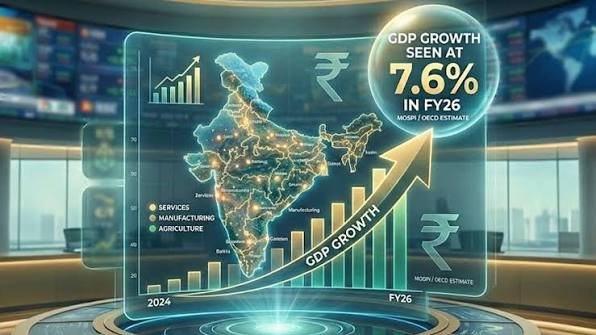
India’s economy is expected to grow by 7.6% in the July-September 2026 quarter, according to a Reuters poll of 43 economists. Strong consumer spending, vehicle sales and government investment are supporting growth, but inflation, higher borrowing costs and global uncertainties remain important concerns for businesses.
India GDP Growth Forecast: What the Latest Estimates Reveal
India’s GDP growth outlook remains strong as the economy continues to show resilience despite inflationary pressures and international uncertainties. According to a Reuters poll conducted between November 13 and 18, 2026, India’s gross domestic product is expected to expand by 7.6% year-on-year during the July-September quarter of the current financial year.
The estimate represents a slight moderation from the 7.8% growth recorded during the April-June quarter. Economists surveyed by Reuters expect the economy to maintain its position among the fastest-growing major economies.
However, the 7.6% figure is a quarterly growth forecast, not the projected growth rate for the entire financial year. The Reuters poll estimates India’s GDP growth at 7.2% for FY2026-27, followed by approximately 7% growth in each of the next two financial years.
The official GDP data for the July-September quarter is scheduled for release on November 30, 2026. Until then, the 7.6% figure remains an economist forecast rather than a confirmed government estimate.
Consumer Spending Continues to Support India’s Economic Growth
One of the major factors supporting India’s GDP growth is domestic consumption. Household spending on vehicles, consumer products, services and other everyday requirements has remained relatively strong.
According to the Reuters report, earlier tax measures have supported consumer demand, while household borrowing has also contributed to spending activity.
Strong passenger vehicle sales and growth in bank credit indicate that consumers and businesses continue to participate in economic activity.
For businesses, higher consumer spending can translate into improved sales opportunities. Retailers, automobile manufacturers, electronics companies, restaurants and consumer goods businesses may benefit when households have greater purchasing capacity.
This trend is also relevant for smaller cities. Markets such as Nagpur, Indore, Jaipur, Lucknow, Surat and Coimbatore have growing retail and service sectors. Increased demand for vehicles, appliances, clothing, food services and other consumer products can create opportunities for businesses operating outside major metropolitan areas.
However, stronger consumption does not automatically mean that every business will experience higher profits. Companies must also account for operating expenses, employee costs, transportation and raw material prices.
Manufacturing and Automobile Businesses Could Benefit From Demand
The manufacturing sector remains an important part of India’s economic expansion. Strong vehicle sales, improving investment activity and government infrastructure spending are supporting industrial demand.
The automobile industry offers a useful example of how economic growth can influence businesses. When consumer confidence improves and financing remains accessible, demand for passenger vehicles and related products can increase.
This creates opportunities across the automobile supply chain, including component manufacturers, dealerships, repair centres, logistics companies and suppliers of automotive technology.
Manufacturing businesses in Tier-2 and Tier-3 cities could also benefit from expanding industrial activity. Cities with established industrial clusters and developing infrastructure may attract new investments in engineering, automobile components, textiles, food processing and other manufacturing activities.
For smaller manufacturers, the opportunity is not limited to selling more products. Stronger industrial activity can also encourage companies to upgrade machinery, improve production capacity and explore new markets.
At the same time, businesses must remain cautious about input costs. Higher energy prices, imported raw materials and transportation expenses can affect profit margins even when sales increase.
Government Capital Spending Supports Business Investment
Government infrastructure expenditure is another important factor behind India’s economic growth.
Investment in highways, railways, airports, industrial corridors, power infrastructure and urban development creates demand across multiple industries.
Construction companies, cement manufacturers, steel producers, equipment suppliers and logistics operators are among the businesses that can benefit from infrastructure development.
The impact can extend to smaller cities and surrounding districts. Infrastructure improvements can make industrial locations more accessible, reduce transportation difficulties and support the movement of goods between production centres and consumer markets.
Government capital expenditure can also encourage private companies to invest when they see better infrastructure and stronger future demand.
According to Reuters, economists have identified sustained government capital spending and stronger corporate earnings as factors supporting improvements in private investment.
The Reserve Bank of India’s September 2026 professional forecasters’ survey also indicates that investment activity is expected to remain important. Its median estimate puts real gross fixed capital formation growth at 8.5% for FY2026-27.
This suggests that investment could remain a significant contributor to economic activity, although actual business decisions will depend on demand, financing costs and project viability.
Services Sector Remains an Important Growth Driver
India’s services industry continues to play a major role in economic expansion. Banking, financial services, information technology, telecommunications, healthcare, hospitality, education and professional services contribute significantly to business activity.
The Reserve Bank of India’s September 2026 survey places median services growth at 8.8% for FY2026-27. This is higher than its corresponding projections for industry and agriculture.
For businesses, a growing services sector can create opportunities in both metropolitan and smaller urban markets.
For example, healthcare providers may expand diagnostic and medical facilities, while education companies may see opportunities in skill development and professional training. Financial institutions can also explore lending and digital banking services in locations where access to formal financial products is improving.
The growth of digital services has further expanded opportunities for small businesses. Local retailers, service providers and independent entrepreneurs can use digital payments, online marketplaces and technology-based platforms to reach customers beyond their immediate locations.
However, businesses will need skilled employees, reliable digital infrastructure and the ability to manage increasing competition.
Inflation and Higher Borrowing Costs Remain Major Concerns
Despite the positive GDP outlook, businesses are not operating without challenges.
Higher crude oil prices, geopolitical tensions and concerns about an inadequate monsoon have increased inflationary pressures. These developments can affect transportation, manufacturing, agricultural production and household spending.
For small businesses, rising input costs can be particularly difficult to manage. A restaurant may face higher ingredient and delivery expenses, while a manufacturer may have to spend more on electricity, fuel and raw materials.
Another concern is the possibility of higher interest rates.
The November Reuters poll found that most surveyed economists expected the Reserve Bank of India to increase its policy rate by at least 25 basis points to 5.75% in December 2026.
This is an economist expectation, not an announced RBI decision.
If borrowing costs increase, companies seeking business loans may face higher financing expenses. Small enterprises planning to purchase equipment, expand facilities or increase inventory could become more cautious about taking fresh loans.
Higher interest rates can also affect consumers who depend on loans to purchase homes, vehicles and other expensive products. This may influence demand in interest-sensitive industries.
What India’s GDP Growth Means for Small Businesses and Startups
The projected economic expansion presents opportunities for small businesses and startups, but the benefits are likely to differ across industries.
Retail businesses may find opportunities through stronger consumer demand. Manufacturing startups could benefit from industrial investment, while technology companies may explore opportunities in digital payments, automation, logistics and business software.
Businesses in smaller cities can also participate in this expansion by serving local demand and connecting with larger supply chains.
For example, a food processing company in Maharashtra could explore opportunities to supply products to retailers in other states. A logistics startup in Madhya Pradesh could serve manufacturers and distributors across multiple districts. Similarly, local service businesses may expand through digital platforms.
Startups should nevertheless avoid treating strong GDP growth as a guarantee of funding or profitability. Investors generally consider factors such as revenue growth, customer acquisition costs, business models, competition and the ability to generate sustainable returns.
Access to finance, employee skills, infrastructure and market demand will remain important considerations for entrepreneurs.
India’s Economic Outlook: Growth Will Depend on Several Factors
India’s economic performance over the coming months will depend on whether domestic consumption remains strong, private investment improves and inflation stays manageable.
The effects of earlier tax cuts are expected to gradually fade, while higher borrowing costs and weaker agricultural performance could influence economic activity during the second half of FY2026-27.
The monsoon is another important factor because agricultural income affects rural consumption and demand for products ranging from two-wheelers to household appliances.
Global developments will also matter. Changes in crude oil prices, international trade conditions and geopolitical tensions can influence India’s import costs, business confidence and investment decisions.
The latest GDP forecast provides a positive indication of economic momentum, but businesses will need to focus on productivity, financial planning and changing consumer requirements rather than depending entirely on headline growth figures.
For India’s smaller cities, the next phase of economic expansion could create opportunities in manufacturing, retail, healthcare, education, logistics and digital services. The extent of these opportunities will depend on how effectively businesses convert wider economic growth into local demand and sustainable operations.
Key Takeaways
- India’s GDP is forecast to grow by 7.6% in the July-September 2026 quarter, according to a Reuters poll of 43 economists.
- The Reuters poll estimates full-year FY2026-27 GDP growth at 7.2%, while the RBI’s September survey puts its median estimate at 7.1%.
- Strong consumer spending, automobile sales, government capital expenditure and services activity are supporting economic growth.
- Inflation, crude oil prices, agricultural uncertainty and potentially higher borrowing costs remain important risks for businesses.
Frequently Asked Questions (FAQs)
1. What is India’s GDP growth forecast for 2026?
According to a Reuters poll published on November 18, 2026, India’s GDP is expected to grow by 7.6% year-on-year in the July-September quarter. For the full financial year 2026-27, the poll estimates growth at 7.2%.
2. Which sectors could benefit from India’s economic growth?
Manufacturing, automobiles, retail, infrastructure, banking, healthcare, logistics, information technology and other service industries could benefit from stronger economic activity. The actual impact will depend on demand, investment and operating costs.
3. How will GDP growth affect small businesses in India?
Stronger economic activity can create opportunities through higher consumer spending, improved infrastructure and increased demand for goods and services. However, small businesses must also manage inflation, competition, financing costs and operational expenses.
4. What are the major risks to India’s economic growth in 2026-27?
Higher crude oil prices, inflation, geopolitical tensions, monsoon uncertainty and potentially tighter monetary conditions are among the major risks identified by economists. These factors could influence consumer spending, business investment and production costs.
(Internal keywords: India GDP growth forecast 2026, Indian economy 2026, India’s GDP growth rate, India economic outlook FY2026-27, business growth in India, Indian manufacturing sector, small businesses in India, startup ecosystem India, RBI economic forecast, India consumer spending, Tier-2 city business opportunities)







Leave a comment