

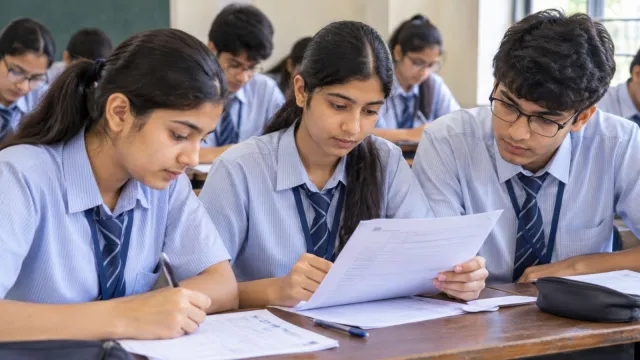
The Central Board of Secondary Education (CBSE) has revised its Scheme of Studies for the 2028 Class 10 board examinations, removing three proposed curricular components and clarifying the subject structure. Students will continue studying nine compulsory curricular areas, while five subjects will form the core board examination.
CBSE Announces Changes to Class 10 Board Exam Scheme
The Central Board of Secondary Education has issued a clarification regarding the subjects and assessment structure for students preparing for the Class 10 board examinations in 2028.
The decision was communicated through Circular No. Acad-70/2026, dated October 29, 2026, issued to the heads of CBSE-affiliated schools.
Under the revised arrangement, three subjects or curricular components will not be included for the affected batches. These are Individuals in Society, Modules on Computational Thinking (CT) and Artificial Intelligence (AI), and Environmental Education.
The clarification comes after concerns about the number of subjects students were expected to study under the earlier proposed arrangement. Reports indicated that the additional components had created confusion among students and increased their academic workload.
The revised structure is intended to provide clarity to schools, parents and students well before the 2028 board examinations.
Which Students Will Be Affected by the CBSE Revision?
The revised CBSE Scheme of Studies applies specifically to students studying in Class 9 during the 2026-27 academic session.
These students will move to Class 10 in the 2027-28 academic session and appear for their Class 10 board examinations in 2028.
The changes do not apply to students who are already studying in Class 10 during the 2026-27 academic session. They will continue under the existing scheme applicable to their batch.
This distinction is important because the announcement has generated questions among students and parents about whether the revised subject structure will affect the upcoming board examinations.
CBSE has clearly specified the applicable batches in its official circular. Schools have been asked to communicate the revised arrangements to students and other stakeholders.
For students currently in Class 9, the clarification provides an opportunity to understand their subject requirements before entering the board examination year.
Five Compulsory Subjects for CBSE Class 10 Board Exams 2028
One of the major clarifications concerns the five compulsory subjects that students must appear for in the Class 10 board examinations.
These subjects are:
- Language 1
- Language 2
- Mathematics
- Science
- Social Science
Students will have to meet the board’s passing requirements in all five subjects.
The two compulsory languages will be selected according to the language options offered under the CBSE scheme. Mathematics, Science and Social Science will remain central academic subjects.
However, the revised structure does not mean students will study only five subjects throughout the academic year.
CBSE has clarified that students must continue studying nine compulsory curricular areas. The five-subject structure specifically refers to the core board examination requirements.
This distinction matters because school-based assessments and board examinations will apply differently to different subjects.
Nine Compulsory Subjects Students Must Study
Although five subjects will form the core board examination, students in the affected batches will study nine compulsory curricular areas.
These include:
- Language 1
- Language 2
- Mathematics
- Science
- Social Science
- Language 3
- Art Education
- Physical Education and Well-being
- Vocational Education
The third language, art education and physical education will continue to be part of the school curriculum.
However, not every subject will require a separate CBSE board examination. Some will be assessed internally by schools.
For example, Language 3, Art Education and Physical Education and Well-being will be assessed through school-based internal assessment under the revised scheme.
Vocational Education will also remain compulsory, although students will have a choice between two assessment pathways.
This arrangement allows students to continue receiving exposure to languages, physical activities, creative learning and practical skills without making every curricular area part of the main board examination.
Individuals in Society, CT and AI Modules Removed
CBSE has specifically clarified that three curricular components will not be included for the affected batches.
The first is Individuals in Society, which was planned as part of the interdisciplinary learning area.
The second is the Modules on Computational Thinking and Artificial Intelligence. These modules were intended to introduce students to structured problem-solving and concepts related to emerging technologies.
The third is Environmental Education, which was scheduled for Class 10 during the 2027-28 academic session.
According to the official circular, these components will not form part of the curriculum for students currently studying in Class 9 in 2026-27 and progressing to Class 10 in 2027-28.
This clarification is particularly relevant for students who were uncertain about whether they would have to prepare for additional assessments in these areas.
However, the removal of the CT and AI modules from this particular interdisciplinary arrangement does not mean that CBSE has removed all artificial intelligence-related learning opportunities.
Artificial Intelligence remains available as one of the vocational skill subjects offered by the board.
Vocational Education Remains Compulsory Under the New Scheme
Another important part of the revised CBSE curriculum concerns vocational education.
CBSE has confirmed that vocational education will remain a compulsory curricular area for the affected students.
However, students can choose between two options: Kaushal Vikas or any one of the 22 skill subjects notified by the board.
The assessment method will depend on the option selected.
Students choosing Kaushal Vikas will undergo school-based internal assessment. They will not have to appear for a separate CBSE board examination in that subject.
Students choosing one of the 22 notified skill subjects will have to appear for the respective subject in the Class 10 board examination.
The board has also clarified that students who successfully pass their selected skill subject will receive an NSQF certificate.
The National Skills Qualifications Framework (NSQF) provides a structured framework for recognising vocational skills and qualifications.
This arrangement gives students an opportunity to study practical subjects alongside conventional academic disciplines.
List of 22 CBSE Skill Subjects for Class 10
Students opting for vocational education through a skill subject can choose from the following 22 options notified by CBSE:
- Retail
- Information Technology
- Security
- Automotive
- Introduction to Financial Markets
- Introduction to Tourism
- Beauty and Wellness
- Agriculture
- Food Production
- Front Office Operations
- Banking and Insurance
- Marketing and Sales
- Health Care
- Apparel
- Multi Media
- Multi Skill Foundation Course
- Artificial Intelligence
- Physical Activity Trainer
- Data Science
- Electronics and Hardware
- Foundation Skills for Sciences (Pharmaceutical and Biotechnology)
- Design Thinking and Innovation
The options cover areas such as technology, business, healthcare, agriculture, tourism and creative industries.
For students interested in technology, subjects such as Information Technology, Artificial Intelligence and Data Science offer exposure to specialised areas.
Similarly, students interested in business-related careers can consider Retail, Banking and Insurance, Marketing and Sales or Introduction to Financial Markets.
The choice should depend on the student’s interests, the subjects available at their school and their future academic plans.
Skill Subject Can Help Students Replace Certain Failed Subjects
One of the significant provisions in the revised CBSE scheme concerns subject replacement.
Students who choose one of the 22 skill subjects under vocational education can receive an important academic benefit.
If a student scores below 33% in any one of the three subjects, Mathematics, Science or Social Science, but passes the selected skill subject, CBSE will allow the skill subject to replace the failed subject while computing the Class 10 result.
For example, if a student does not meet the passing requirement in Science but successfully passes the selected skill subject, the board can replace Science with that skill subject for the purpose of calculating the result.
However, this provision comes with an important condition.
The replacement facility is not available to students who choose Kaushal Vikas instead of one of the 22 skill subjects.
The board has also specified a separate replacement provision for students who select an additional language as an optional subject. If they fail in either of their two compulsory languages but pass the additional language, the optional language can replace the failed language.
These provisions provide additional academic flexibility, but students must understand the eligibility conditions before selecting their subjects.
What the CBSE Revision Means for Students and Parents
The revised scheme provides greater clarity about the subjects students will study and the examinations they will take in Class 10.
For parents, one of the main concerns has been the increasing number of subjects and the possibility of additional academic pressure.
The clarification separates compulsory curricular learning from the subjects that require board examinations.
Students will continue studying languages, mathematics, science, social science, art, physical education and vocational education. However, the assessment method will differ depending on the subject.
The vocational education options also provide an opportunity to explore career-related skills before entering higher secondary education.
For schools, the circular provides a clearer framework for planning subject combinations, arranging teachers and communicating assessment requirements.
Students should consult their school authorities before making choices related to vocational education and optional subjects. The availability of specific subjects and school-level arrangements will be important while selecting the appropriate option.
The revised scheme is also consistent with the broader objective of giving students exposure to practical learning while maintaining the importance of core academic subjects.
Key Takeaways
- CBSE has revised the Scheme of Studies for students currently in Class 9 during the 2026-27 academic session, who will appear for Class 10 board examinations in 2028.
- Individuals in Society, CT and AI modules, and Environmental Education will not be included for these batches.
- Students will study nine compulsory curricular areas, while five subjects will form the core compulsory board examination.
- Vocational education remains compulsory, with a choice between Kaushal Vikas and 22 skill subjects, including an additional subject-replacement benefit for eligible students choosing a skill subject.
Frequently Asked Questions (FAQs)
1. What are the five compulsory subjects for CBSE Class 10 board exams in 2028?
The five compulsory board examination subjects are Language 1, Language 2, Mathematics, Science and Social Science.
2. Does the revised CBSE scheme apply to students appearing for Class 10 exams in 2027?
No. The revised scheme applies to students currently studying in Class 9 during 2026-27, who will enter Class 10 in 2027-28. Students already in Class 10 during 2026-27 will continue under the existing scheme.
3. Is vocational education compulsory for CBSE Class 10 students in 2028?
Yes. Students must choose either Kaushal Vikas or one of the 22 skill subjects notified by CBSE. Kaushal Vikas is assessed internally by schools, while the selected skill subjects require a board examination.
4. Can a CBSE skill subject replace Mathematics, Science or Social Science in the 2028 board examination?
Yes. If a student passes one of the 22 notified skill subjects but scores below 33% in any one of Mathematics, Science or Social Science, the skill subject can replace that failed subject while computing the result. This provision does not apply to students choosing Kaushal Vikas.







Leave a comment