

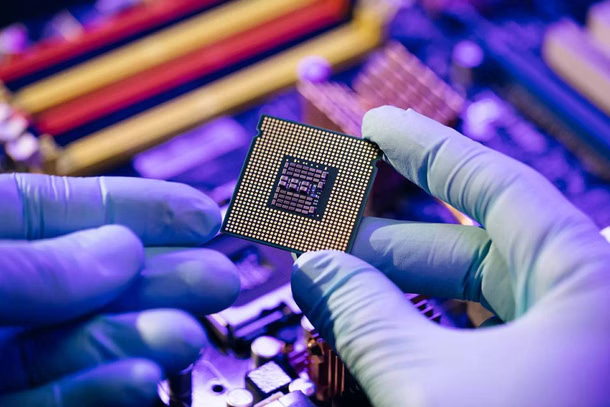
India’s semiconductor expansion is entering a more important phase as the country moves beyond chip policy announcements towards commercial production, new manufacturing projects and workforce development. The government’s Semicon 2.0 programme is designed to build capabilities across chip design, fabrication, packaging, equipment, materials, research and talent.
India’s Semiconductor Push Moves Into Production
India’s semiconductor industry has changed significantly over the past few years. The government launched the Semicon India Programme in 2021 with an overall outlay of ₹76,000 crore to develop semiconductor and display manufacturing capabilities. Since then, multiple projects have been approved across Gujarat, Assam, Uttar Pradesh, Odisha, Punjab and Andhra Pradesh. Press Information Bureau
The latest development is particularly important because the sector is no longer limited to planned investments. Five semiconductor manufacturing units among the approved projects had commenced commercial production by September 2026, according to the government. This marks a shift from building policy support and infrastructure towards actual manufacturing activity. Press Information Bureau
That transition matters for India because semiconductors are used across smartphones, automobiles, telecom equipment, defence systems, artificial intelligence infrastructure, data centres and industrial electronics.
A stronger domestic semiconductor base can therefore influence several industries at the same time.
Semicon 2.0 Expands India’s Chip Strategy
The next phase is being driven by Semicon 2.0, which was approved by the Union Cabinet in July 2026 with a total outlay of ₹1,27,500 crore. The programme is designed to expand the semiconductor ecosystem rather than focus only on individual manufacturing plants. Press Information Bureau
The strategy covers six broad areas: chip design, machines and materials, new fabrication facilities, advanced packaging, research and development, and talent development. Press Information Bureau
This wider approach is significant because a semiconductor industry cannot operate through fabs alone. Manufacturing requires specialised machinery, chemicals, materials, packaging, testing, precision engineering, logistics, software and highly trained workers.
The Union Budget 2026-27 had also announced India Semiconductor Mission 2.0, with ₹1,000 crore provided for FY 2026-27, alongside an increased ₹40,000 crore allocation for the Electronics Components Manufacturing Scheme. The objective is to strengthen the broader electronics and semiconductor supply chain inside India. Press Information Bureau
What Semiconductor Expansion Means for Jobs
The biggest employment impact will not necessarily come only from people working directly inside chip fabrication plants.
The semiconductor industry creates demand across a much wider network. Engineers are required for chip design, process engineering, equipment maintenance, testing and quality control. Technicians are needed for manufacturing and packaging facilities. There is also demand for specialists in automation, materials, industrial gases, clean-room operations, logistics and precision manufacturing.
In September, the government said Semicon 2.0 had already attracted around ₹1 lakh crore in investment commitments and could generate close to one lakh new employment opportunities across the ecosystem. It also announced plans to train one lakh technicians. Press Information Bureau
Earlier government estimates for individual projects also show how employment can spread beyond the factories themselves. The Micron facility in Gujarat, for example, was expected to create up to 5,000 direct and 15,000 indirect jobs over five years. Tata’s semiconductor packaging unit in Assam was expected to generate 15,000 direct and 11,000 to 13,000 indirect jobs. Press Information Bureau
This means the employment opportunity could extend to supporting businesses, contractors, transport operators, equipment suppliers and local service providers.
Tier-2 Cities Could Gain From Semiconductor Jobs
India’s semiconductor expansion could also change the geography of technology employment.
Semiconductor activity is being distributed across multiple states rather than concentrated entirely in traditional technology centres such as Bengaluru, Hyderabad, Pune and Chennai. Gujarat has emerged as a major manufacturing location, while projects are also being developed in Assam, Uttar Pradesh, Odisha, Punjab and Andhra Pradesh. Press Information Bureau
This creates opportunities for engineering graduates and technical workers outside the largest metropolitan areas.
The government said in August that students from Tier-II and Tier-III cities had already designed more than 250 semiconductor chips. It also reported that the target of developing 85,000 semiconductor engineers had been achieved in four years, against an original 10-year target. Press Information Bureau
For smaller cities, the long-term benefit could come from partnerships between colleges, semiconductor companies and training institutions. Local ecosystems can support internships, testing facilities, electronics suppliers and specialised manufacturing services without requiring every skilled worker to relocate to a major metro.
Chip Design Remains a Major Indian Strength
Manufacturing is receiving considerable attention, but chip design remains one of India’s strongest advantages.
India already has a large pool of engineers working in semiconductor design and research. Government data says India hosts about 7% of the world’s semiconductor-domain Global Capability Centres and employs nearly 20% of the global semiconductor chip design workforce. Press Information Bureau
The next challenge is to connect this design strength with domestic manufacturing.
Semicon 2.0 therefore places greater emphasis on Indian intellectual property, research, system design and semiconductor startups. The government has said 105 startups have begun developing chips, while 24 chip design projects have been approved with a combined value of about ₹900 crore. Press Information Bureau
If more Indian-designed chips can eventually move from research and prototyping into commercial products, the economic value could extend well beyond manufacturing.
Electronics Industry Could Become a Bigger Beneficiary
The semiconductor push is closely connected to India’s larger electronics manufacturing strategy.
Government data shows that electronics production increased from around ₹1.9 lakh crore in 2014-15 to approximately ₹12 lakh crore in 2024-25. The Electronics Components Manufacturing Scheme is intended to deepen this ecosystem by supporting components and materials such as printed circuit boards, capacitors, laminates and manufacturing equipment. Press Information Bureau
A stronger domestic chip supply could help Indian electronics manufacturers reduce dependence on imported components over time. It could also make India more attractive for companies looking to build regional supply chains.
However, semiconductor manufacturing is capital intensive and technically demanding. Building factories is only one part of the challenge. Maintaining high production yields, developing reliable suppliers, securing specialised talent and competing with established semiconductor hubs will determine how successful the industry becomes.
What India Needs to Get Right Next
India’s semiconductor opportunity is substantial, but the results will depend on execution.
The country needs a continuous pipeline of engineers and technicians, stronger industry-academia research, reliable power and water infrastructure, specialised materials and equipment suppliers, and efficient logistics.
Commercial production is an important milestone, but building a globally competitive semiconductor industry will take years. India will also need to move progressively towards higher-value areas such as advanced chip design, sophisticated packaging, semiconductor equipment and materials.
The government’s own shift from Semicon 1.0 to Semicon 2.0 reflects this challenge. The first phase focused heavily on establishing fabs and packaging facilities. The second phase is designed to connect those facilities with research, design, talent, machinery and materials. Press Information Bureau
India’s Chip Push Could Reshape Industrial Employment
India’s semiconductor expansion is therefore about more than producing chips domestically. It is an attempt to create an industrial ecosystem around one of the world’s most strategically important technologies.
For workers, the opportunity could mean new engineering and technical careers. For Tier-2 and Tier-3 cities, it could create pathways into advanced manufacturing without requiring every opportunity to be located in a major technology hub. For electronics companies, it could provide a stronger domestic supply chain.
The next test will be whether announced investments translate into sustained production, competitive products, skilled employment and globally integrated Indian companies.
If that happens, India’s semiconductor strategy could become an important part of the country’s next manufacturing and technology cycle.
Key Takeaways
- India has moved from semiconductor planning towards commercial production, with five approved manufacturing units operational by September 2026. Press Information Bureau
- Semicon 2.0 has a ₹1,27,500 crore outlay and covers design, fabs, advanced packaging, materials, machines, research and talent. Press Information Bureau
- The government expects close to one lakh new employment opportunities across the semiconductor ecosystem from emerging investment commitments. Press Information Bureau
- Tier-2 and Tier-3 cities could benefit through engineering education, chip design, technical training and manufacturing-linked employment. Press Information Bureau
FAQ
What is India Semiconductor Mission 2.0?
India Semiconductor Mission 2.0 is the next phase of India’s semiconductor development strategy. It focuses on chip design, semiconductor equipment and materials, new fabs, advanced packaging, research and talent development. The Cabinet approved Semicon 2.0 with an outlay of ₹1,27,500 crore in July 2026. Press Information Bureau
How many jobs could India’s semiconductor push create?
The government said in September 2026 that around ₹1 lakh crore in investment commitments had been received under Semicon 2.0 and close to one lakh new employment opportunities were expected across the ecosystem. Press Information Bureau
Which Indian states are attracting semiconductor projects?
Semiconductor projects have been approved across states including Gujarat, Assam, Uttar Pradesh, Odisha, Punjab and Andhra Pradesh. Gujarat has emerged as one of the biggest semiconductor manufacturing hubs, with several major projects concentrated around Dholera and Sanand. Press Information Bureau
Will semiconductor expansion create jobs outside major cities?
Yes. Semiconductor manufacturing requires engineers, technicians, equipment specialists, logistics workers and other supporting professionals. Government initiatives are also expanding semiconductor training and chip-design education beyond major technology centres, including Tier-II and Tier-III cities. Press Information Bureau








Leave a comment