

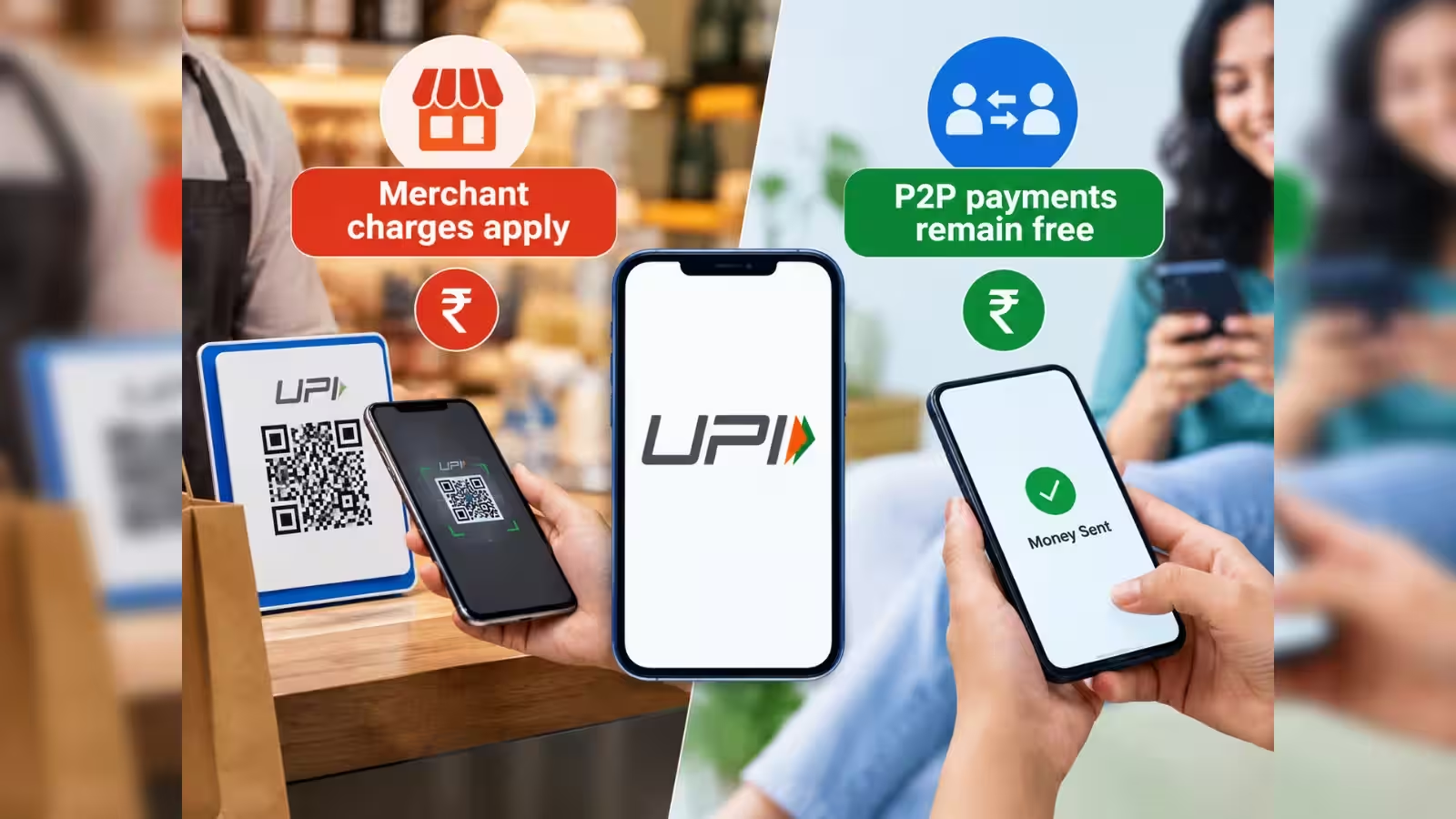
India is introducing a new Merchant Discount Rate on selected UPI merchant payments above ₹2,000 from October 15, 2026. While customers will continue using UPI without a direct transaction fee, the new framework could change payment costs for some merchants, including businesses serving Tier-2 and Tier-3 markets.
UPI charges above ₹2,000 begin from October 15
The new UPI charges above ₹2,000 are part of a revised Merchant Discount Rate, or MDR, framework announced by the National Payments Corporation of India (NPCI).
From October 15, eligible person-to-merchant, or P2M, UPI transactions above ₹2,000 will attract an MDR of 0.4%. The fee is paid within the payments ecosystem rather than being charged directly to the person making the payment.
The new framework does not mean that consumers will suddenly have to pay a UPI transaction fee. Person-to-person payments will remain free, while merchant payments up to ₹2,000 will also remain outside the MDR framework.
The MDR will also have an overall cap of ₹300 for transactions of ₹75,000 or more. This distinction is important because headlines about UPI charges could otherwise give consumers the impression that every payment above ₹2,000 will carry an additional cost for them.
How the new UPI MDR works for merchants
Merchant Discount Rate is a fee associated with processing digital payments. Until now, UPI has largely operated without MDR for merchants, unlike several card-based payment systems.
Under the new framework, a merchant receiving an eligible payment of more than ₹2,000 will have 0.4% applied to the transaction, subject to the applicable cap and exclusions.
For example, a ₹5,000 eligible UPI payment would attract an MDR of ₹20 before applicable taxes.
A ₹10,000 transaction would result in an MDR of ₹40.
For a ₹50,000 transaction, the MDR at 0.4% would work out to ₹200.
At ₹75,000, 0.4% equals ₹300, which is also the stated maximum cap for the MDR.
The actual accounting and collection of the charge will be handled through the payments ecosystem rather than requiring customers to make a separate payment at the shop.
Small merchants have a specific zero-MDR protection
The impact on small-town merchants depends heavily on how a business is classified.
NPCI’s framework provides mandatory zero MDR for merchants falling under the P2PM category. These generally include smaller merchants, street vendors and local businesses receiving less than ₹1 lakh per month through UPI, according to reporting on the NPCI framework.
This means the new MDR should not be treated as a blanket charge on every small shop accepting UPI.
For a neighbourhood grocery store, roadside vendor, small repair shop or local service provider that falls within the eligible P2PM classification, the zero-MDR provision is particularly relevant.
However, merchants should not assume that simply being a small physical shop automatically guarantees exemption. Their classification within the UPI ecosystem and the applicable transaction rules matter.
This distinction could become especially important in Tier-2 and Tier-3 cities, where many small businesses rely heavily on QR-code payments.
What it could mean for Tier-2 and Tier-3 businesses
Digital payments have become an important part of everyday commerce beyond India’s major metropolitan areas.
Small retailers, restaurants, clinics, educational businesses, repair services and local traders increasingly use QR codes because customers can pay instantly without carrying cash.
For businesses that regularly receive larger UPI payments, even a small percentage-based processing cost can become an operating expense.
Consider a local furniture shop receiving a ₹30,000 UPI payment. At 0.4%, the MDR would be ₹120 before GST. If such transactions become frequent, the cumulative cost could become noticeable for a business operating on relatively narrow margins.
At the same time, a shop receiving mostly ₹500, ₹1,000 or ₹1,500 payments would not face MDR on those transactions because P2M payments up to ₹2,000 remain outside the new charge.
This creates different implications for different businesses rather than a uniform impact across the small-town retail sector.
GST will apply to the MDR
The cost calculation also includes GST on the MDR.
According to reporting by The Economic Times, the 0.4% MDR will attract 18% GST from October 15. Registered merchants can claim input tax credit on the GST paid on these fees, subject to the applicable tax rules.
Using the ₹5,000 example, the MDR would be ₹20. The GST on that MDR would be ₹3.60, making the combined cost ₹23.60 for a merchant that bears both amounts.
The treatment of GST is particularly relevant for businesses that maintain formal accounts and are registered under GST, because eligible businesses may be able to claim input tax credit.
Smaller businesses outside the relevant GST framework will have different tax implications, so merchants should check their individual accounting position rather than applying one calculation to every business.
Consumers are not being charged directly
One of the biggest points of confusion around the new rules is whether customers will have to pay extra when they scan a QR code for a payment above ₹2,000.
The current framework says consumers will continue to transact through UPI without a direct transaction fee. P2P payments remain free, and P2M transactions up to ₹2,000 remain outside the MDR.
The government has also indicated that the MDR burden should not simply be passed on to consumers. Reports say discussions have been held with payment aggregators and other participants to sensitise them about ensuring that customers are not charged the new fee.
That means a merchant should not automatically add a separate UPI surcharge to a customer’s bill simply because the transaction exceeds ₹2,000.
The practical implementation and merchant communication around the new framework will therefore be important once the rules take effect.
Some sectors will have a different MDR
Not every eligible transaction above ₹2,000 will use the standard 0.4% MDR.
Specific merchant categories, including railways, telecom services, insurance and fuel, have been assigned a flat concessional MDR of ₹5 for transactions above ₹2,000, according to reports on the NPCI framework.
This distinction matters for businesses where high-value digital payments are common.
Fuel stations, for example, can process many payments above ₹2,000. Petrol dealer associations in Gujarat have already raised concerns about the proposed MDR because fuel dealers operate with regulated margins.
The response from different industries could therefore shape how the new framework develops in practice.
Could merchants encourage cash payments?
The introduction of MDR has already triggered debate among traders about payment preferences.
The Global Trade Research Initiative has warned that the new fee could encourage some small merchants and price-sensitive customers to move back towards cash. Delhi traders have also discussed encouraging cash payments to avoid additional UPI transaction costs. These are stakeholder reactions, not evidence that consumers nationally are shifting away from UPI.
For Tier-2 and Tier-3 markets, the outcome could depend on the type of business.
A local retailer receiving mostly small-value payments may see little direct impact because transactions up to ₹2,000 remain outside MDR. A business selling higher-value goods or services through UPI could have a stronger reason to examine its payment costs.
The availability of cash, customer preferences and competition among local businesses will also influence how merchants respond.
Why UPI is introducing MDR now
The policy change comes as UPI has become a major part of India’s digital payments infrastructure.
The new MDR framework is intended to create a commercial revenue stream within the payments ecosystem and support the costs associated with maintaining and expanding payment infrastructure, innovation and cybersecurity.
The government has maintained that the framework is not designed to make ordinary consumers pay for UPI.
For merchants, however, October 15 marks a significant change because selected higher-value transactions will no longer operate under the previous zero-MDR structure.
The practical impact will become clearer as payment providers, banks and merchants begin implementing the new system.
What small-town merchants should check before October 15
Merchants should first determine how their business is classified within the UPI ecosystem and whether they qualify for the P2PM zero-MDR framework.
They should also review their average UPI transaction value rather than simply counting the number of payments they receive. A shop receiving hundreds of small payments below ₹2,000 will have a different exposure from a business receiving frequent payments of ₹10,000 or ₹20,000.
Businesses registered for GST should also understand how GST on MDR will be recorded and whether input tax credit is available in their circumstances.
Most importantly, merchants should wait for communication from their acquiring bank, payment service provider or payment aggregator about how the MDR will appear in settlement statements.
For small-town businesses, understanding the classification and actual settlement deductions will be more useful than assuming that every UPI payment above ₹2,000 will attract the same cost.
Key Takeaways
- Eligible UPI merchant payments above ₹2,000 will attract a 0.4% MDR from October 15, 2026, subject to the applicable cap and exclusions.
- Consumers will not be directly charged for making UPI payments, while P2P payments and P2M payments up to ₹2,000 remain free.
- Eligible small merchants under the P2PM category, generally those receiving less than ₹1 lakh per month through UPI, have mandatory zero-MDR protection.
- The MDR attracts 18% GST, while eligible registered merchants may claim input tax credit according to applicable tax rules.
FAQs
Will customers be charged for UPI payments above ₹2,000?
No direct UPI transaction fee is being imposed on consumers under the new framework. The MDR applies to specified merchant transactions, while person-to-person payments remain free.
Do small shopkeepers have to pay the new UPI charge?
Not necessarily. Merchants classified under the P2PM category, generally including eligible small businesses receiving less than ₹1 lakh per month through UPI, are covered by mandatory zero MDR.
How much is the new UPI MDR?
The standard MDR for eligible P2M transactions above ₹2,000 is 0.4%, with a maximum MDR of ₹300 for transactions of ₹75,000 or more. Certain specified sectors have a separate flat ₹5 MDR.
When will the new UPI charges start?
The new MDR framework for eligible transactions is scheduled to take effect from October 15, 2026.







Leave a comment