

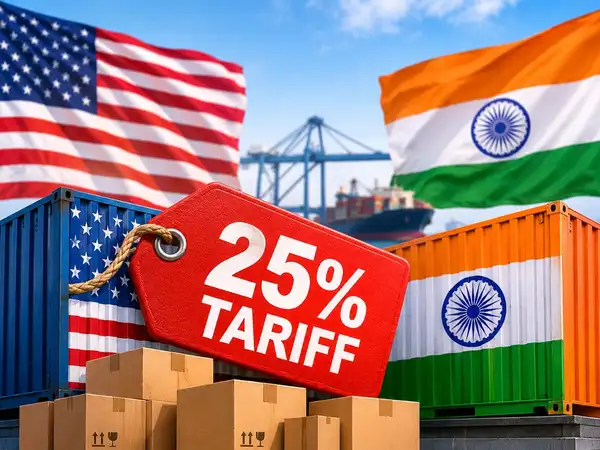
The United States has proposed tariffs of up to 25% on Indian goods, with a possible reduction to 17% if both countries conclude a trade agreement. The development creates fresh uncertainty for Indian exporters across textiles, jewellery, seafood, solar products and manufacturing.
US Tariff Proposal 2026: What Has Washington Announced?
The latest US tariff proposal could create fresh challenges for Indian exporters doing business in America’s large consumer market. On November 25, 2026, the Office of the United States Trade Representative (USTR) proposed tariffs of up to 25% on Indian goods following an investigation into structural excess industrial capacity and manufacturing practices.
The proposal also includes a possible reduction to 17% if India and the United States reach a reciprocal trade agreement that addresses the concerns raised in the investigation.
The announcement covers India and several other trading partners as part of Washington’s broader examination of manufacturing capacity, production policies and market access.
The development comes at a time when New Delhi and Washington are negotiating a Bilateral Trade Agreement (BTA). The proposed tariff structure adds another issue to discussions that already involve market access, industrial policies and trade competitiveness.
However, exporters should understand one important distinction: the 25% tariff is a proposal, not a duty that has already come into effect.
Why Has the US Proposed Fresh Tariffs on India?
The proposed measures follow investigations conducted under Section 301 of the US Trade Act of 1974.
Section 301 allows the United States to investigate foreign government policies and practices that it considers unreasonable or discriminatory and that burden or restrict American commerce.
In its findings, the USTR raised concerns about India’s industrial policies, manufacturing capacity, labour protections, financial practices and market access barriers.
The investigation also examined the role of government-backed industrial programmes, including Make in India and Production Linked Incentive (PLI) schemes.
According to Washington, certain manufacturing policies contribute to structural excess capacity and create competitive pressures for American producers.
India has disputed this assessment.
The Ministry of Commerce and Industry has stated that India does not have structural excess capacity in any sector. It has also maintained that trade-related concerns should be addressed through the ongoing bilateral trade negotiations rather than treated separately.
The disagreement highlights the different approaches both countries have towards industrial development, domestic manufacturing and international trade.
Will Indian Exporters Actually Pay 25% More?
The proposed 25% rate does not mean that every Indian product entering the US will automatically face an additional 25% duty on top of all existing tariffs.
The USTR proposal specifies that the proposed Section 301 tariff would operate net of existing Section 301 tariffs, with exemptions for certain products.
A senior US trade official has also indicated that importers would pay the higher applicable rate rather than simply adding the proposed duty to the existing forced-labour-related tariff.
For many Indian goods currently subject to an additional 10% Section 301 duty under the separate forced-labour investigation, the proposed 17% rate would represent a seven-percentage-point increase, while the 25% rate would represent a 15-percentage-point increase.
The actual impact would depend on the product’s tariff classification, applicable exemptions and other existing US duties.
Some products already covered by separate national-security tariffs under Section 232 are excluded from the proposed measure.
Therefore, exporters need to examine product-specific tariff classifications instead of assuming that every shipment will face the same increase.
Which Indian Export Sectors Could Face the Biggest Impact?
The proposed tariffs could affect several Indian industries that depend on the American market.
According to the exemption list and reporting on the USTR proposal, some major Indian export categories remain exposed.
1. Textiles and Apparel
India’s textile and garment industry could face additional pressure if the proposed tariffs are implemented.
Indian manufacturers supply clothing, home textiles, fabrics and other products to American retailers and importers.
Higher import duties could make these products more expensive for US buyers. American importers may respond by negotiating lower purchase prices, reducing orders or exploring alternative suppliers.
This could affect textile manufacturing clusters in cities such as Tiruppur, Surat and Ludhiana, where businesses depend on domestic and international demand.
The USTR is also seeking views on a possible mechanism that would allow certain volumes of textile and apparel imports at reduced tariff rates.
2. Gems and Jewellery
India is an important global centre for diamond cutting, polishing and jewellery manufacturing.
The US is a significant destination for Indian jewellery exports. Higher tariffs could increase the landed cost of products and create pressure on exporters operating with limited profit margins.
Businesses in Surat and Mumbai could face greater uncertainty if American buyers reconsider their sourcing arrangements.
3. Seafood and Shrimp Exports
India’s seafood industry, particularly shrimp exporters, has a significant presence in the US market.
The proposed tariff increase could make Indian seafood less competitive against supplies from countries facing different tariff rates.
Exporters may need to negotiate prices with American buyers or explore additional markets to reduce dependence on a single destination.
4. Solar Modules and Renewable Energy Products
Solar manufacturing is another area highlighted in the US investigation.
India has been expanding domestic solar manufacturing capacity through industrial policies and incentives. However, higher import duties in the American market could create difficulties for manufacturers seeking to increase exports.
The development also raises questions about how international trade policies may influence India’s renewable energy manufacturing ambitions.
5. Engineering and Medical Devices
Engineering products and medical devices could also face challenges depending on their tariff classification and exemption status.
While certain products, including patented pharmaceutical articles and specified semiconductor goods, are exempt under the proposal, medical devices are not covered by a blanket exemption.
Manufacturers will therefore need to examine the detailed product annex before assessing their exposure.
Which Products Are Exempt From the Proposed Tariffs?
The USTR’s proposal includes exemptions for certain products already covered by other US tariff measures.
These include specified steel, aluminium and copper articles, passenger vehicles and their parts, medium and heavy-duty vehicles, wood products, patented pharmaceutical articles and semiconductor articles.
Informational materials, donations and accompanied baggage are also included among the exemptions.
These exclusions are important because India’s exports to the US cover a wide range of industries with different tariff arrangements.
For example, an exporter of a patented pharmaceutical product may be treated differently from a manufacturer exporting garments or jewellery.
The exemption list also means that the proposed 25% rate should not be interpreted as a uniform additional charge across all Indian exports.
Businesses must review the official USTR annex and their individual product classifications before calculating potential costs.
Why the 17% Tariff Option Matters for India
The possibility of a 17% tariff following a trade agreement is an important part of the latest announcement.
The lower proposed rate could improve India’s relative position against some competing Asian exporters.
According to reporting on the USTR proposal, countries such as Bangladesh, Cambodia, Indonesia, Malaysia and Thailand face proposed rates of around 18% under their respective arrangements, while Vietnam faces a higher proposed rate.
A 17% rate could therefore provide Indian exporters with a modest tariff advantage in certain product categories.
However, the difference of one percentage point against several competitors may not be sufficient by itself to determine sourcing decisions.
American buyers also consider manufacturing costs, delivery schedules, product quality, reliability, supply-chain capacity and long-term commercial agreements.
For India, the trade negotiations could therefore influence not only tariff costs but also the future competitiveness of its manufacturing and export industries.
India’s Response: Bilateral Trade Negotiations Remain Central
The Indian government has said that it is examining the latest USTR notice.
The Ministry of Commerce and Industry has reiterated that India and the United States are engaged in negotiations for a Bilateral Trade Agreement.
New Delhi has also rejected the US assessment that India has structural excess capacity in its manufacturing sectors.
India’s position is that domestic industrial initiatives, including Make in India and PLI programmes, are intended to strengthen manufacturing capabilities and reduce critical supply-chain dependencies.
The government has indicated that it remains committed to working towards an early conclusion of the bilateral trade agreement.
For Indian exporters, the outcome of these negotiations will be important because tariff arrangements can influence pricing, investment decisions and long-term supply contracts.
What Happens Next? Important Dates for Indian Businesses
The proposed tariff measures will go through a consultation and review process before any final action is determined.
The USTR has invited written comments and requests to appear at the public hearings. The current schedule includes two important dates:
- January 5, 2027: Deadline for submitting written comments and requests to appear at the hearings.
- January 25, 2027: Public hearings are scheduled to begin at the US International Trade Commission in Washington.
Following the consultation process, the USTR will consider the submissions before deciding on further action.
This means Indian exporters still have an opportunity to assess the proposal and communicate concerns through relevant industry associations and government channels.
Businesses should also review their dependence on the US market, understand the tariff classifications of their products and evaluate alternative export destinations.
For smaller manufacturers, particularly those operating in Tier-2 and Tier-3 industrial centres, early preparation could help reduce uncertainty if the proposed measures are eventually implemented.
What the US Tariff Proposal Means for India’s Export Future
The proposed 25% tariff has introduced another layer of uncertainty into India-US trade relations.
For Indian exporters, the immediate concern is not only the potential increase in import duties but also the possibility of losing price competitiveness against suppliers from other countries.
Labour-intensive industries such as textiles, apparel, jewellery and seafood could face particular pressure if higher duties are implemented.
At the same time, the proposed 17% rate linked to a bilateral agreement offers a possible route towards a more favourable tariff arrangement.
The final outcome will depend on the consultation process and the progress of trade negotiations between the two countries.
For India, the challenge will be to protect export competitiveness while continuing to expand domestic manufacturing and strengthen its position in global supply chains.
Key Takeaways
- The US proposed tariffs of up to 25% on Indian goods on November 25, 2026, following a Section 301 investigation.
- The proposed rate could fall to 17% if India and the US conclude a reciprocal trade agreement addressing Washington’s concerns.
- Textiles, jewellery, seafood, solar products and several engineering goods could face exposure, depending on product classifications and exemptions.
- The proposal is not yet final. Written comments are due by January 5, 2027, with public hearings scheduled to begin on January 25, 2027.
Frequently Asked Questions (FAQs)
1. Why has the US proposed a 25% tariff on Indian goods in 2026?
The US Trade Representative proposed tariffs of up to 25% following a Section 301 investigation into structural excess industrial capacity and manufacturing practices. Washington has raised concerns about India’s industrial policies, labour protections and market access barriers.
2. Can the proposed US tariff on India be reduced to 17%?
Yes. The USTR has proposed considering a 17% tariff rate if India reaches a reciprocal trade agreement with the US that addresses the findings of its investigation. This reduction is conditional and has not yet been implemented.
3. Which Indian industries could be affected by the proposed tariffs?
Textiles, apparel, gems and jewellery, seafood, solar products, medical devices and several engineering goods could be exposed. The actual impact will depend on product classifications and the exemptions included in the proposal.
4. When will the proposed US tariffs on Indian goods come into effect?
The proposal has not yet become a final tariff measure. The USTR has invited written comments until January 5, 2027, and public hearings are scheduled to begin on January 25, 2027. The final implementation timeline will depend on the outcome of the review process.
(Internal Keywords: US tariffs on India 2026, 25% US tariff proposal, India US trade relations, Indian exporters, US India trade agreement, 17% US tariff on India, Section 301 investigation, Indian textile exports, Indian jewellery exports, India seafood exports, US trade policy, Make in India, Production Linked Incentive scheme, India export market, bilateral trade agreement 2026)












Leave a comment