

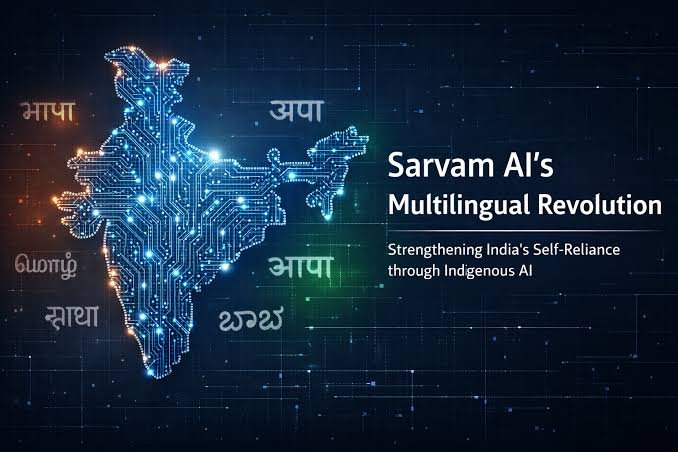
Sarvam AI is developing speech recognition and voice-generation models designed around Indian languages, accents and everyday conversations. Its technology highlights how multilingual voice interfaces could expand access to AI across India, although accuracy, dialect diversity and affordability remain important challenges.
Article Type: Evergreen Technology Analysis
Why Indian Languages Matter in the AI Revolution
Artificial intelligence is often designed around English, but that approach does not reflect how millions of Indians communicate every day. People use Hindi, Marathi, Tamil, Bengali, Telugu and dozens of other languages, frequently mixing English words into everyday conversations. Sarvam AI is attempting to address this gap through multilingual voice technology developed specifically for Indian language requirements.
The opportunity is significant. According to the Internet and Mobile Association of India (IAMAI) and Kantar’s Internet in India report for 2024, approximately 870 million internet users accessed the internet in Indic languages. The report also found that 57% of urban internet users preferred accessing online content in Indic languages.
These figures highlight why language support is not simply an additional feature for AI companies. It can determine whether people feel comfortable using digital services at all. Voice-based systems could make technology easier to access for users who prefer speaking over typing or are less comfortable navigating English-language interfaces.
What Is Sarvam AI Building for Indian Languages?
Sarvam AI is an Indian artificial intelligence company developing language models, speech recognition systems, translation technology and text-to-speech solutions. Its approach focuses on the linguistic patterns found in Indian conversations rather than treating Indian languages as secondary additions to English-first AI systems.
Its speech technology includes two important model families: Saaras and Bulbul.
Saaras is designed for automatic speech recognition, which means converting spoken words into text. Bulbul performs the opposite task by converting written text into spoken audio. Together, these capabilities can form the foundation of voice assistants, automated customer support systems, transcription tools and multilingual applications.
Sarvam’s documentation lists Saaras V4 as supporting 22 Indian languages and English for speech recognition. Its Bulbul text-to-speech family supports 11 languages, including 10 Indian languages and English. These figures demonstrate the growing scope of the company’s language technology, although speech recognition and voice generation do not have identical language coverage.
Saaras V4: Understanding How Indians Actually Speak
One of the important developments in Sarvam AI’s speech technology is Saaras V4, introduced in September 2026.
The model is designed to recognise speech across India’s scheduled languages while handling practical challenges such as background noise, different accents and code-mixed conversations. This matters because people rarely speak in perfectly structured sentences.
A person may ask a question in Hindi but include English terms related to banking, technology or business. Someone else may switch between Marathi and English within the same sentence. Traditional speech recognition systems can struggle when language patterns change frequently.
Saaras V4 offers five output formats: transcription in the original language, English translation, verbatim transcription, Roman-script transliteration and code-mixed text. These options allow developers to select the format required by their applications.
Sarvam has reported a 5.22% language-identification error rate across 22 Indian languages using its verified IndicVoices data, with the figure falling to 2.9% across the 10 most widely spoken languages. The company has also reported strong benchmark results for speech recognition.
These are company-reported evaluations, not a guarantee that the system will perform equally well in every regional setting. Real-world performance still needs to be assessed across different speakers, dialects and recording conditions.
Bulbul: Giving AI a Natural Indian Voice
Speech recognition is only one part of a voice-based AI experience. Users also need systems that can respond in a language and voice they understand.
Sarvam’s Bulbul models are designed to convert text into natural-sounding speech. The technology supports languages such as Hindi, Bengali, Gujarati, Kannada, Malayalam, Marathi, Odia, Punjabi, Tamil and Telugu, alongside Indian English.
The newer Bulbul V4 Flash model offers more than 200 persona voices, according to Sarvam’s API documentation. Its features include natural speech delivery and the ability to handle code-mixed text. Developers can also control elements such as speaking pace and pitch.
This could be useful for applications that need to communicate with customers in regional languages. A bank could use voice technology to explain account services, while an education platform could convert written lessons into audio. News publishers and content creators could also explore regional-language narration and audio formats.
However, natural-sounding speech does not automatically mean perfect pronunciation. Regional names, local expressions, technical terms and differences in speaking styles still require careful testing.
How Multilingual Voice AI Could Change Everyday Services
The practical value of Indian-language AI will depend on how effectively it can be used outside technology demonstrations.
Banking and financial services: Voice-based systems could help customers check account information, understand basic banking procedures and access support in their preferred languages. This may be particularly useful for people who find text-heavy digital interfaces difficult to navigate.
Healthcare communication: Hospitals and health platforms could use speech recognition to transcribe conversations, support multilingual information services and make basic instructions more accessible. Such applications would require strong safeguards because errors in medical communication can have serious consequences.
Education: Students could interact with learning platforms through spoken questions, while teachers could use transcription and translation tools to prepare multilingual learning material. Text-to-speech technology may also support students who prefer audio-based learning.
Agriculture: Farmers could potentially access information about weather, crop management and government services through voice interfaces in regional languages. The usefulness of these systems would depend on reliable local information and accurate recognition of agricultural terminology.
Government services: Citizens could use multilingual voice assistants to understand application procedures, access public information and navigate digital services without depending entirely on English-language instructions.
These possibilities are consistent with the wider direction of India’s digital language ecosystem. The government’s BHASHINI initiative has been building language technology infrastructure for translation, speech recognition and text-to-speech applications.
Why Tier-2 and Rural India Could Benefit
The growth of voice AI could have particular relevance for Tier-2 cities, smaller towns and rural communities.
Many people use smartphones and digital payment services without necessarily being comfortable with long written instructions or English-language applications. A voice interface in Marathi, Hindi, Gujarati, Bengali or another familiar language could reduce some of these barriers.
For example, a small business owner in Nagpur could use a voice assistant to draft customer messages or understand business information. A shopkeeper in a smaller town could interact with a digital service by speaking rather than typing. Students could ask questions in their preferred language and receive spoken explanations.
These examples illustrate potential applications rather than confirmed outcomes. Actual adoption will depend on whether the technology works reliably with local accents, familiar expressions and everyday vocabulary.
The Challenges: Dialects, Accuracy and Language Representation
India’s linguistic diversity makes multilingual AI development difficult. Supporting a language at a technical level does not mean understanding every dialect, regional expression or community-specific way of speaking.
For instance, Marathi spoken in Vidarbha may differ in vocabulary and pronunciation from Marathi used in other parts of Maharashtra. Similar differences exist across Hindi, Bengali, Tamil and other languages.
Speech systems also need to work in noisy environments, including crowded markets, public transport, farms and workplaces. Poor network connectivity can create additional problems for applications that depend on cloud-based processing.
A February 2026 report by Digital Futures Lab on responsible voice technology in India highlighted challenges involving language data collection, infrastructure, common data standards, privacy and intellectual property. It also recommended making foundational language datasets more accessible and strengthening independent evaluation.
This is an important consideration. AI models need diverse, representative speech data to understand how people actually communicate. Without sufficient data from smaller language communities and regional dialects, some speakers may receive less accurate results than others.
Privacy and Responsible Use of Voice Technology
Voice AI also raises questions about how recordings are collected, stored and processed. Speech can contain personal information, financial details, health-related conversations and other sensitive data.
Businesses adopting voice assistants will need clear policies on user consent, data retention, access controls and security. Users should understand when their speech is being recorded and how it may be used.
Another concern is the possibility of misuse through synthetic voices and voice cloning. While these technologies can support accessibility, dubbing and content creation, they can also be misused for impersonation and fraud.
Responsible deployment will therefore require safeguards alongside improvements in speech quality.
Can Indian Languages Shape the Future of AI?
Sarvam AI’s multilingual voice technology reflects a broader shift in how artificial intelligence is being developed for India. Instead of expecting users to adapt to English-first systems, companies are exploring models that can work with the languages people already use.
The progress of Saaras and Bulbul shows that Indian-language speech recognition and voice generation are becoming more capable. The wider development of BHASHINI and other language technology initiatives also indicates that multilingual AI is gaining importance across the country’s digital ecosystem.
However, long-term success will depend on more than the number of supported languages or available voices. Accuracy across dialects, reliable performance in everyday environments, affordable access and responsible data practices will determine whether these tools become genuinely useful.
If these challenges are addressed, Indian languages could become a central part of how people interact with artificial intelligence. The future of AI in India may not be limited to typing questions into a chatbot. It could increasingly involve speaking naturally in the language people know best.
Key Takeaways
- Sarvam AI is developing Indian-language speech recognition and text-to-speech models through its Saaras and Bulbul technology families.
- Saaras V4 supports speech recognition across 22 Indian languages and English, while Bulbul supports text-to-speech in 11 languages.
- Voice AI could expand access to digital services across banking, education, healthcare, agriculture and government platforms.
- Dialect recognition, speech accuracy, data privacy and affordable access remain important challenges for wider adoption.
Frequently Asked Questions
1. What is Sarvam AI’s multilingual voice technology?
Sarvam AI’s multilingual voice technology includes systems that convert spoken Indian languages into text and written text into speech. Its Saaras models handle speech recognition, while Bulbul models generate spoken audio.
2. How many Indian languages does Sarvam AI support?
Sarvam’s Saaras V4 supports speech recognition across 22 Indian languages and English. Its Bulbul text-to-speech family supports 10 Indian languages and English. Language coverage varies depending on the model and capability.
3. How can voice AI help people in smaller Indian cities?
Voice AI could help users access digital services, educational content, customer support and public information in familiar languages. It may be particularly useful for people who prefer speaking rather than typing or navigating English-language interfaces.
4. What are the main challenges facing Indian-language voice AI?
Major challenges include recognising regional dialects, handling code-mixed conversations, maintaining accuracy in noisy environments, collecting representative language data and protecting users’ voice recordings.








Leave a comment