

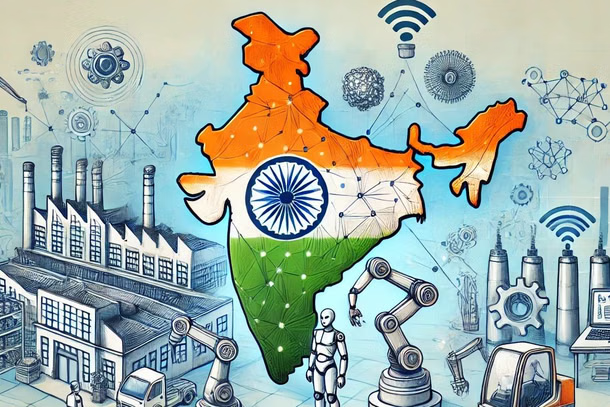
India’s manufacturing sector continues to attract fresh investments as central and state governments compete to build industrial ecosystems. Improved infrastructure, production-linked incentives, and investor-friendly policies are driving manufacturing growth across several states, creating jobs and strengthening India’s position as a global production hub.
India’s manufacturing push has become a major driver of economic growth as both domestic and international companies expand their presence across multiple states. This is an evergreen topic supported by ongoing investment announcements and industrial policy developments rather than a single breaking news event. Recent years have seen sustained investments across sectors such as electronics, semiconductors, automobiles, renewable energy, pharmaceuticals, and textiles, with several states emerging as preferred destinations for new manufacturing projects.
Why India Is Becoming a Preferred Manufacturing Destination
India’s manufacturing ambitions have gained momentum through initiatives such as Make in India, the Production Linked Incentive (PLI) scheme, PM Gati Shakti, and investments in industrial corridors. These initiatives aim to strengthen domestic production, reduce import dependence, improve exports, and generate employment.
Global companies are also looking to diversify their manufacturing operations beyond traditional production bases. India’s large domestic market, skilled workforce, expanding infrastructure, and improving ease of doing business make it an attractive destination for long-term industrial investments.
States are playing a critical role by offering competitive industrial policies, faster approvals, land availability, tax incentives, and infrastructure support. As a result, manufacturing investment is no longer concentrated in a few metro regions but is spreading across emerging industrial clusters.
Gujarat Continues to Lead Large Industrial Investments
Gujarat remains one of India’s strongest manufacturing destinations due to its well-developed industrial ecosystem and business-friendly policies.
The state has attracted major investments in chemicals, petrochemicals, automobiles, renewable energy, engineering goods, and semiconductor manufacturing. Industrial regions such as Sanand, Dholera, Hazira, and Dahej continue to witness expansion from both Indian and multinational companies.
The development of the Dholera Special Investment Region and ongoing investments in semiconductor manufacturing have further strengthened Gujarat’s position in India’s industrial landscape.
Strong port connectivity, reliable power supply, and efficient logistics continue to make Gujarat attractive for export-oriented manufacturing.
Tamil Nadu Strengthens Its Electronics and Auto Manufacturing Base
Tamil Nadu has established itself as one of India’s leading manufacturing states, particularly in automobiles, electronics, aerospace, and renewable energy.
The state hosts production facilities for several global automobile manufacturers and has become an important electronics manufacturing hub through investments in mobile phones, consumer electronics, and electronic components.
Cities such as Chennai, Hosur, Coimbatore, Tiruchirappalli, and Sriperumbudur continue attracting investments due to their skilled workforce and established supplier networks.
Tamil Nadu’s industrial ecosystem also benefits from engineering talent, technical institutions, and strong export infrastructure.
Uttar Pradesh Emerges as a Major Electronics Hub
Uttar Pradesh has significantly expanded its manufacturing footprint over the past few years.
The state has attracted substantial investments in electronics manufacturing, mobile phone assembly, data centers, defense production, and food processing. Noida and Greater Noida have evolved into major electronics manufacturing clusters, supplying products for both domestic and export markets.
The Uttar Pradesh Defence Industrial Corridor has also encouraged investment in aerospace and defense manufacturing across cities including Lucknow, Kanpur, Aligarh, Jhansi, Agra, and Chitrakoot.
Improved expressways, industrial parks, and logistics infrastructure have increased investor confidence across the state.
Maharashtra, Karnataka and Telangana Continue to Expand
Maharashtra remains one of India’s largest industrial economies with strengths in automobiles, pharmaceuticals, engineering, electric vehicles, and advanced manufacturing.
Industrial centers such as Pune, Aurangabad, Nagpur, Nashik, and Chhatrapati Sambhajinagar continue attracting investments due to established supplier networks and transport connectivity.
Karnataka has strengthened its manufacturing presence through aerospace, electronics, electric vehicles, biotechnology, and precision engineering. Bengaluru remains an innovation hub while cities like Mysuru, Hubballi, Dharwad, and Belagavi are seeing industrial expansion.
Telangana has attracted investments in pharmaceuticals, life sciences, medical devices, electronics, and clean energy. Hyderabad continues to serve as the state’s industrial and technology backbone while nearby manufacturing clusters continue expanding.
Emerging States Are Gaining Investor Attention
Several emerging states are becoming attractive alternatives for manufacturers seeking lower operational costs and growing infrastructure.
Odisha continues attracting investments in steel, aluminum, mining, and green energy projects.
Andhra Pradesh is expanding its manufacturing base through electronics, ports, food processing, and renewable energy investments.
Rajasthan is witnessing growth in solar equipment, cement, engineering products, and mining-based industries.
Madhya Pradesh has improved its position by promoting automobile manufacturing, textiles, food processing, and logistics. States such as Haryana, Punjab, and Chhattisgarh also continue receiving investments across multiple industrial sectors.
This wider geographic distribution reflects India’s strategy of promoting balanced regional industrial development.
Infrastructure and Policy Remain Key Investment Drivers
Infrastructure development remains one of the strongest factors influencing manufacturing investment decisions.
Dedicated Freight Corridors, industrial parks, multimodal logistics hubs, expanded highway networks, modern ports, and airport connectivity have reduced transportation costs for businesses.
Government initiatives under PM Gati Shakti aim to integrate transport infrastructure across railways, roads, ports, and logistics systems, improving supply chain efficiency nationwide.
At the same time, digital governance, faster environmental clearances, online approval systems, and investor facilitation cells have improved the ease of establishing manufacturing facilities.
Companies increasingly evaluate both infrastructure quality and policy stability before selecting investment destinations.
What Lies Ahead for India’s Manufacturing Growth
India’s manufacturing sector is entering a phase of broader geographic expansion. Rather than relying only on traditional industrial cities, investment is increasingly flowing into new manufacturing clusters across multiple states.
Electronics, semiconductors, renewable energy, electric vehicles, pharmaceuticals, defense manufacturing, and advanced engineering are expected to remain major investment drivers over the coming years.
Success will depend not only on attracting fresh capital but also on developing skilled workers, strengthening local supply chains, maintaining policy consistency, and investing in sustainable infrastructure.
If current momentum continues, India’s manufacturing ecosystem could play an even larger role in economic growth, exports, employment generation, and global supply chain diversification.
Key Takeaways
- Gujarat, Tamil Nadu, Uttar Pradesh, Maharashtra, Karnataka, and Telangana continue attracting significant manufacturing investments.
- Government initiatives such as Make in India, PLI schemes, and PM Gati Shakti are encouraging industrial expansion.
- Electronics, automobiles, semiconductors, renewable energy, pharmaceuticals, and defense manufacturing remain high-growth sectors.
- Better infrastructure and state-level industrial policies are driving investment beyond traditional metro cities.
Frequently Asked Questions
Q1. Which Indian states are attracting the highest manufacturing investments?
Gujarat, Tamil Nadu, Uttar Pradesh, Maharashtra, Karnataka, Telangana, Andhra Pradesh, Odisha, Rajasthan, and Madhya Pradesh are among the leading destinations for new manufacturing investments.
Q2. Why are companies investing more in India’s manufacturing sector?
Companies are attracted by India’s large market, government incentives, improving infrastructure, skilled workforce, and efforts to strengthen domestic manufacturing under initiatives like Make in India and the PLI scheme.
Q3. Which sectors are receiving the most manufacturing investments?
Electronics, semiconductors, electric vehicles, renewable energy, pharmaceuticals, automobiles, defense manufacturing, engineering, and food processing are among the fastest-growing sectors.
Q4. How do manufacturing investments benefit individual states?
They create employment opportunities, improve infrastructure, strengthen local businesses, increase exports, and contribute to long-term regional economic development.










Leave a comment