

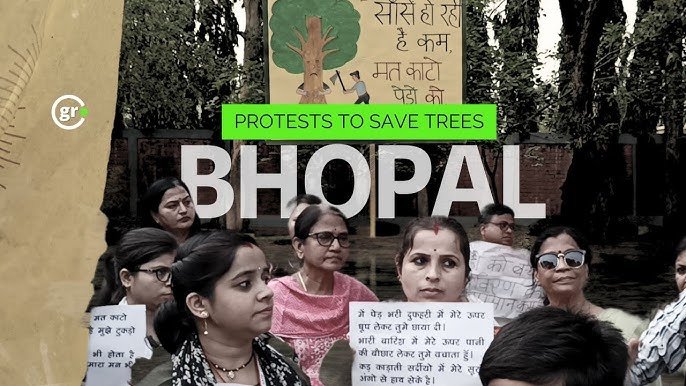
NSUI protests in Bhopal over cutting 8,000 trees for road widening have brought environmental concerns into sharp political focus in Madhya Pradesh’s capital. The demonstrations highlight growing public unease over urban development projects that prioritize infrastructure expansion over ecological balance.
The NSUI protests in Bhopal are a time sensitive news event, unfolding amid ongoing road widening plans that involve large scale tree removal. With student activists mobilising on environmental grounds, the issue has triggered debate around development planning, public consultation and sustainable urban growth.
Bhopal has witnessed multiple protest gatherings led by the National Students’ Union of India opposing the proposed felling of nearly 8,000 mature trees for a major road expansion project. Protesters argue that the move threatens the city’s green cover and contradicts long standing claims of Bhopal being among India’s greener urban centres. The demonstrations have drawn participation from students, environmental groups and local residents concerned about rising pollution and shrinking open spaces.
Why the road widening project sparked opposition
The road widening project at the centre of the NSUI protests in Bhopal aims to ease traffic congestion along key city corridors. Authorities have cited increasing vehicle numbers and infrastructure pressure as justification for the expansion. However, critics argue that the planning process underestimated environmental costs and failed to explore alternatives that could preserve existing trees.
Many of the trees marked for removal are decades old and provide shade, temperature regulation and air quality benefits. Environmental activists point out that such mature trees cannot be easily replaced through compensatory plantation, as saplings take years to deliver comparable ecological value. The scale of the proposed felling has intensified public scrutiny and raised questions about urban planning priorities.
NSUI leaders claim that students were not consulted despite the project affecting college areas and daily commuter routes. This perceived exclusion has added fuel to the protests.
Student politics and environmental activism intersect
The NSUI protests in Bhopal reflect a broader trend where student organisations increasingly engage with environmental issues. Rather than framing the agitation purely as opposition to the government, NSUI has positioned the protests as a civic responsibility to protect urban ecology.
Demonstrators have used slogans, placards and social media campaigns to draw attention to the environmental consequences of unchecked development. The messaging focuses on climate resilience, rising urban temperatures and the long term health impact of reducing green cover. By anchoring the protests in environmental language, NSUI has attempted to broaden appeal beyond traditional student politics.
This approach has resonated with sections of the public who may not align politically with the organisation but share concerns about air quality and livability in Bhopal.
Administrative response and official position
Authorities have responded by defending the road widening plan as essential for future mobility needs. Officials argue that congestion leads to higher vehicle emissions and that improved road infrastructure can reduce idling time and fuel consumption. They have also assured that compensatory tree plantation will be undertaken in designated zones.
However, critics remain sceptical of such assurances, citing past experiences where plantation drives failed to offset tree loss effectively. Questions have been raised about the survival rate of newly planted saplings and the availability of land for meaningful green replacement.
The administration has urged protesters to engage through formal channels, but student groups insist that visible public protest is necessary to force reconsideration of the project’s scale and execution.
Environmental implications for Bhopal
Bhopal’s identity as a city with lakes and green spaces has long been part of its civic narrative. Large scale tree cutting threatens to alter local microclimates, increase surface temperatures and reduce natural air filtration. Environmental experts warn that removing mature trees along roads can worsen heat island effects and increase dust levels.
Residents living near the proposed project areas fear increased noise pollution and loss of shade, particularly during summer months. For pedestrians and cyclists, tree lined roads offer basic comfort and safety, which could be compromised after widening.
The NSUI protests in Bhopal have amplified these concerns, framing the issue as one of quality of life rather than isolated activism.
Political signals and wider implications
The protests carry political significance beyond the immediate environmental debate. Student activism often serves as an early indicator of shifting public sentiment, particularly among young voters. By opposing the tree cutting, NSUI is positioning itself as responsive to urban environmental anxieties.
Opposition parties have expressed support for the concerns raised, while ruling establishment voices caution against delaying infrastructure projects. The issue highlights a recurring policy tension between rapid urban development and sustainable planning.
If the protests sustain momentum, they could pressure authorities to review the project design, explore alternative routes or adopt phased implementation with reduced tree loss.
What the controversy reveals about urban planning
The NSUI protests in Bhopal underline systemic gaps in how urban projects are communicated and executed. Lack of transparent consultation, limited environmental impact disclosure and reactive public engagement often lead to resistance after plans are finalised.
Urban planners increasingly argue that sustainable development requires integrating green infrastructure into transport planning rather than treating trees as obstacles. The controversy has reopened conversations around tree translocation, narrower road designs and investment in public transport as congestion solutions.
Whether these ideas influence final decisions remains to be seen, but the protests have already shifted the conversation from traffic efficiency to environmental accountability.
Takeaways
- NSUI protests in Bhopal oppose the cutting of nearly 8,000 trees for road widening
- Student activism has brought environmental concerns into mainstream urban debate
- Authorities defend the project but face scepticism over compensatory plantation claims
- The issue highlights the need for sustainable and consultative urban planning
FAQs
Why are students protesting the road widening project in Bhopal?
Students argue that cutting 8,000 mature trees will harm the city’s environment and was planned without adequate public consultation.
What is the government’s justification for the tree cutting?
Authorities state that road widening is necessary to reduce congestion and improve traffic flow, with compensatory plantation planned.
Can compensatory plantation replace mature trees?
While plantation helps, young saplings take many years to provide the ecological benefits of mature trees.
Could the protests change the project’s outcome?
Sustained public pressure may lead to design modifications or alternative approaches, but final decisions rest with authorities.











Leave a comment