

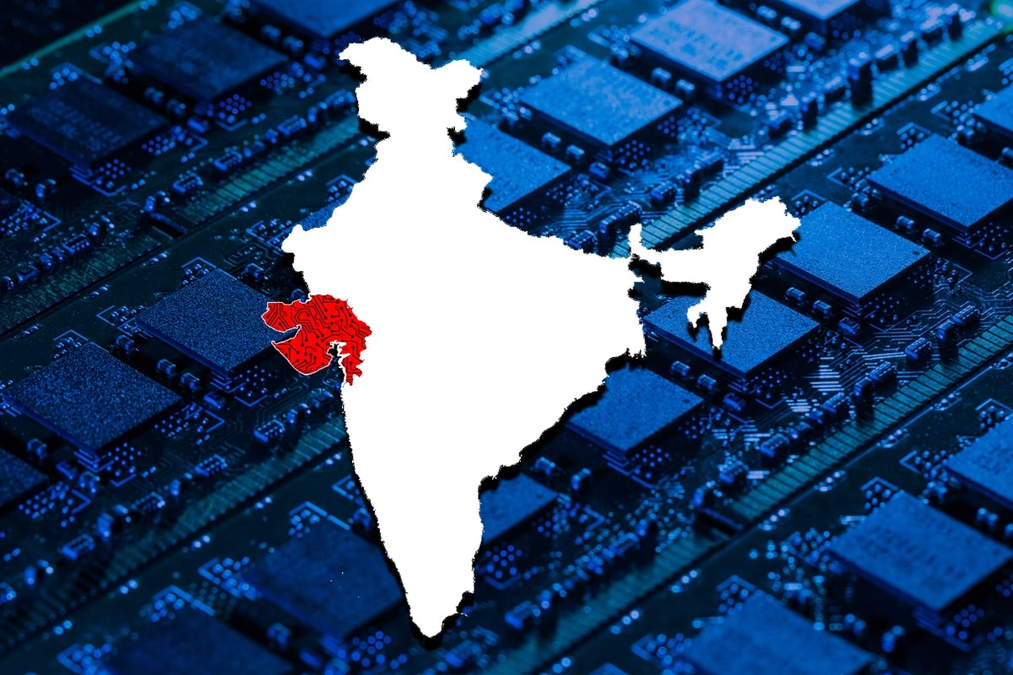
India’s semiconductor industry is emerging as a key pillar of the country’s industrial strategy. Government incentives, new fabrication plants, chip design investments, and expanding electronics manufacturing are expected to generate high-skilled employment and strengthen India’s position in the global technology supply chain.
The topic is evergreen with a strong current affairs angle. It is based on India’s ongoing semiconductor mission, government policy, and industry investments rather than a single breaking news event. Therefore, this article follows an explanatory style supported by recent developments and verified industry trends.
India’s semiconductor push is becoming one of the country’s most important economic and technological initiatives. While semiconductor manufacturing often attracts attention because of billion-dollar investments and advanced technology, its long-term significance lies in its potential to create large-scale employment across multiple industries. From chip fabrication and electronics manufacturing to research, software development, logistics, and equipment maintenance, India’s semiconductor ecosystem could generate thousands of direct jobs and many more indirect employment opportunities over the next decade.
As global companies seek to diversify their supply chains and reduce dependence on a limited number of manufacturing locations, India is positioning itself as a competitive destination for semiconductor production. With support from the India Semiconductor Mission, Production Linked Incentive (PLI) schemes, and state government initiatives, the country is gradually building an ecosystem that extends beyond manufacturing and into design, packaging, testing, and research.
Why Semiconductors Are Critical to the Modern Economy
Semiconductors, commonly known as computer chips, are the foundation of nearly every modern electronic device. Smartphones, laptops, automobiles, medical equipment, industrial machinery, satellites, defence systems, telecommunications networks, and artificial intelligence applications all depend on semiconductor technology.
The global chip shortage during the COVID-19 pandemic demonstrated how essential semiconductors are to economic stability. Disruptions in chip production affected industries ranging from automotive manufacturing to consumer electronics, delaying production and increasing costs worldwide.
Recognising the strategic importance of semiconductors, governments across the world have increased investments in domestic chip manufacturing. India has joined this effort with the objective of strengthening technological self-reliance while creating new industrial opportunities.
India’s Semiconductor Mission Is Building a New Ecosystem
India’s semiconductor strategy is not limited to establishing fabrication plants. It focuses on developing an integrated ecosystem that includes chip design, wafer fabrication, assembly, testing, packaging, equipment manufacturing, materials supply, research, and workforce development.
The India Semiconductor Mission, launched by the Government of India, provides financial incentives to encourage global and domestic companies to invest in semiconductor manufacturing and related industries.
Recent announcements involving semiconductor fabrication facilities, outsourced semiconductor assembly and test units, and electronics manufacturing investments indicate that India is gradually building capabilities across the semiconductor value chain.
Several global technology companies already operate chip design centres in India, making the country an important contributor to semiconductor research and engineering even before large-scale fabrication begins.
Job Creation Will Extend Beyond Chip Manufacturing
One of the biggest misconceptions about semiconductor investments is that employment is limited to engineers working inside fabrication facilities.
In reality, semiconductor manufacturing supports a broad industrial network requiring professionals from multiple disciplines. Electrical engineers, mechanical engineers, chemical engineers, software developers, data scientists, production managers, quality control specialists, equipment technicians, logistics experts, safety professionals, and research scientists all contribute to semiconductor operations.
Supporting industries also benefit. Construction companies build manufacturing plants, equipment suppliers provide specialised machinery, logistics firms manage transportation, educational institutions develop skilled professionals, and component manufacturers supply materials used during production.
Each major semiconductor facility can stimulate the growth of hundreds of supporting businesses, creating significant indirect employment across regional economies.
Tier-2 Cities Could Benefit from Semiconductor Expansion
Although semiconductor fabrication plants require specialised infrastructure, their economic impact extends far beyond the cities where they are located.
Tier-2 cities with engineering colleges, industrial clusters, electronics manufacturing capabilities, and research institutions are well positioned to participate in the expanding semiconductor ecosystem.
Cities such as Ahmedabad, Surat, Mysuru, Coimbatore, Nagpur, Indore, Bhubaneswar, Chandigarh, Kochi, and Visakhapatnam already possess growing technology ecosystems and skilled engineering talent.
These cities can attract suppliers, testing facilities, packaging units, software development centres, equipment servicing companies, and training institutes supporting the semiconductor industry.
As manufacturing expands, regional cities could become important contributors to India’s electronics supply chain while creating employment opportunities closer to home for engineering graduates.
Education and Skill Development Will Play a Key Role
Building a competitive semiconductor industry requires a highly skilled workforce.
Recognising this need, educational institutions, government agencies, and private companies are increasing investments in semiconductor-related training programmes. Universities are expanding courses in electronics engineering, microelectronics, integrated circuit design, embedded systems, materials science, artificial intelligence, and advanced manufacturing.
Industry-academia partnerships are expected to become increasingly important as companies seek graduates with specialised technical skills.
Upskilling existing professionals through certification programmes, internships, and practical industry exposure will also help meet future workforce requirements.
This focus on talent development strengthens India’s long-term competitiveness in high-technology manufacturing.
Challenges India Must Address
Despite strong momentum, India’s semiconductor ambitions face several challenges.
Semiconductor fabrication requires extremely high capital investment, reliable electricity, ultra-pure water, sophisticated manufacturing equipment, advanced supply chains, and highly skilled personnel.
Global competition remains intense, with countries such as Taiwan, South Korea, the United States, Japan, and China possessing decades of experience in semiconductor manufacturing.
India will need consistent policy support, efficient infrastructure, regulatory stability, research investment, and continued collaboration between government and industry to remain competitive.
Building an internationally competitive semiconductor ecosystem will take time, but current investments provide an important foundation.
The Road Ahead
India’s semiconductor push represents far more than an industrial policy initiative. It reflects the country’s ambition to become a global technology and manufacturing leader while reducing dependence on imported electronic components.
As fabrication facilities, chip design centres, electronics manufacturing units, and supporting industries continue expanding, employment opportunities are expected to grow across engineering, manufacturing, software, logistics, research, and technical services.
For young professionals entering the workforce, the semiconductor sector offers the potential for high-skilled careers in one of the world’s fastest-growing industries.
If current policy momentum continues, India’s semiconductor ecosystem could become a major source of innovation, exports, and quality employment over the coming decades, benefiting both metropolitan regions and emerging industrial cities across the country.
Key Takeaways
- India’s semiconductor mission aims to build a complete chip manufacturing and design ecosystem.
- Employment opportunities will extend beyond fabrication plants into research, logistics, software, equipment manufacturing, and advanced engineering.
- Tier-2 cities with strong industrial and educational infrastructure could benefit significantly from semiconductor investments.
- Continued policy support, infrastructure development, and skill training will be essential for long-term success.
FAQ
Q1. Why is India investing heavily in semiconductors?
India is investing in semiconductors to strengthen technological self-reliance, attract global manufacturing, reduce import dependence, and create long-term economic growth.
Q2. What types of jobs will the semiconductor industry create?
The industry will create opportunities for engineers, technicians, software developers, researchers, quality control professionals, manufacturing specialists, logistics experts, and equipment maintenance professionals.
Q3. Can Tier-2 cities benefit from India’s semiconductor industry?
Yes. Many Tier-2 cities have engineering talent, industrial infrastructure, and educational institutions that can support semiconductor manufacturing, packaging, testing, design, and supply chain operations.
Q4. What challenges does India’s semiconductor sector face?
Major challenges include high capital requirements, advanced technology needs, skilled workforce shortages, infrastructure development, and strong global competition.












Leave a comment