

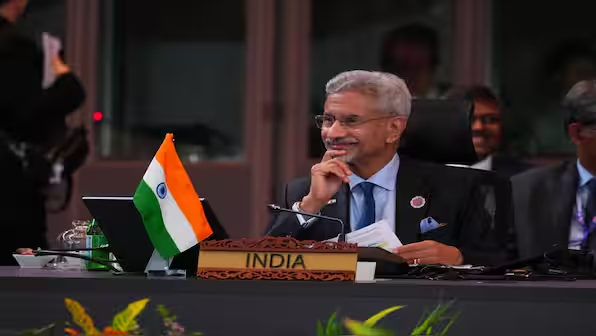
Jaishankar’s Middle East tour has placed India’s strategic priorities in sharp focus, spanning energy security, diaspora welfare and defence cooperation. The high level engagements underline how West Asia remains central to India’s economic stability and geopolitical balancing.
Jaishankar’s Middle East tour is a time sensitive diplomatic development. The engagements are current, policy driven and linked to evolving regional dynamics. The tone of this article follows a news reporting style with contextual analysis.
Why the Middle East remains critical for India
The Middle East occupies a unique position in India’s external strategy. A significant share of India’s crude oil and natural gas imports originates from the region, making energy security a constant priority. Any instability or pricing shock directly affects India’s economy, inflation and fiscal planning.
Beyond energy, the region hosts one of the largest Indian diaspora populations in the world. Millions of Indian workers and professionals contribute to Gulf economies while sending remittances back home. These financial flows support household incomes and regional development across Indian states.
Strategically, the Middle East also intersects with India’s interests in maritime security, trade routes and regional stability. Jaishankar’s visit reflects this multi layered importance.
Energy security and long term supply assurances
Energy discussions form a core pillar of the tour. India seeks stable and predictable supply arrangements at a time when global energy markets remain volatile. Long term contracts, diversification of suppliers and collaboration on storage infrastructure are all on the table.
India is also engaging Middle Eastern partners on investments in downstream sectors such as refining and petrochemicals. Joint ventures help secure supply while sharing risk. At the same time, India is exploring cooperation in cleaner energy transitions, including hydrogen and renewables, where Gulf countries are investing heavily.
For Middle Eastern producers, India offers a large and reliable market. The dialogue therefore aims at mutual predictability rather than short term price bargaining.
Diaspora welfare and labour mobility priorities
Protecting the interests of the Indian diaspora is a recurring theme in high level visits. Indian workers form the backbone of construction, healthcare, logistics and services sectors across the Gulf. Ensuring their safety, fair treatment and job security remains a top diplomatic objective.
Jaishankar’s engagements include discussions on labour agreements, grievance redressal mechanisms and skill recognition. Simplifying mobility frameworks benefits both sides by matching workforce supply with regional demand.
Remittances from the Middle East play a vital role in India’s economy, particularly for states like Kerala, Uttar Pradesh and Bihar. Sustaining these flows requires stable labour relations and predictable migration policies.
Defence cooperation and security alignment
Defence and security cooperation has grown steadily between India and Middle Eastern countries. Naval exercises, intelligence sharing and defence equipment collaboration are now routine components of bilateral ties.
India aims to strengthen maritime security cooperation to safeguard sea lanes critical for trade and energy transport. Joint patrols, port access agreements and information sharing enhance regional stability.
Defence exports and co development opportunities are also part of the conversation. As Middle Eastern countries diversify defence procurement, India positions itself as a cost effective and reliable partner, particularly in areas such as naval platforms, drones and maintenance services.
Balancing regional complexities
One of the challenges of India’s Middle East engagement is navigating regional rivalries. India maintains relations with multiple partners whose interests do not always align. Jaishankar’s diplomacy focuses on issue based cooperation rather than bloc politics.
This approach allows India to engage pragmatically on energy, trade and security without being drawn into regional conflicts. Strategic autonomy remains a guiding principle.
The tour also signals continuity. Despite leadership changes and geopolitical shifts, India’s West Asia policy remains anchored in economic and security interests rather than ideological alignment.
Economic and investment linkages beyond oil
While energy dominates headlines, broader economic ties are expanding. Middle Eastern sovereign funds have increased investments in Indian infrastructure, logistics and technology sectors. These investments support India’s growth while offering stable returns to investors.
Trade discussions during the tour cover supply chain resilience, food security and logistics cooperation. India’s agricultural exports and food processing capabilities align with regional import needs.
By deepening economic integration, India aims to move the relationship beyond transactional energy dependence.
What the tour means for India’s foreign policy
Jaishankar’s Middle East tour underscores India’s shift toward proactive regional engagement. Rather than reacting to crises, India is shaping partnerships around long term interests.
The focus on energy security, diaspora welfare and defence cooperation reflects a holistic approach to foreign policy. It recognises that economic stability, citizen protection and security readiness are interconnected.
As global power dynamics evolve, India’s ability to maintain strong ties across the Middle East will influence its strategic leverage on the world stage.
Takeaways
Energy security remains the cornerstone of India’s Middle East engagement
Diaspora welfare and labour mobility are key diplomatic priorities
Defence cooperation is expanding beyond traditional exercises
India continues to balance regional ties through pragmatic diplomacy
FAQs
Why is Jaishankar visiting the Middle East now
To advance ongoing discussions on energy supply, diaspora issues and defence cooperation amid shifting regional dynamics.
How important is the Indian diaspora in the Middle East
It is critical, with millions of Indians contributing to regional economies and sending remittances to India.
What defence areas are being discussed
Maritime security, joint exercises, defence exports and technology collaboration.
Does this tour change India’s Middle East policy
It reinforces existing priorities rather than marking a policy shift.






Leave a comment