

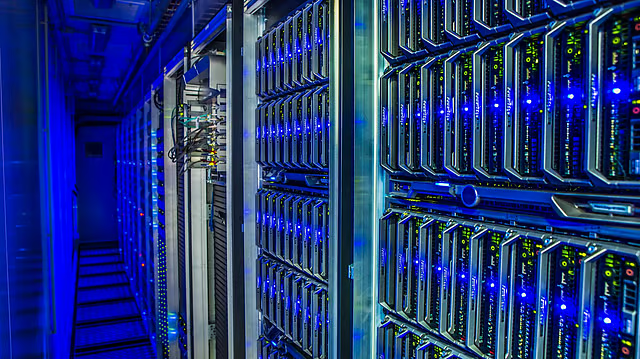
AI data centres and edge compute infrastructure are expanding rapidly across Karnataka, reshaping regional tech clusters beyond Bengaluru. Driven by enterprise AI demand, cloud adoption, and latency sensitive applications, the build out signals a new phase of distributed digital infrastructure growth in the state.
AI data centres and edge compute are becoming central to Karnataka’s technology growth story as the state sees accelerated infrastructure investments across multiple regions. This topic is time sensitive and news driven, as recent enterprise demand and policy alignment are actively shaping deployment decisions. While Bengaluru remains the anchor, the current phase focuses on spreading compute capacity closer to users, industries, and data sources to support AI workloads that cannot rely only on centralised cloud models.
Why Karnataka Is Seeing A Compute Infrastructure Surge
Karnataka has long been India’s technology backbone, but the current AI data centres and edge compute surge reflects a shift in how digital infrastructure is planned. Traditional hyperscale data centres served cloud storage and enterprise IT needs. AI workloads are different. They require high density power, specialised cooling, and low latency processing.
This has pushed operators to rethink location strategy. Instead of concentrating everything in one metro, infrastructure is being distributed across regional clusters within Karnataka. Factors driving this include rising power costs in core urban zones, land availability, and the need to reduce network latency for AI inference tasks.
Government incentives, stable policy frameworks, and Karnataka’s mature tech talent ecosystem further strengthen its position compared to other states competing for similar investments.
From Bengaluru To Regional Tech Clusters
Bengaluru continues to dominate as the control centre for AI development, but the build out is increasingly extending to nearby and emerging clusters. Areas around the city, as well as secondary hubs such as Mysuru, Hubballi Dharwad, and Mangaluru, are gaining attention for edge compute facilities and modular data centres.
These locations offer lower real estate costs, easier grid access, and proximity to industrial corridors. For AI applications used in manufacturing, logistics, healthcare, and smart city deployments, edge compute nodes closer to operations improve performance and reliability.
This decentralisation reduces pressure on Bengaluru’s infrastructure while creating new employment and skill development opportunities in regional cities.
Edge Compute And Industry Specific Use Cases
The rise of edge compute in Karnataka is closely tied to industry demand. Manufacturing units are deploying AI based quality control systems that require real time processing. Healthcare providers are using AI assisted diagnostics where data privacy and response time are critical.
Logistics and mobility firms rely on edge compute for route optimisation, fleet monitoring, and autonomous system testing. These use cases cannot afford the delays associated with sending data back and forth to distant data centres.
As a result, smaller, purpose built compute facilities are being deployed near factories, hospitals, ports, and transport hubs. This creates a network of regional nodes rather than a single centralised infrastructure spine.
Power, Sustainability, And Infrastructure Challenges
Power availability remains a defining factor in AI data centre expansion. AI workloads are energy intensive, and operators are under pressure to ensure reliable supply while meeting sustainability targets.
Karnataka’s renewable energy capacity offers an advantage, particularly for operators looking to integrate solar and wind into their power mix. However, grid stability, last mile connectivity, and water usage for cooling remain challenges, especially in semi urban regions.
To address this, operators are investing in advanced cooling technologies, energy efficient hardware, and backup systems. These investments increase upfront costs but are necessary to ensure long term viability and regulatory compliance.
Talent And Ecosystem Spillover Effects
The infrastructure build out is creating spillover effects across the tech ecosystem. Demand for data centre engineers, network specialists, AI infrastructure architects, and maintenance professionals is rising.
Regional clusters benefit as training institutes, service providers, and startups align around new opportunities. Local IT firms are finding roles in deployment, monitoring, and security services tied to AI data centres and edge compute networks.
Over time, this could reduce migration pressure toward Bengaluru by creating meaningful tech employment in other parts of the state.
How Karnataka Compares Nationally
Compared to other Indian states pursuing data centre investments, Karnataka’s advantage lies in its combination of demand and supply. Enterprise AI adoption is already strong due to the concentration of global technology firms and startups.
States with aggressive incentives may attract hyperscale projects, but without a deep AI development ecosystem, utilisation can lag. Karnataka benefits from having both compute demand and skilled users within the same geography.
This alignment improves return on infrastructure investments and accelerates ecosystem maturity.
What The Next Phase Looks Like
The next phase of AI data centre and edge compute growth in Karnataka will focus on scale and integration. Larger facilities will coexist with dense networks of edge nodes. Interoperability, security, and resilience will become priorities as workloads increase.
Policy clarity around data governance, power pricing, and environmental norms will influence the pace of expansion. If aligned well, Karnataka could set a template for distributed AI infrastructure development across India.
Takeaways
- AI data centres and edge compute are expanding beyond Bengaluru into regional Karnataka clusters
- Industry specific AI use cases are driving demand for low latency infrastructure
- Power availability and sustainability are key challenges shaping deployment decisions
- The build out is creating new tech employment opportunities across the state
FAQs
Why is edge compute important for AI workloads?
Edge compute reduces latency by processing data closer to where it is generated, which is critical for real time AI applications.
Is Bengaluru losing relevance in this shift?
No. Bengaluru remains the core development hub, while regional clusters complement it with infrastructure and deployment capacity.
Which sectors benefit most from this expansion?
Manufacturing, healthcare, logistics, and smart infrastructure sectors see the strongest impact.
Will this reduce pressure on Bengaluru’s infrastructure?
Yes. Distributed compute helps balance growth and reduces over concentration in one urban area.











Leave a comment