


India drawing $67.5 billion in AI investments marks a decisive moment for the country’s technology and infrastructure trajectory. The surge reflects global confidence in India’s digital scale, talent pool, and policy direction, while also exposing strategic risks and environmental trade offs that policymakers and industry leaders must now confront.
This topic is time sensitive news. The tone here follows a reporting and analytical style focused on current developments and their near to medium term implications.
How India Reached The $67.5 Billion AI Investment Milestone
India’s AI investment inflow accelerated sharply over the last two years as global technology firms, cloud providers, and semiconductor linked players expanded capacity. Capital has flowed into data centres, AI model training infrastructure, enterprise automation platforms, and applied AI solutions across sectors.
Several factors converged. India offers cost competitive engineering talent, a vast digital user base, and improving ease of doing business. Large scale digitisation in governance, payments, and public services created real world datasets that attract AI development.
Multinational firms view India not only as a market but as a strategic base for global AI operations, pushing investment numbers to historic levels.
Infrastructure Build Out Drives The Investment Surge
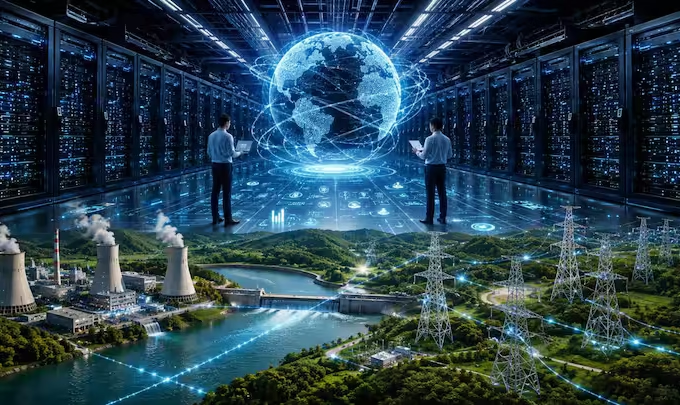
A significant portion of AI investments is tied to physical and digital infrastructure. Hyperscale data centres, cloud regions, GPU clusters, and high capacity power connections are expanding across multiple states.
Cities with strong fibre networks and power availability have emerged as AI infrastructure hubs. State governments are competing to attract projects through land allotments, fast track clearances, and power tariffs.
This build out supports both domestic startups and global firms training large models, deploying enterprise AI, and offering cloud based services. Infrastructure readiness has become India’s strongest AI investment magnet.
Strategic Importance For India’s Economic Positioning
AI investments strengthen India’s position in the global technology value chain. The country is moving beyond services delivery into AI driven product development, model deployment, and platform ownership.
Sectors such as finance, healthcare, manufacturing, logistics, and agriculture are seeing rapid AI adoption. This boosts productivity and creates demand for specialised skills.
However, strategic dependence on foreign capital and imported hardware remains a concern. Advanced chips and high end processors are still sourced externally, leaving supply chains vulnerable to geopolitical shifts.
Strategic Risks Behind The Investment Optimism
While the $67.5 billion figure signals confidence, it also carries strategic risks. Concentration of AI infrastructure in a few urban clusters increases regional imbalance and systemic vulnerability.
There is also a risk of India becoming primarily a hosting and execution layer while core AI intellectual property remains offshore. Without sustained investment in foundational research, India could miss long term value capture.
Data governance is another concern. As AI systems process sensitive personal and enterprise data, regulatory clarity and enforcement will determine trust and sustainability.
Environmental Trade Offs Come Into Sharp Focus
AI infrastructure is energy intensive. Data centres require continuous power and cooling, placing pressure on electricity grids and water resources.
Several AI clusters are located in regions already facing water stress. Cooling systems and backup power generation raise environmental questions that were previously secondary to growth narratives.
Renewable energy integration is improving but not uniform. Without careful planning, AI driven growth could conflict with climate commitments and local resource sustainability.
Environmental impact is now part of the AI investment conversation rather than an afterthought.
Employment Impact And Skill Realignment
AI investments are reshaping India’s employment landscape. Demand for AI engineers, data scientists, cloud architects, and cybersecurity professionals has surged.
At the same time, automation is altering roles in IT services, back office operations, and routine analytics. The net employment effect depends on how quickly the workforce reskills.
Educational institutions and companies are under pressure to align curricula with AI driven job profiles. Skill readiness will determine whether investment translates into broad based opportunity.
Policy And Regulatory Balancing Act
The government faces a complex balancing act. Encouraging AI investment while safeguarding data, competition, and environmental standards requires calibrated regulation.
Overregulation could slow momentum, while under regulation risks long term harm. Clear frameworks around data usage, cross border flows, and accountability are essential.
States competing for AI projects must also coordinate on standards to avoid a race to the bottom on environmental or labour safeguards.
What This Means For India’s AI Future
The $67.5 billion AI investment wave positions India as a major global AI hub. The opportunity is significant but so are the responsibilities.
Success will depend on moving beyond infrastructure to innovation ownership, balancing growth with sustainability, and building resilient supply chains.
The current phase is about scale. The next phase must be about depth, governance, and long term value creation.
Takeaways
India has emerged as a major global destination for AI infrastructure investment
Infrastructure readiness is the primary driver of capital inflows
Strategic dependence and environmental costs pose real risks
Policy clarity will shape long term outcomes of AI growth
FAQs
Why are global companies investing heavily in AI infrastructure in India
India offers large scale digital adoption, skilled talent, and improving infrastructure at competitive costs.
Does this investment mean India leads in AI innovation
Not necessarily. Infrastructure leadership does not automatically translate into ownership of core AI models or intellectual property.
What are the environmental concerns linked to AI investments
High energy consumption, water usage for cooling, and grid stress are key challenges that require sustainable planning.
Will AI investments create jobs in India
Yes, but mainly in high skill roles. Workforce reskilling will determine how broadly benefits are distributed.











Leave a comment