

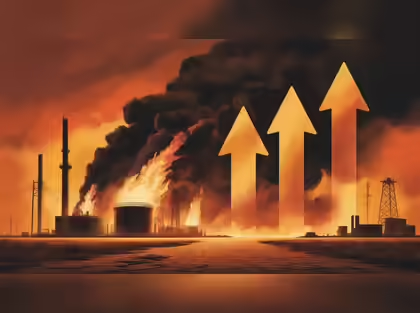
India’s energy crisis concerns are gaining attention as rising demand, fuel price volatility, and supply pressures begin affecting startups and manufacturing units. Businesses across sectors are facing higher costs, operational uncertainty, and the need to rethink energy dependence.
India’s energy crisis concerns have moved into focus in 2026 as multiple factors including rising power demand, global fuel price fluctuations, and infrastructure limitations begin to strain supply systems. For startups and manufacturing units, especially in Tier-2 and industrial clusters, the impact is immediate and operational.
Rising Power Demand and Supply Pressure in India
India’s energy demand has been steadily increasing due to industrial growth, urban expansion, and rising temperatures. Peak electricity demand records have been consistently challenged in recent years, putting pressure on generation and distribution systems.
Coal continues to dominate India’s power mix, contributing a significant share of electricity generation. Any disruption in coal supply, logistics, or pricing can directly impact power availability. Renewable energy capacity is growing, but it is not yet sufficient to fully stabilise supply during peak demand periods.
For startups and manufacturing units, this imbalance translates into risks such as power outages, voltage fluctuations, and inconsistent supply. These issues are more pronounced in Tier-2 and Tier-3 industrial areas where infrastructure is still evolving.
Impact on Manufacturing Units and Industrial Output
Manufacturing units are among the most affected by India’s energy crisis concerns. Energy costs form a substantial portion of operational expenses, particularly in sectors like textiles, chemicals, metals, and food processing.
When electricity costs rise or supply becomes unreliable, production efficiency declines. Factories may be forced to rely on diesel generators as backup, which significantly increases costs due to high fuel prices.
Inconsistent power supply can also disrupt production schedules, leading to delays in order fulfilment. This affects not only domestic supply chains but also export commitments, where timelines are critical.
Small and medium manufacturing units are especially vulnerable because they lack the financial capacity to absorb prolonged cost increases or invest in alternative energy solutions.
Challenges for Startups and Emerging Businesses
Startups in India are also facing pressure due to the ongoing energy situation. While many startups operate in digital or service sectors, a growing number are entering manufacturing, logistics, and electric mobility.
For these startups, energy costs directly impact unit economics. Higher electricity tariffs increase operational expenses, while fuel price volatility affects logistics and delivery models.
Early-stage startups often operate on tight budgets and depend on predictable costs for scaling. Sudden increases in energy expenses can disrupt financial planning and delay expansion.
In sectors like EV charging infrastructure and clean tech, energy availability and pricing also influence adoption rates and customer demand, adding another layer of complexity.
Rising Fuel Prices and Logistics Cost Impact
One of the key dimensions of India’s energy crisis concerns is the rise in global fuel prices. Crude oil price movements influence petrol, diesel, and transportation costs across the economy.
For manufacturing units, higher fuel costs increase the expense of moving raw materials and finished goods. For startups in logistics and e-commerce, this directly affects last-mile delivery costs and pricing strategies.
Tier-2 cities, which rely heavily on road transport, are particularly sensitive to fuel price changes. Increased logistics costs often get passed on to consumers, affecting demand and overall market activity.
This interconnected impact highlights how energy costs influence not just production but the entire business ecosystem.
Shift Toward Renewable Energy and Cost Optimisation
In response to India’s energy crisis concerns, many businesses are exploring renewable energy options such as solar power. Rooftop solar installations are becoming more common in industrial units as a way to reduce dependency on grid electricity.
While the initial investment can be high, long-term savings and government incentives are making renewable energy more viable. Some manufacturing clusters are also exploring shared energy solutions to reduce costs.
Startups are leveraging technology to optimise energy consumption through smart systems and analytics. Energy-efficient machinery and automation are being adopted to minimise waste and improve productivity.
However, widespread adoption still faces challenges including financing, infrastructure, and regulatory clarity.
Policy Outlook and Long-Term Industry Impact
India’s energy policies are increasingly focused on balancing demand growth with sustainable supply. Government initiatives promoting renewable energy, grid modernisation, and efficiency improvements are expected to play a key role.
For startups and manufacturing units, policy stability and infrastructure development will be critical in managing future risks. Access to reliable and affordable energy will directly influence competitiveness and growth.
If current challenges persist without adequate intervention, smaller businesses may face consolidation pressure. On the other hand, those that adapt through efficiency and innovation could gain a competitive advantage.
The energy situation in 2026 is therefore not just a short-term concern but a structural factor shaping India’s industrial and startup ecosystem.
Takeaways
– India’s energy crisis concerns are increasing operational costs for startups and manufacturers
– Power supply inconsistencies and rising tariffs are affecting production efficiency
– Fuel price volatility is driving up logistics and delivery expenses
– Renewable energy adoption is emerging as a key strategy for cost control
FAQs
Q1. What is causing India’s energy crisis concerns in 2026?
Rising demand, dependence on coal, fuel price volatility, and infrastructure limitations are key factors.
Q2. How are manufacturing units affected by energy issues?
They face higher costs, production disruptions, and reliance on expensive backup power sources.
Q3. Why are startups vulnerable to energy cost increases?
Startups operate with limited budgets and depend on predictable costs for scaling operations.
Q4. What solutions are businesses adopting to manage energy challenges?
They are investing in renewable energy, improving efficiency, and optimising operations.









Leave a comment