

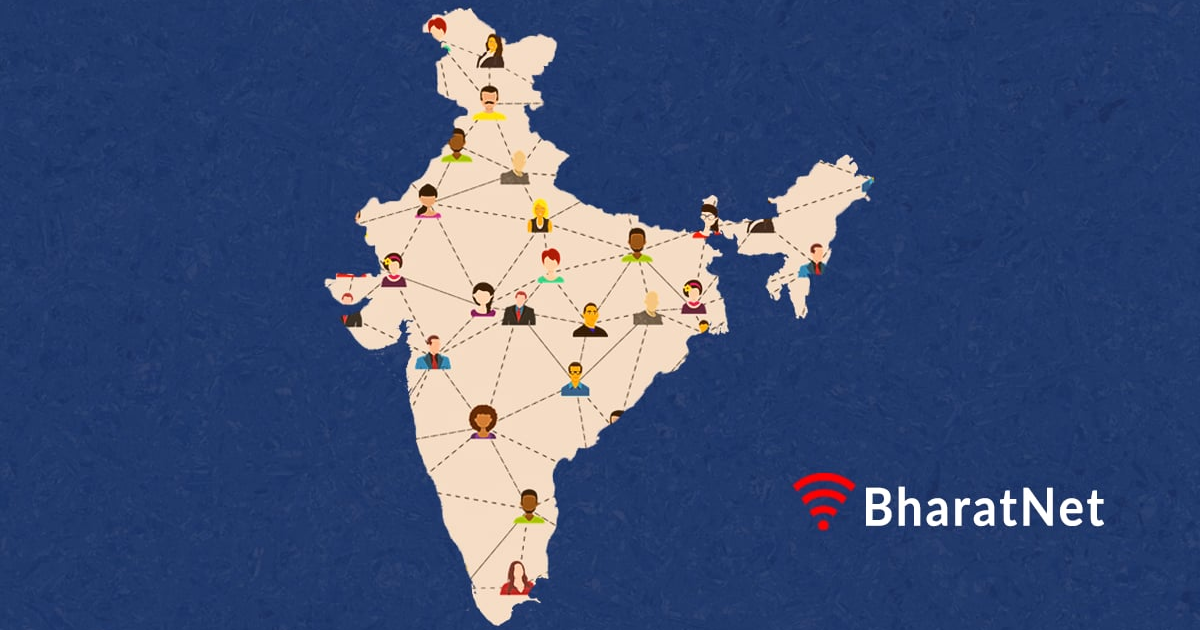
Rural internet expansion under BharatNet is transforming connectivity in semi-urban India, but the ground reality remains uneven. While millions of households are now linked through fiber networks, issues like last-mile access, service quality, and digital literacy continue to affect actual usage.
BharatNet Rollout and Its Reach in Semi-Urban Regions
Rural internet expansion under BharatNet is one of India’s largest digital infrastructure projects, aimed at connecting gram panchayats with high-speed broadband. Launched by the Government of India, the project targets rural and semi-urban areas where private telecom penetration has traditionally been low.
Under BharatNet, optical fiber has been laid to over two lakh gram panchayats across the country. This backbone infrastructure is intended to enable internet services through local providers, Wi-Fi hotspots, and common service centers.
In semi-urban regions, especially those located near district headquarters, the presence of fiber networks has improved significantly. Towns that once depended on slow mobile data now have access to higher-speed broadband connections, at least in theory.
Last-Mile Connectivity Challenges Persist
Despite the expansion of fiber networks, last-mile connectivity remains a major bottleneck. While BharatNet connects the gram panchayat level, extending that connection to individual homes and businesses depends on local internet service providers.
In many semi-urban areas, this last-mile network is either underdeveloped or unreliable. Local operators often face financial and technical constraints, which delays service rollout to end users.
Secondary keyword focus: BharatNet last mile connectivity, rural broadband challenges India
In some regions, infrastructure exists but is underutilized due to lack of awareness or operational issues. This creates a gap between network availability and actual internet usage, limiting the project’s overall impact.
Impact on Education, Governance, and Local Economy
Where BharatNet connectivity is effectively implemented, the impact is visible across sectors. Schools and colleges in semi-urban areas can access online learning platforms, digital classrooms, and educational resources that were previously unavailable.
Government services have also become more accessible. Residents can use online portals for documentation, banking, and welfare schemes, reducing the need to travel to urban centers.
Secondary keyword focus: digital services rural India, BharatNet benefits education
Small businesses and entrepreneurs are beginning to leverage internet access for e-commerce, digital payments, and marketing. In towns with stable connectivity, local shops are expanding their reach beyond physical markets.
However, these benefits are not consistent across all regions. Variations in service quality and access continue to create disparities.
Digital Literacy and Adoption Barriers
Digital literacy is another critical factor influencing the success of rural internet expansion under BharatNet. Even where internet access is available, many users lack the skills to fully utilize digital services.
In semi-urban India, younger populations adapt quickly to online platforms, but older residents often struggle with basic digital tools. This limits the adoption of services such as online banking, telemedicine, and e-governance.
Secondary keyword focus: digital literacy India, rural internet adoption challenges
Awareness campaigns and training programs have been introduced in some areas, but coverage remains limited. Without adequate user education, infrastructure alone cannot drive meaningful digital inclusion.
Role of Local Entrepreneurs and Service Providers
Local entrepreneurs play a crucial role in bridging the connectivity gap. Small internet service providers and cable operators often act as intermediaries, delivering broadband services from BharatNet nodes to end users.
In semi-urban towns, these operators are responsible for setting up Wi-Fi hotspots, maintaining connections, and offering customer support. Their involvement is essential for ensuring reliable service delivery.
Secondary keyword focus: local ISPs India, rural broadband providers
However, the viability of these businesses depends on consistent demand and supportive policies. In areas where user adoption is low, sustaining operations can be challenging.
Policy Push and Future Outlook for BharatNet
The government continues to expand and upgrade BharatNet under newer phases, focusing on improving service quality and increasing private sector participation. Efforts are being made to integrate the network with 4G and 5G services to enhance speed and reliability.
In semi-urban India, the future of rural internet expansion will depend on how effectively last-mile connectivity and digital literacy gaps are addressed. Strengthening partnerships with local providers and investing in user education will be key.
As digital services become more central to daily life, reliable internet access is no longer optional. BharatNet has laid the foundation, but its success will be measured by how widely and effectively that connectivity is used.
Key Takeaways
• BharatNet has expanded fiber connectivity to a large number of rural and semi-urban areas
• Last-mile connectivity remains a major challenge affecting actual internet usage
• Digital access is improving education, governance, and local business opportunities
• Digital literacy and service quality gaps continue to limit full adoption
FAQs
Q1. What is BharatNet?
BharatNet is a government initiative to provide high-speed broadband connectivity to rural and semi-urban areas through optical fiber networks.
Q2. Why is last-mile connectivity important?
It connects the main fiber network to individual homes and businesses, enabling actual internet usage.
Q3. How is BharatNet helping local communities?
It improves access to education, government services, and digital business opportunities.
Q4. What are the main challenges facing BharatNet?
Key challenges include last-mile connectivity gaps, limited digital literacy, and inconsistent service quality.








Leave a comment