

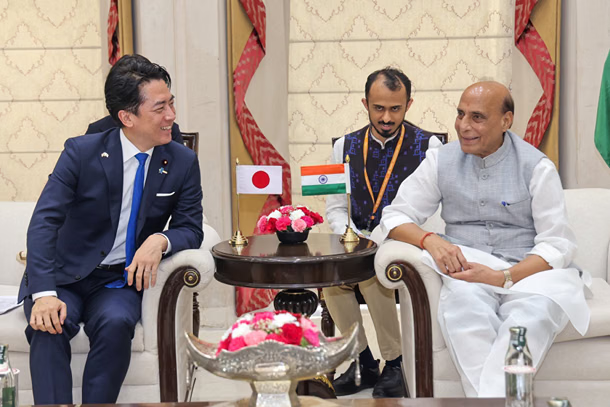
India and Japan have agreed to deepen defence cooperation through expanded military exercises, maritime security coordination and defence technology partnerships. A new agreement allowing Japanese forces to use Indian firing ranges for live-fire training marks an important development in bilateral security relations.
India-Japan defence cooperation is entering a significant new phase following a series of agreements reached during the fourth India-Japan 2+2 Foreign and Defence Ministerial Dialogue in Tokyo on November 19, 2026. The two countries have agreed to expand joint military exercises, strengthen maritime security coordination and explore new areas of defence technology collaboration. One of the major developments is the signing of a Letter of Intent (LOI) that will allow Japan’s Self-Defense Forces to conduct live-fire training at designated firing ranges in India for the first time. The development reflects growing strategic coordination between the two Asian countries amid changing security conditions in the Indo-Pacific region. Press Information Bureau+2
India and Japan Agree to Expand Military Training Cooperation
The latest agreement was reached during discussions between Indian Defence Minister Rajnath Singh and Japanese Defence Minister Shinjiro Koizumi in Tokyo. External Affairs Minister S Jaishankar and Japanese Foreign Minister Toshimitsu Motegi also participated in the fourth India-Japan 2+2 dialogue.
The meeting reviewed progress in defence relations and identified areas where both countries could increase operational cooperation. The ministers welcomed the expansion of military exercises involving their respective armed forces and agreed to make future training activities more complex.
An important part of the discussions involved improving the ability of military personnel from both countries to operate together during different security situations. The two sides also discussed integrating unmanned systems into exercises and exploring the possibility of conducting bilateral and multilateral military activities at short notice.
These measures are intended to improve coordination, operational preparedness and the ability to respond to emerging regional security challenges. Japan Ministry of Defense+1
Japanese Forces to Conduct Live-Fire Training in India
One of the most notable outcomes of the latest defence discussions is the proposed use of Indian firing ranges by Japan’s Self-Defense Forces.
India and Japan signed a Letter of Intent to facilitate the arrangement. Under the proposed framework, Japanese military personnel will be able to conduct live-fire training in India, including exercises involving surface-to-ship missiles.
This would be the first time Japan’s Self-Defense Forces conduct such training at Indian firing ranges. Both governments have agreed to accelerate discussions between their defence authorities to implement the arrangement at the earliest.
The agreement is significant because military training facilities and access to suitable testing environments are important components of defence preparedness. For Japan, the arrangement could provide additional opportunities to train outside its domestic facilities. For India, it creates another avenue for military cooperation with a strategic partner.
However, the Letter of Intent should not be confused with an announcement that the training has already begun. The two governments still need to complete the necessary coordination before the proposed activities can take place. Press Information Bureau+2
Joint Military Exercises Strengthen Operational Preparedness
Joint military exercises remain an important part of India-Japan defence cooperation. They allow armed forces to understand each other’s procedures, improve communication and practise coordinated responses to different operational situations.
One of the established exercises is Dharma Guardian, conducted between the Indian Army and Japan Ground Self-Defense Force. The seventh edition took place at Chaubattia in Uttarakhand from February 24 to March 9, 2026.
The exercise involved 120 personnel from each country. Training activities included intelligence, surveillance and reconnaissance operations, temporary operating base establishment, cordon and search operations, heliborne operations and house intervention drills.
Such exercises help military personnel develop familiarity with each other’s operational methods, particularly during situations that require coordinated action in challenging environments. Press Information Bureau+1
The two countries have also expanded cooperation between their air forces and navies. During the November discussions, the ministers highlighted the first-ever visit of Japan Air Self-Defense Force fighter aircraft to India for the Veer Guardian 26 exercise.
Naval cooperation has also progressed through the Japan-India Maritime Exercise JAIMEX 26 and the multilateral Malabar 2026 exercise involving India, Japan, the United States and Australia. Both exercises were conducted in Japan during November 2026.
The governments have agreed to further strengthen exchanges between their Special Operations Forces and improve the complexity of future joint exercises. Japan Ministry of Defense+1
Maritime Security Becomes a Major Area of Cooperation
Maritime security is another important focus of the India-Japan partnership. Both countries depend heavily on secure sea routes for international trade, energy supplies and economic activity. Maintaining stability across the Indo-Pacific therefore remains a shared strategic priority.
In August 2026, India and Japan signed a Memorandum of Arrangement on Maritime Security Cooperation. During the November meeting, the ministers reviewed progress under this arrangement and discussed ways to translate it into practical cooperation.
The discussions included improving mine countermeasure capabilities, strengthening Maritime and Air Domain Awareness, enhancing search and rescue coordination and facilitating information sharing between the Indian Navy and Japan Maritime Self-Defense Force.
Both countries also agreed to explore possibilities for joint development in naval shipbuilding and design. Japan brings considerable experience in advanced maritime technology, while India has expanding shipbuilding and defence manufacturing capabilities.
The proposed cooperation could create opportunities for technical exchanges and stronger industrial partnerships. However, any joint shipbuilding projects would require further discussions and formal decisions. Japan Ministry of Defense+2
Defence Technology and Make in India Opportunities
Beyond military exercises, India and Japan are looking to strengthen cooperation in defence equipment and technology.
An important project discussed during the November meeting is UNICORN, a naval communication antenna system developed in Japan. The two governments expressed expectations for an early conclusion of the related arrangements, with India aiming to complete its Acceptance of Necessity (AoN) by February 2027.
The project is relevant to India’s efforts to improve communication capabilities across its naval platforms. It also reflects the possibility of greater technology cooperation between the two countries.
The ministers discussed strengthening defence research and development cooperation between India’s Defence Research and Development Organisation (DRDO) and Japan’s Acquisition, Technology and Logistics Agency (ATLA).
The broader approach is being described as Design with Japan, Make in India. It aims to combine Japanese technological expertise with India’s manufacturing capabilities.
For Indian defence companies, this could create opportunities to participate in technology development, component manufacturing and industrial partnerships. However, the actual benefits will depend on project approvals, investment decisions and the terms of future agreements. Press Information Bureau+1
Why India-Japan Defence Relations Matter in the Indo-Pacific
India and Japan share important strategic interests in maintaining stability across the Indo-Pacific. The region includes major international shipping routes and plays a central role in global trade and economic connectivity.
Both countries have repeatedly supported the idea of a free, open and inclusive Indo-Pacific based on international law and respect for national sovereignty.
Their defence partnership also operates within the broader framework of the Quadrilateral Security Dialogue, commonly known as the Quad, which includes India, Japan, the United States and Australia.
However, India-Japan defence cooperation is a bilateral partnership in its own right. It is not limited to the Quad and includes independent military exercises, defence technology discussions, maritime agreements and institutional exchanges.
The growing relationship provides both countries with additional opportunities to coordinate on maritime security, disaster response and regional stability.
For India, stronger cooperation with Japan also supports its broader efforts to diversify defence partnerships and improve its capabilities across land, air and maritime domains. Japan Ministry of Defense+1
What the New Defence Partnership Means for India
The latest developments indicate that India-Japan defence relations are moving beyond diplomatic discussions towards more practical military and industrial cooperation.
For India’s armed forces, expanded training opportunities could improve familiarity with international military procedures and strengthen interoperability with Japanese forces. Greater naval coordination may also support maritime surveillance, search and rescue operations and information sharing.
The partnership could have implications for India’s defence manufacturing sector as well. Cooperation in naval technology, communication systems and research may create opportunities for domestic companies to work with Japanese organisations.
Another important aspect is the potential for more frequent military exchanges. Training involving unmanned systems, advanced equipment and short-notice exercises could help both countries prepare for a wider range of operational requirements.
At the same time, these developments should be viewed as part of a long-term defence relationship rather than an immediate change in India’s military posture. Agreements must be translated into operational arrangements, and their effectiveness will depend on implementation.
The November 19 meeting has nevertheless established a clearer direction for future cooperation. With the proposed use of Indian firing ranges, expanded military exercises and deeper maritime engagement, India and Japan are building a more comprehensive defence partnership.
Key Takeaways
- India and Japan signed a Letter of Intent for Japanese Self-Defense Forces to use Indian firing ranges for live-fire training.
- Both countries agreed to expand joint military exercises and improve coordination between their armed forces.
- Maritime security cooperation will focus on information sharing, mine countermeasures and naval technology.
- Defence technology partnerships, including the UNICORN project, could strengthen India’s domestic defence manufacturing capabilities.
Frequently Asked Questions (FAQs)
1. What is the latest development in India-Japan defence cooperation?
India and Japan signed a Letter of Intent on November 19, 2026, to facilitate the use of Indian firing ranges by Japan’s Self-Defense Forces for live-fire training, including exercises involving surface-to-ship missiles.
2. What is Exercise Dharma Guardian?
Dharma Guardian is an annual joint military exercise between the Indian Army and Japan Ground Self-Defense Force. It focuses on improving interoperability, tactical coordination and combined operational capabilities.
3. What is the importance of the Veer Guardian 26 exercise?
Veer Guardian 26 strengthened cooperation between the Indian Air Force and Japan Air Self-Defense Force. The 2026 edition was particularly significant because Japanese fighter aircraft visited India for the first time as part of the exercise.
4. How will India benefit from stronger defence cooperation with Japan?
India could benefit through improved military training, stronger maritime security coordination, defence technology exchanges and opportunities for domestic manufacturing partnerships with Japanese companies.







Leave a comment