

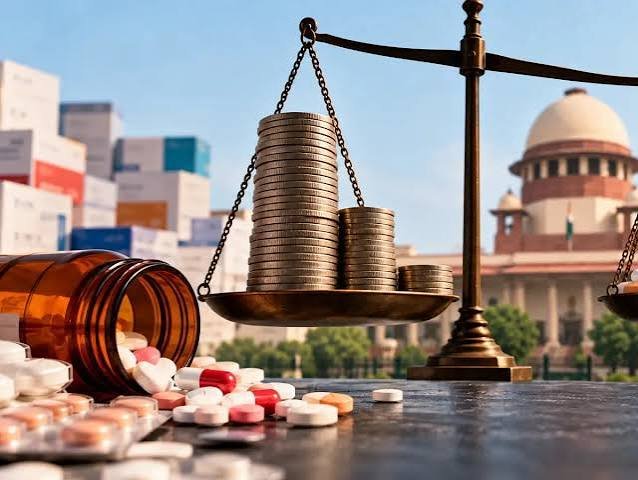
The Supreme Court of India has raised serious concerns over medicine pricing, questioning the Centre about large gaps between the prices at which medicines are supplied and the amounts patients are charged. The October 2026 proceedings could influence future discussions on drug price controls, hospital mark-ups and access to affordable healthcare.
Supreme Court Raises Concerns Over High Medicine Prices
The Supreme Court’s latest observations on medicine pricing have brought renewed attention to the cost of essential and life-saving drugs in India. On October 27, 2026, a bench comprising Justices Vikram Nath and Sandeep Mehta questioned the Centre’s approach to regulating medicine prices and asked why price controls did not cover a wider range of medicines.
The court was hearing petitions seeking stronger regulation of drug prices, including controls on the initial prices of medicines outside the scheduled price-control system and restrictions on trade margins for medical devices. The bench also expressed concern over the difference between the maximum retail price (MRP) of medicines and the price at which retailers procure them.
According to reports published on October 27 and 28, the court reserved its order after hearing the parties. This means the proceedings had reached an important stage, but the final outcome was still awaited at the time of reporting.
The central issue is whether India’s existing regulatory framework provides sufficient protection to patients who depend on medicines for long-term treatment, cancer care and other serious medical conditions.
Why Medicine Pricing Has Become a Public Concern
Medicine expenses can place considerable pressure on household budgets, particularly when patients require treatment for months or years. Cancer treatment, diabetes management, heart disease and other chronic conditions may involve repeated purchases of medicines, diagnostic tests and hospital services.
The Supreme Court highlighted an example involving an anti-cancer drug in which a distributor reportedly offered to procure the medicine for ₹1,100, while a private hospital charged ₹1.30 lakh for it. The example drew attention to the potential difference between procurement costs and the amounts patients may be asked to pay.
However, a procurement price and a hospital’s final charge are not always directly comparable. The total bill may involve different formulations, dosages, administration costs, storage requirements and other services. The exact medicine, quantity and applicable charges must be examined before drawing conclusions about a particular transaction.
Even with these distinctions, large price differences raise questions about transparency, the justification for mark-ups and the ability of patients to compare treatment costs before making decisions.
For families in Tier-2 and Tier-3 cities, these concerns are especially relevant. Patients may have fewer specialist treatment options nearby and may need to travel to larger cities for advanced care, adding transport and accommodation costs to their medical expenses.
How India’s Drug Price Control System Works
India already has a framework for regulating medicine prices under the Drugs (Prices Control) Order, 2013, commonly known as DPCO 2013. The National Pharmaceutical Pricing Authority (NPPA), under the Department of Pharmaceuticals, implements the price-control framework and monitors compliance.
The system distinguishes between scheduled medicines, which are subject to notified price ceilings, and non-scheduled medicines, which are generally not subject to the same ceiling-price mechanism.
The scheduled category is linked to medicines included in the National List of Essential Medicines. Under the existing framework, the NPPA calculates ceiling prices for scheduled formulations using a market-based methodology. The rules also provide for monitoring prices and regulating increases for non-scheduled formulations.
This distinction matters because a medicine can be available in the Indian market without being covered by the same price ceiling as a scheduled essential medicine. Critics of the current framework argue that leaving many medicines outside direct ceiling-price regulation can expose patients to high initial prices and substantial differences between brands.
The government, meanwhile, has argued that regulation must balance affordability with the availability of medicines, competition and investment in the pharmaceutical sector.
The Supreme Court’s questions have brought this policy debate back into focus: how can India protect patients from excessive prices without creating unintended problems in medicine supply?
Anti-Cancer Medicines and the Proposed Trade-Margin Cap
One significant issue before the court concerns price controls on anti-cancer medicines. The Centre informed the court that it had decided to cap trade margins at 30% of the MRP for 137 anti-cancer drugs. The government estimated that the measure could save patients around ₹2,500 crore annually, according to Hindustan Times’ report on October 28, 2026.
The court questioned why similar protections should not be considered for a wider range of medicines. It also asked why the existing system allowed certain drugs to remain outside the scheduled category.
A trade-margin cap and a ceiling price are not the same thing. A trade-margin cap limits the difference permitted within a specified part of the supply chain, while a ceiling price establishes the maximum permitted price for a covered formulation. Their effects on the final amount paid by a patient can therefore differ.
The wider question is whether a targeted measure covering selected anti-cancer medicines is sufficient or whether a broader framework is needed to address excessive margins and high initial prices across the pharmaceutical market.
The government’s position, as reported during the proceedings, was that complete price control would not necessarily be the right solution. It argued that policy must also account for competition, investment and the continued availability of medicines.
What Could Change for Indian Patients?
The immediate impact on patients remains uncertain because the Supreme Court had reserved its order and had not yet delivered a final ruling in the reported proceedings. Nevertheless, the case highlights several areas that could matter for future healthcare costs.
First, stronger controls on the initial prices of non-scheduled medicines could limit the scope for unusually high launch prices, depending on the framework ultimately adopted.
Second, clearer rules on hospital and supply-chain mark-ups could improve transparency. Patients may find it easier to understand why a medicine’s price differs between a retail pharmacy and a hospital if billing and procurement practices are adequately disclosed.
Third, any expansion of price regulation could affect how pharmaceutical companies set prices and how distributors and healthcare providers structure their charges. The actual outcome would depend on the scope of the rules and how they are implemented.
Finally, the case could strengthen the discussion around generic medicines. Lower-cost generic alternatives can help patients manage recurring expenses when an appropriate equivalent is available. However, patients should not switch medicines or change dosages without consulting their treating doctor or pharmacist.
It is important to remember that court observations do not automatically change the prices printed on medicine packs. Any new requirements will depend on the final judicial order and any subsequent government notifications or regulatory action.
What Patients Can Do While the Case Continues
Patients do not need to wait for a new policy before taking practical steps to understand their medicine expenses.
They can compare the prices of the same medicine, strength, dosage form and pack size across licensed pharmacies. They can also ask their doctor whether an appropriate lower-cost generic or alternative brand is available.
For medicines covered by price-control rules, the NPPA’s official website provides information about the regulatory framework and notified prices. Patients who suspect that a medicine is being sold above its applicable ceiling price can seek clarification from the relevant regulatory authority.
Those receiving treatment in hospitals can request an itemised bill and ask for the medicine name, strength, quantity and charge to be specified. This makes it easier to distinguish the cost of the drug from administration fees or other hospital services.
For patients with limited incomes, government health schemes and Jan Aushadhi Kendras may also provide avenues to reduce eligible medicine expenses. Availability and suitability will vary by location and prescription.
The larger lesson is that medicine affordability depends on more than the printed MRP. Procurement practices, distribution margins, hospital billing, generic availability and effective enforcement all influence what patients ultimately pay.
Key Takeaways
- The Supreme Court questioned the Centre over high medicine prices and large differences between procurement prices and patient charges.
- The court reserved its order on petitions seeking stronger controls on non-scheduled medicines and medical-device trade margins.
- The Centre said a 30% trade-margin cap covering 137 anti-cancer drugs could save patients around ₹2,500 crore annually.
- No immediate, universal reduction in medicine prices should be assumed until a final order or applicable regulatory changes are announced.
Frequently Asked Questions
1. Why did the Supreme Court question medicine pricing in India?
The court raised concerns about large differences between medicine procurement prices and the amounts charged to patients. It also questioned why price-control measures did not cover a wider range of medicines.
2. Will medicine prices fall after the Supreme Court’s observations?
Not automatically. The court had reserved its order in the reported proceedings. Any price changes will depend on the final ruling and subsequent government or regulatory action.
3. What is the role of the NPPA in medicine pricing?
The National Pharmaceutical Pricing Authority implements India’s drug price-control framework, fixes or monitors prices under applicable rules and oversees compliance with relevant price-control provisions.
4. How can patients check whether a medicine is overpriced?
Patients can compare the same formulation, strength and pack size, check applicable price notifications through the NPPA and ask licensed pharmacists for clarification. They can also seek regulatory assistance if they suspect a violation of the applicable price ceiling.








Leave a comment