

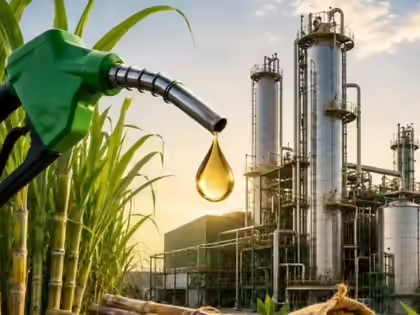
India is exploring cleaner and more diversified energy options, and ethanol as a cooking fuel has emerged as one of the promising alternatives. While LPG remains the dominant household cooking fuel, ethanol-based solutions are gaining attention for their potential to improve energy security, reduce fossil fuel imports and support the country’s biofuel economy.
This is an evergreen policy and energy explainer. Although ethanol cooking fuel is linked to ongoing government initiatives and research, the topic focuses on long-term energy strategy rather than a single breaking news event.
India’s dependence on LPG has reduced significantly over the years through domestic production and infrastructure expansion, but the country still imports a substantial portion of its LPG requirement. This makes global price fluctuations and supply disruptions an important concern. Ethanol as a cooking fuel has therefore attracted attention as policymakers explore cleaner and locally produced alternatives that could complement, rather than immediately replace, conventional LPG.
Why India Is Exploring Ethanol as a Cooking Fuel
India has already established itself as one of the world’s fastest-growing ethanol producers through its Ethanol Blended Petrol Programme. The government’s focus has primarily been on blending ethanol with petrol to reduce crude oil imports and lower vehicle emissions. This success has encouraged policymakers and researchers to examine whether ethanol can also play a larger role in household cooking.
Unlike LPG, which is largely derived from fossil fuels, ethanol is produced from agricultural feedstocks such as sugarcane, maize and surplus food grains. This gives India an opportunity to generate fuel domestically while supporting farmers and the agricultural economy.
Several pilot initiatives and clean cooking programmes have demonstrated that ethanol can be used safely in specially designed cookstoves. These stoves burn liquid ethanol efficiently, producing a blue flame with significantly lower smoke emissions than traditional biomass fuels such as firewood or charcoal.
How Ethanol Cooking Fuel Works
Ethanol cooking systems use specially designed burners that vaporise liquid ethanol before combustion. Unlike conventional LPG stoves, they do not require pressurised cylinders. Instead, households refill portable fuel containers with denatured ethanol produced specifically for cooking purposes.
One advantage of ethanol is its clean-burning nature. Properly designed ethanol stoves emit very low levels of particulate matter, reducing indoor air pollution that continues to affect millions of households using traditional cooking fuels.
The fuel is biodegradable and burns without producing soot, making kitchens cleaner while reducing exposure to harmful smoke. However, ethanol requires dedicated appliances because standard LPG stoves are not designed to use liquid biofuels safely.
Could Ethanol Reduce India’s LPG Dependence?
Ethanol has the potential to reduce India’s dependence on imported LPG, but experts believe its contribution will likely remain complementary rather than replacing LPG entirely.
India consumes millions of tonnes of LPG every year for household cooking, commercial establishments and industries. Replacing such a large energy system would require significant investments in fuel production, storage, transportation, distribution networks and consumer awareness.
In regions where ethanol feedstocks are readily available, ethanol-based cooking solutions could provide an alternative energy source, particularly for institutional kitchens, rural communities and locations where LPG logistics are more expensive.
The larger benefit lies in diversifying India’s cooking fuel mix. Relying on multiple clean energy sources makes the country less vulnerable to international energy price fluctuations and supply chain disruptions.
Benefits Beyond Energy Security
The advantages of ethanol cooking fuel extend beyond reducing LPG imports. Increased ethanol production can create new market opportunities for farmers by generating additional demand for agricultural produce.
Expansion of biofuel industries may also encourage investment in rural processing facilities, creating employment across farming, transportation and manufacturing sectors.
From an environmental perspective, sustainably produced ethanol can contribute to lower greenhouse gas emissions compared to fossil fuels. Its use also supports India’s broader objectives of expanding renewable energy and reducing carbon intensity across sectors.
Another important advantage is public health. Cleaner-burning cooking fuels reduce indoor air pollution, which remains a significant health concern in households still dependent on solid fuels such as firewood and agricultural residue.
Challenges That Need to Be Addressed
Despite its potential, ethanol cooking fuel faces several practical challenges before widespread adoption becomes possible.
The first challenge is fuel availability. Producing sufficient quantities of ethanol for both transportation and cooking would require expanded production capacity without affecting food security or agricultural sustainability.
Infrastructure is another consideration. Distribution systems for ethanol cooking fuel are still limited compared to India’s well-established LPG network, which reaches millions of households through extensive cylinder delivery systems.
Consumer awareness and acceptance also play an important role. Households are already familiar with LPG, while ethanol cooking technology remains relatively new. Large-scale adoption would require safety standards, certification, affordability and confidence in fuel availability.
Cost competitiveness will ultimately determine how attractive ethanol becomes compared to subsidised LPG for many households.
A Complementary Fuel for India’s Energy Future
Ethanol is unlikely to replace LPG completely in the foreseeable future. However, it represents an important opportunity to diversify India’s clean cooking energy portfolio.
As domestic ethanol production continues to grow and biofuel technologies mature, ethanol could become an effective supplementary cooking fuel in selected regions and applications. Continued research, pilot projects and supportive policy frameworks will help determine its long-term role.
India’s transition toward cleaner energy will depend on multiple solutions rather than a single fuel. Ethanol cooking fuel demonstrates how innovation in the biofuel sector can contribute to energy security, rural development and environmental sustainability while reducing dependence on imported fossil fuels over time.
Takeaways
- Ethanol cooking fuel offers a clean-burning alternative that could complement LPG in selected applications.
- Domestic ethanol production supports energy security by reducing reliance on imported fossil fuels.
- Cleaner combustion can help reduce indoor air pollution and improve household health outcomes.
- Infrastructure expansion, production capacity and consumer awareness remain key challenges before large-scale adoption.
Frequently Asked Questions
Q1. Can ethanol completely replace LPG in India?
Not at present. Experts consider ethanol a complementary cooking fuel rather than a complete replacement due to infrastructure, production and distribution limitations.
Q2. Is ethanol cooking fuel environmentally friendly?
Yes. Sustainably produced ethanol burns cleanly with lower particulate emissions than traditional biomass fuels and can contribute to reduced greenhouse gas emissions.
Q3. Does ethanol require a different cooking stove?
Yes. Ethanol must be used in specially designed cookstoves that safely burn liquid ethanol. Standard LPG stoves are not compatible with ethanol fuel.
Q4. Why is India interested in ethanol as a cooking fuel?
India aims to strengthen energy security, reduce dependence on imported fuels, support domestic biofuel production and promote cleaner cooking solutions for households.
(Internal keyword suggestions: ethanol cooking fuel India, ethanol vs LPG, clean cooking fuel, biofuel India, ethanol stove, India’s LPG dependence, renewable cooking fuel, ethanol energy policy, alternative cooking fuel, sustainable household energy)











Leave a comment