

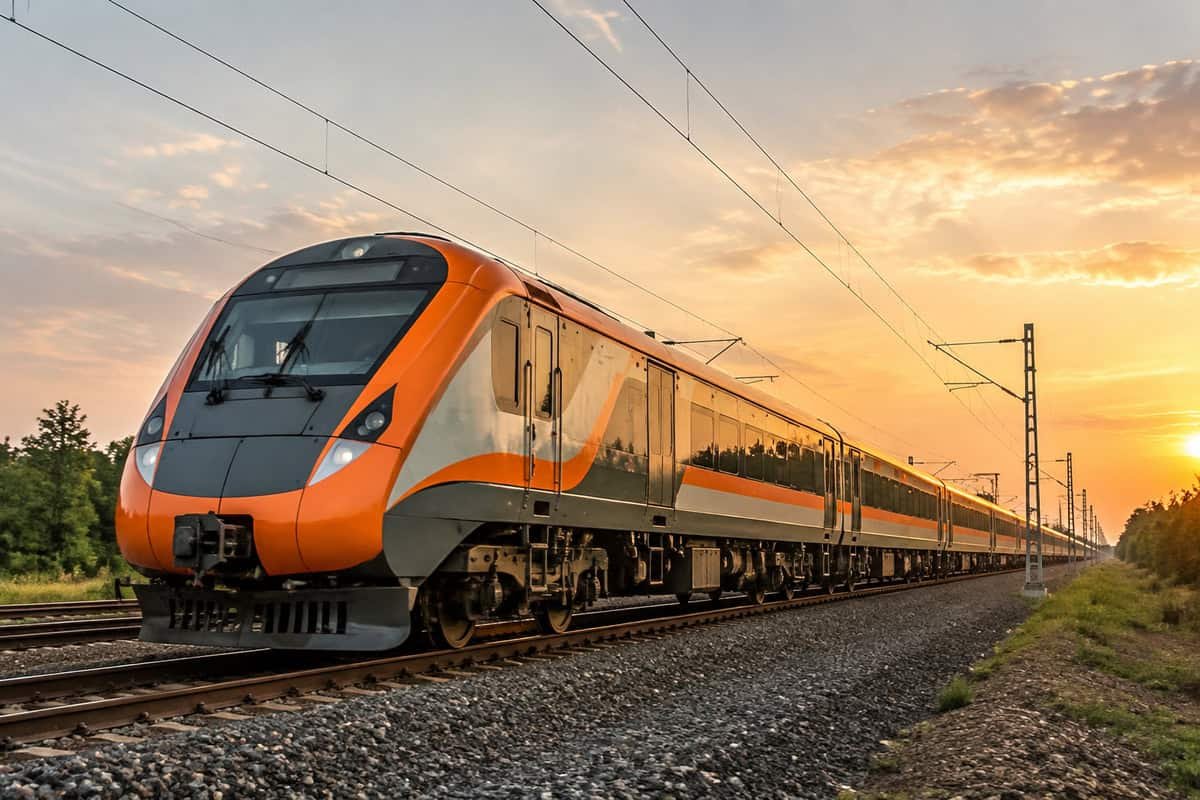
Indian Railways is expanding the Amrit Bharat Express network with seven newly approved services, strengthening long-distance connections across several states. The expansion is particularly significant for smaller cities and regional centres, where affordable rail links can improve access to jobs, education, business and major urban markets.
Seven New Amrit Bharat Express Services Approved
The Railway Board has approved seven new Amrit Bharat Express services as part of its continuing effort to expand long-distance passenger connectivity. The approved routes span northern, central, western and southern parts of India and include several important regional railway hubs.
The newly approved services include Dhanbad-Coimbatore, Prayagraj-Lokmanya Tilak Terminus, Prayagraj-Udhna, Subedarganj-Lokmanya Tilak Terminus, Gorakhpur-Delhi, Gorakhpur-Bandra Terminus and Charlapalli-Gorakhpur.
Most of these services are planned as weekly trains. Their routes include cities and junctions such as Jabalpur, Itarsi, Nagpur, Bhusaval, Kota, Ratlam, Vadodara, Gonda, Basti and Khalilabad.
For passengers in smaller cities, the importance of these routes is not simply about adding another train. Direct or improved connections can reduce the need to travel first to a major metropolitan railway station before beginning a long-distance journey.
Smaller Cities Could Gain Better Long-Distance Access
One of the clearest features of the expansion is the number of regional centres included in the routes.
The Dhanbad-Coimbatore service, for example, will pass through Nagpur, Jabalpur, Itarsi, Betul, Chandrapur, Vijayawada, Warangal, Salem, Erode and Tiruppur. It is expected to cover the full route in around 50 hours and 20 minutes and will operate once a week in each direction.
This matters because cities such as Nagpur, Jabalpur and Betul are not merely transit points. They serve large surrounding populations and connect smaller towns with wider regional economies.
The Charlapalli-Gorakhpur route also has direct relevance for central India. Its proposed stoppages include Nagpur, Betul, Itarsi and Bhopal before continuing towards Uttar Pradesh.
In practical terms, better rail connectivity can make long-distance travel more accessible for students, workers, families and small businesses that depend heavily on affordable public transport.
Nagpur Gets Another Important Rail Link
For Maharashtra, the expansion has particular relevance to Nagpur.
The Charlapalli-Gorakhpur Amrit Bharat Express is scheduled to provide a direct rail connection between Nagpur and Gorakhpur from October 2, after South Central Railway regularised an existing special service. The train will operate as train numbers 22075 and 22076.
The proposed route includes Charlapalli, Kazipet, Peddapalli, Manchiryal, Balharshah, Chandrapur, Nagpur, Betul, Itarsi, Bhopal, Bina, Jhansi, Kanpur, Lucknow and Gorakhpur, among other stops.
For Nagpur, this adds another option for passengers travelling towards eastern Uttar Pradesh. It also strengthens the city’s role as an important railway junction connecting northern, southern, eastern and western parts of the country.
The Dhanbad-Coimbatore service will also pass through Nagpur, giving the city another connection to a long-distance east-south corridor.
Why Affordable Rail Connectivity Matters
Amrit Bharat Express trains are designed as non-AC long-distance services aimed at providing modernised travel while remaining accessible to lower and lower-middle-income passengers.
According to the government, the trains were introduced to provide affordable transportation, with configurations including general and sleeper class coaches, a pantry car and luggage-cum-Divyangjan coaches. As of March 18, 2026, 60 Amrit Bharat Express services were operational across the Indian Railways network.
This positioning is important for India’s smaller cities because affordability remains a major factor in travel decisions.
A faster or more comfortable train is useful only if ordinary passengers can realistically afford it. Amrit Bharat’s non-AC configuration allows the network to target a different passenger segment from premium services such as Vande Bharat.
For students travelling to universities, workers travelling between states and families making long-distance journeys, the availability of another affordable option can make a meaningful difference.
Connectivity Can Support Local Economies
Rail connectivity also has an economic dimension.
When a smaller city gains better access to larger markets, businesses can potentially reach customers, suppliers and workers across a wider region. Improved passenger movement can also support tourism, hospitality, education and local retail.
The impact is unlikely to be uniform across every station. A weekly train cannot provide the same flexibility as a daily service, and the actual benefit will depend on timings, fares, demand and connections with other trains.
That distinction is important. The approval of a new service does not automatically mean that every city along its route will experience a major economic transformation.
However, sustained improvements in rail access can gradually strengthen the links between regional centres and larger economic hubs.
Expansion Is Also About Building a Wider Rail Network
The Amrit Bharat expansion is taking place alongside broader railway infrastructure modernisation.
The government has been developing railway stations under the Amrit Bharat Station Scheme, while also investing in capacity enhancement and station upgrades. In March 2026, the Railway Ministry said 60 Amrit Bharat Express trains were operational nationwide and that 132 stations in Maharashtra had been identified under the station redevelopment programme, with 17 completed at that time.
The combination of train services and station redevelopment is important.
A new train can improve connectivity, but passengers also depend on functioning platforms, better access, waiting areas, signage, passenger information systems and other basic facilities.
For smaller cities, the larger objective is therefore not just to introduce modern trains. It is to improve the entire travel chain connecting regional communities with the wider railway network.
What This Could Mean for Tier-2 and Tier-3 Cities
The latest approvals show a railway strategy that is not limited to metro-to-metro connectivity.
Routes involving places such as Gonda, Basti, Khalilabad, Betul, Chandrapur, Jabalpur, Itarsi and other regional centres indicate that smaller cities are increasingly being incorporated into long-distance rail planning.
That could matter for migration, employment and education patterns. A young person from a Tier-2 or Tier-3 city may have better access to opportunities in another state without needing to first travel to a major metropolitan centre.
For businesses, better connectivity can make inter-city travel easier. For tourism, it can open additional routes between destinations that previously had fewer convenient direct options.
The key question now will be how these services perform after introduction. Passenger demand, punctuality, frequency and future expansion will determine whether the initial approvals translate into sustained connectivity improvements.
Key Takeaways
- Railway Board has approved seven new Amrit Bharat Express services across India.
- Several new routes pass through important Tier-2 and regional cities, including Nagpur, Jabalpur, Itarsi, Basti and Gonda.
- Nagpur is set to gain a regular Charlapalli-Gorakhpur Amrit Bharat Express connection from October 2.
- The expansion could improve affordable access to jobs, education, business and tourism, although actual benefits will depend on frequency, timings and passenger demand.
FAQ
What is the Amrit Bharat Express?
Amrit Bharat Express is a long-distance passenger train service designed to provide modernised travel at relatively affordable fares. The trains primarily serve non-AC passenger segments, including general and sleeper class travellers.
How many new Amrit Bharat Express trains have been approved?
The Railway Board has approved seven new Amrit Bharat Express services in the latest expansion announced in August 2026.
Will Nagpur get a new Amrit Bharat Express?
Yes. The Charlapalli-Gorakhpur Amrit Bharat Express is scheduled to provide a regular connection involving Nagpur from October 2, 2026.
Why are Amrit Bharat trains important for smaller cities?
They can provide affordable long-distance connectivity between regional centres and major cities. This can make interstate travel easier for students, workers, families and businesses while reducing dependence on metro railway hubs.









Leave a comment