

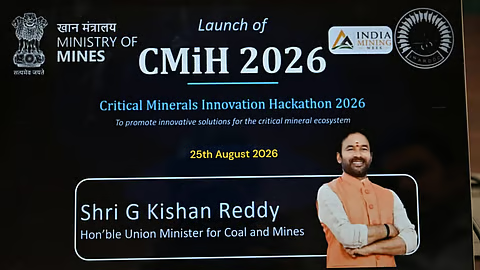
The Critical Minerals Innovation Hackathon 2026 has been launched to bring students, researchers, academic institutions, startups and technology innovators into India’s effort to strengthen its critical minerals ecosystem. The initiative focuses on practical technology solutions for mineral exploration and research intelligence.
Critical Minerals Innovation Hackathon 2026 launched
The Critical Minerals Innovation Hackathon 2026 was launched on August 25 by Union Minister for Coal and Mines G. Kishan Reddy. The initiative is being organised and hosted by the Jawaharlal Nehru Aluminium Research Development and Design Centre, or JNARDDC, Nagpur, an autonomous body under the Ministry of Mines.
The hackathon is linked to the objectives of India’s National Critical Mineral Mission, which seeks to strengthen capabilities across the critical minerals value chain.
The programme is specifically inviting students, researchers, academic and R&D institutions, startups and innovators to work on identified technical challenges. Participants will have the opportunity to present ideas, receive expert mentorship and develop selected concepts further.
According to JNARDDC, shortlisted teams can receive support to turn their ideas into proof-of-concepts or prototypes, with promising solutions potentially moving toward further research, pilot demonstrations and technology development.
Why critical minerals matter to India’s economy
Critical minerals are important inputs for several modern industries. They are used in areas including clean energy, electric mobility, electronics, advanced manufacturing and other strategic applications.
Lithium, for example, is closely associated with battery technologies, while rare earth elements have applications across electronics, energy, defence and advanced manufacturing.
This makes reliable access to these resources an economic and strategic issue. If a country depends heavily on external sources for minerals or the technologies needed to process them, disruptions in supply can affect industries further down the manufacturing chain.
India’s challenge is therefore not limited to finding mineral deposits. It also involves improving exploration methods, processing capabilities, recycling, technology development and information about research and patents.
The Ministry of Mines says the hackathon is intended to contribute to a secure and self-reliant critical minerals ecosystem, making innovation and domestic technical capability an important part of the broader policy effort.
Two problem statements define the 2026 hackathon
The Critical Minerals Innovation Hackathon 2026 is focused on two specific problem statements rather than a broad, open-ended technology challenge.
The first is Mineral Prospectivity Mapping from Open Data. Participants are expected to develop a prospectivity heatmap for lithium or rare earth element pegmatites using open data. The proposed mapping must then be validated against known mineral occurrences.
The second challenge is the development of a Smart Technology and Patent Tracker for Critical Minerals. The objective is to create an intuitive web-based system that can track research and development activity and patents related to critical minerals.
The two challenges cover different but connected parts of the sector. One deals with identifying areas that may have mineral potential, while the other focuses on understanding the technology and intellectual property landscape around critical minerals.
What the mineral mapping challenge means for students
The mineral prospectivity challenge could be particularly relevant for students and researchers working in geology, geospatial technology, data science, artificial intelligence and related fields.
The task involves using publicly available information to identify patterns that could indicate areas with potential for lithium or rare earth element pegmatites. The resulting heatmap would then need to be compared against known mineral occurrences.
This creates an opportunity to apply computational and analytical skills to a real-world resource problem.
For students, the challenge is different from a conventional academic project because the objective is connected to an operational question. A strong solution would need to demonstrate not only technical sophistication but also whether the approach can produce useful and verifiable results.
The requirement for validation is especially important. A map based only on theoretical predictions would have limited practical value unless it can be tested against geological evidence and known occurrences.
Why the patent tracker challenge matters
The second problem statement addresses a different challenge: information.
Research into critical minerals is taking place across universities, government institutions, companies and research organisations. Patents can also provide important information about technologies being developed in areas such as extraction, processing, recycling and related applications.
A smart technology and patent tracking system could make it easier to find and organise this information.
For researchers and startups, such a system could potentially help identify existing technologies, understand areas of active research and reduce duplication of effort. It could also make it easier to track technological developments over time.
The Ministry has specifically described the proposed platform as a web-based Smart R&D and Patent Tracking System for critical minerals.
The challenge therefore sits at the intersection of technology intelligence, research management and the critical minerals sector.
Startups can approach the challenges differently
For startups, the hackathon offers a chance to work on a defined industry problem rather than developing a technology without a clear application.
A startup with expertise in geospatial analytics could explore the mineral mapping challenge. A company working in data platforms, artificial intelligence, search technology or intellectual property analytics could potentially approach the patent tracker challenge.
The official framework also goes beyond simply awarding prizes. JNARDDC says shortlisted teams will receive expert mentoring and that promising ideas could be developed into proof-of-concepts or prototypes.
That distinction matters for early-stage innovators. A prototype developed through the programme could provide technical validation that may help researchers and startups pursue further R&D or pilot opportunities.
However, participation should not be viewed as a guaranteed route to commercialisation. Moving from a hackathon prototype to a deployable technology would still require testing, funding, domain validation and, where applicable, regulatory or institutional approvals.
Submission deadline and prize details
The deadline for submitting ideas for CMiH 2026 is September 20, 2026.
The winners are scheduled to be announced during India Mining Week 2026, which is planned for November 15 to 17. There will be two winning teams for each of the two problem statements.
For each problem statement, the first-prize team will receive ₹1.50 lakh, while the second-prize team will receive ₹1 lakh.
This means the total prize allocation across both challenges will be ₹5 lakh.
The official JNARDDC page provides the problem statements, applicant guidelines and registration information.
Why Nagpur is significant to the initiative
The hackathon is being hosted by JNARDDC in Nagpur, giving the city a direct role in an initiative connected to India’s critical minerals strategy.
JNARDDC operates under the Ministry of Mines and has a research and development mandate related to aluminium and mineral technologies. Its role as the host institute places Nagpur at the centre of the 2026 innovation programme.
For students and researchers in Nagpur and other Tier-2 cities, the initiative also demonstrates how specialised government research institutions can connect local academic and technical talent with national-level technology challenges.
The opportunity is not restricted to participants from major metropolitan technology hubs. The official invitation includes students, researchers, academic and R&D institutions, startups and innovators broadly.
What this means for India’s critical minerals strategy
India’s critical minerals challenge cannot be solved through mining alone.
Exploration needs better technology. Extracted minerals need processing capacity. Materials can potentially be recovered through recycling. Research needs to move efficiently between laboratories and industry. Technology developments need to be identified and evaluated.
The CMiH 2026 problem statements reflect two pieces of this larger requirement: finding potential mineral resources more effectively and improving access to information about research and patents.
The National Critical Mineral Mission provides the broader policy framework, while initiatives such as this hackathon attempt to bring technical talent into specific challenges.
The immediate outcome will depend on the quality of solutions submitted and how successfully promising concepts are developed after the competition. The longer-term value will be clearer if successful ideas progress beyond prototypes into research programmes, pilots or deployable technologies.
A practical opportunity for India’s young innovators
For students, the hackathon offers exposure to a strategic sector that is closely connected to energy, mobility, electronics and advanced manufacturing.
For researchers, it provides a defined problem where existing academic and technical expertise can be applied to a national priority.
For startups, it creates an opportunity to demonstrate technology against real sector-specific requirements.
The prize money is one incentive, but the larger opportunity is access to expert mentoring and the possibility of developing a technically feasible idea into a prototype.
With submissions open until September 20, the immediate focus is now on the quality of ideas that participants can bring to the two challenges. If the programme succeeds in connecting promising technical solutions with further R&D and deployment, it could become one part of India’s broader effort to build domestic capability in critical minerals.
Key Takeaways
- The Critical Minerals Innovation Hackathon 2026 was launched on August 25 by Union Minister G. Kishan Reddy and is hosted by JNARDDC, Nagpur.
- The two challenges focus on mineral prospectivity mapping for lithium or rare earth element pegmatites and a web-based R&D and patent tracking system.
- Students, researchers, academic and R&D institutions, startups and innovators are eligible to participate, with shortlisted teams receiving expert mentorship.
- Ideas must be submitted by September 20, 2026, while winners are scheduled to be announced during India Mining Week from November 15 to 17.
Frequently Asked Questions
Q1. What is the Critical Minerals Innovation Hackathon 2026?
The Critical Minerals Innovation Hackathon 2026 is a Ministry of Mines initiative designed to encourage students, researchers, academic institutions, startups and innovators to develop technical solutions for identified challenges in India’s critical minerals sector.
Q2. What are the two challenges in CMiH 2026?
The first challenge involves developing a prospectivity heatmap for lithium or rare earth element pegmatites using open data and validating it against known mineral occurrences. The second involves creating a web-based system to track R&D and patents related to critical minerals.
Q3. What is the last date to submit ideas?
The last date for idea submission is September 20, 2026. Winners are scheduled to be announced during India Mining Week 2026, from November 15 to 17.
Q4. What are the prizes for the winners?
For each of the two problem statements, the first-prize team will receive ₹1.50 lakh and the second-prize team will receive ₹1 lakh. Two winning teams will be selected for each challenge.
(Internal keywords: Critical Minerals Innovation Hackathon 2026, CMiH 2026, critical minerals India, critical minerals hackathon, JNARDDC Nagpur, Ministry of Mines hackathon, National Critical Mineral Mission, lithium India, rare earth elements India, mineral exploration technology, India mining innovation, startup hackathon India, student hackathon 2026)











Leave a comment