

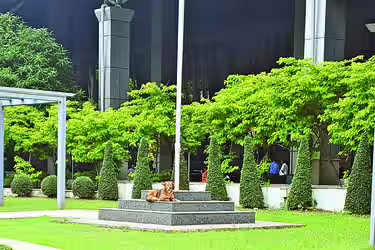
Chandrapur’s 104-year-old Sarai Building has received protected monument status from the Maharashtra government, ending a four-year legal battle over its proposed demolition. The decision gives the historic structure legal protection and places future alterations, repairs and redevelopment under archaeological oversight.
Chandrapur Sarai Building finally receives legal protection
The Maharashtra government has formally granted protected monument status to the historic Sarai Building in Chandrapur, bringing an end to years of uncertainty over the future of the century-old structure. The decision was communicated to the Nagpur Bench of the Bombay High Court through an affidavit filed in an ongoing Public Interest Litigation.
The building, located on Railway Station Road in Sarai Ward, was constructed in 1921. It was originally established as a charitable rest house for pilgrims visiting the Mahakali Temple in Chandrapur.
The structure survived for more than a century and became part of the city’s built heritage. Its preservation had been challenged by plans for redevelopment, leading citizens and heritage advocates to approach the court.
The government has now officially recognised the building as a protected monument under the Maharashtra Ancient Monuments and Archaeological Sites and Remains Act, 1960. The notification means that its future can no longer be decided simply as an ordinary municipal property.
Why the 1921 Sarai Building matters to Vidarbha
The importance of the Chandrapur Sarai goes beyond its age. The building represents a period of Chandrapur’s urban development when public facilities, religious travel and charitable institutions played an important role in the city’s social life.
The Sarai was built through contributions from donors, landlords and the government. Its original purpose was to provide accommodation to pilgrims visiting the Mahakali Temple, connecting the building directly with one of Chandrapur’s important religious and cultural traditions.
Architecturally, the building is known for its colonial-era design, including arched verandahs and stone masonry. These features distinguish it from many newer structures that dominate rapidly developing urban areas.
For Vidarbha, where several towns have undergone substantial redevelopment over the decades, the survival of an early 20th-century public building provides a physical link to the region’s urban history.
Chandrapur itself has a much older historical background. The district administration notes that the area has been associated with Gond and Maratha rule and that the city was historically known by different names before becoming Chandrapur.
Four-year legal battle stopped proposed demolition
The heritage status comes after a prolonged legal dispute over the proposed demolition of the building.
The Chandrapur Municipal Corporation had proposed demolishing the structure as part of an Integrated Urban Development Programme. The plan involved developing a commercial complex at the site, with the civic body citing the building’s dilapidated condition.
Citizens challenged the proposed demolition through a Public Interest Litigation filed in 2022 before the Nagpur Bench of the Bombay High Court. Ashok Jairaj Singh and Madhusudan Roongta approached the court through advocates Amol Mardikar and Ratna Singh, seeking protection for the historic structure.
The case continued as different authorities considered the question of whether the building qualified for formal protection.
A significant development came in 2024, when the High Court sought clarity from the Archaeological department on whether the century-old structure would be declared a protected monument. The court’s intervention kept the issue under scrutiny while the government considered its heritage status.
Maharashtra issued heritage notifications in two stages
The legal protection did not happen immediately.
According to the state’s affidavit submitted before the High Court, the Maharashtra government first issued an intent notification on April 15, 2025. This was followed by the final notification on May 22, 2026, formally granting protected monument status to the Sarai Building.
The notification was issued under the Maharashtra Ancient Monuments and Archaeological Sites and Remains Act, 1960.
This distinction is important because the recent development is not merely a symbolic heritage recognition. Protected monument status creates a legal framework governing what can happen to the property.
Any alteration, demolition, construction or repair work at the site will require permission from the Directorate of Archaeology and Museums.
That gives the state archaeological authorities a formal role in deciding how the structure is maintained and what kind of conservation work can be carried out.
Sarai has historical associations beyond architecture
The building’s significance is also linked to historical figures who are reported to have visited Chandrapur.
According to the latest report, the Sarai Building is associated with visits by national leaders including Mahatma Gandhi and Veer Savarkar. Such associations add another layer to the building’s historical importance, although the primary basis for its protection is its architectural, cultural and historical value as a century-old public structure.
For a city such as Chandrapur, preserving such sites can help document aspects of local history that may not be captured by monuments associated with major political events alone.
A former pilgrim rest house can reveal how people travelled, where they stayed, how charitable institutions functioned and how religious centres shaped the growth of towns.
That makes the Sarai relevant not only to heritage specialists but also to residents interested in Chandrapur’s social history.
What protected monument status means now
The most immediate change is legal.
Before the notification, the building’s future was tied to an unresolved dispute involving its condition and a proposed redevelopment project. Now, the structure has formal protection under state archaeological law.
This does not mean that the building can simply be left untouched. Heritage protection usually creates a responsibility to conserve, maintain and document the structure appropriately.
Any repair work will have to be undertaken within the permissions and requirements of the Directorate of Archaeology and Museums. This is particularly important because the building has been standing for more than 100 years and was already described as being in a dilapidated condition during the redevelopment debate.
The next challenge is therefore conservation. Recognition prevents demolition, but preserving a historic building requires sustained technical and financial attention.
High Court now wants civic body to explain next steps
The heritage notification has also changed the legal position before the Bombay High Court.
The state government has asked that the Public Interest Litigation be disposed of following its declaration of protected status. The petitioners, however, remain involved in the proceedings concerning the building’s future.
The High Court has directed the Chandrapur civic body to file an affidavit explaining the steps it proposes to take in view of the government’s notification.
This means the question has now shifted from whether the building should receive protection to what should happen to it under that protection.
The civic body’s response could provide greater clarity on conservation, maintenance and the status of earlier redevelopment plans.
The outcome is significant because a heritage designation needs to be followed by practical preservation measures if the building is to remain usable and structurally safe for future generations.
Why Chandrapur’s heritage matters for Vidarbha
The Sarai Building’s protection also raises a broader issue for Vidarbha’s historic towns.
Urban development has changed Chandrapur and other cities across the region considerably. Older buildings can face pressure from new roads, commercial projects, redevelopment and changing land values.
Once a historic structure is demolished, its original architectural character and connection to local history cannot be recreated simply by constructing a replica.
Chandrapur’s heritage includes more than individual monuments. The district’s history reflects Gond, Maratha and later colonial influences, while its cultural identity includes longstanding local traditions and communities.
The Sarai Building therefore represents one small but tangible part of a much larger regional story.
Its protection could encourage greater attention to other historically significant structures that may not yet have formal legal protection.
The next challenge is conservation, not recognition
The government’s decision settles one major question, but it also creates a new responsibility.
The Sarai Building now needs a practical conservation plan that addresses its structural condition while respecting its original architectural character. Any restoration should ideally document existing features before intervention and ensure that repairs do not erase the qualities that made the structure historically valuable.
The building’s future could also have implications for heritage awareness in Chandrapur. If properly conserved, the Sarai could become a point of public interest for residents, students, researchers and visitors studying the city’s history.
For now, the most important development is that demolition is no longer the immediate question. The state has formally recognised the building as a protected monument.
After four years of legal uncertainty, Chandrapur’s 104-year-old Sarai has secured its place within Maharashtra’s protected heritage landscape. The next test will be whether that legal protection translates into careful conservation and a sustainable future for the landmark.
Key Takeaways
- Maharashtra has granted protected monument status to Chandrapur’s 104-year-old Sarai Building, constructed in 1921.
- The decision follows a four-year legal battle over a proposal to demolish the structure for a commercial complex.
- The building is known for its colonial-era architecture, arched verandahs and stone masonry and was originally built as a charitable rest house for Mahakali Temple pilgrims.
- Future alterations, repairs, construction or demolition will require permission from the Directorate of Archaeology and Museums.
FAQ
When was Chandrapur’s Sarai Building constructed?
The Sarai Building was constructed in 1921, making it 105 years old in 2026 by calendar-year calculation. Recent reports describe it as 104 years old based on the elapsed period since its construction. It was built as a charitable rest house for pilgrims visiting the Mahakali Temple.
Why was the Sarai Building facing demolition?
The Chandrapur Municipal Corporation had proposed demolishing the building as part of an Integrated Urban Development Programme to make way for a commercial complex. The proposal was challenged by citizens who argued that the structure had significant historical and cultural value.
What does protected monument status mean for the Sarai Building?
The status gives the structure legal protection under Maharashtra’s ancient monuments law. Alterations, demolition, construction and repair work will require permission from the Directorate of Archaeology and Museums.
What happens to the building after receiving heritage protection?
The immediate priority is expected to be determining appropriate conservation and maintenance measures. The Bombay High Court has directed the Chandrapur civic body to explain the steps it proposes to take following the government’s heritage notification.
(Chandrapur Sarai Building, Chandrapur heritage building, Chandrapur heritage news, Sarai Building heritage status, Vidarbha heritage, Chandrapur history, Maharashtra protected monuments, Chandrapur Mahakali Temple, Chandrapur heritage conservation, Maharashtra heritage buildings)










Leave a comment