

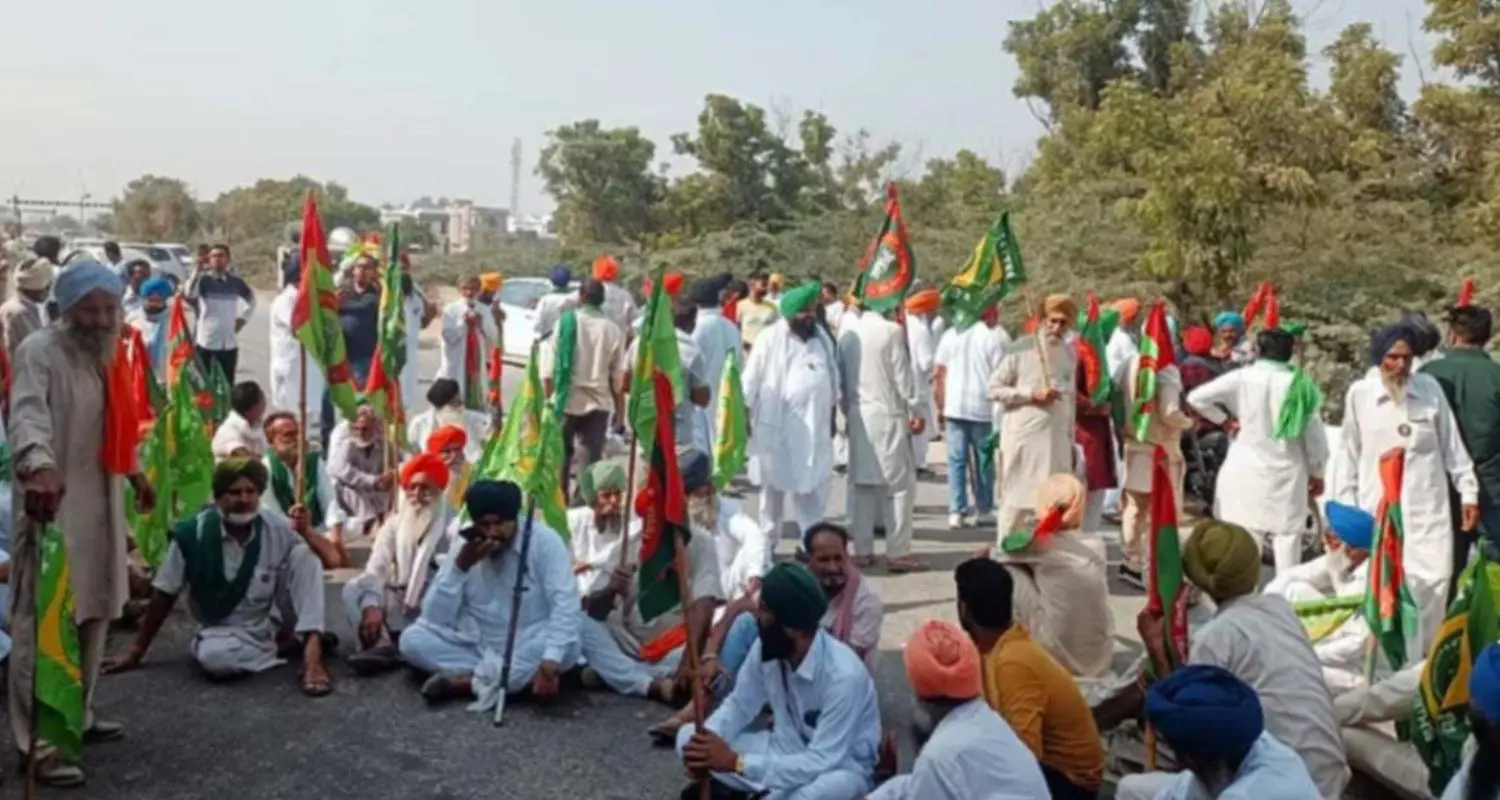
Haryana farmers are protesting over the delayed start of paddy procurement for the 2026-27 kharif marketing season. The dispute centres on procurement dates, early crop arrivals, access to government purchase at MSP and the difficulties farmers face when produce reaches mandis before official buying begins.
Why Haryana Farmers Are Protesting Over Paddy Procurement
The Haryana paddy procurement row has intensified after farmer groups demanded that government agencies begin purchasing paddy earlier than the scheduled date. The issue escalated in Shahabad, Kurukshetra, on September 22, when farmers under the Bharatiya Kisan Union (Charuni) attempted to block National Highway-44.
Police used water cannons and tear gas to disperse protesters after some farmers crossed barricades and reached the highway. Traffic was temporarily affected before regular movement was restored.
The immediate disagreement is over timing. Farmers had initially demanded procurement from September 15 and later accepted September 22 as a deadline. When government procurement had still not begun by that date, the union went ahead with its planned protest.
The controversy is therefore not simply about the Minimum Support Price. It is also about when farmers can actually sell their harvested crop through the government procurement system.
Paddy Procurement Was Scheduled From October 1
For the 2026-27 kharif marketing season, the scheduled paddy procurement period in Haryana is October 1 to November 15. The state government had asked the Centre to advance the start to September 20 because paddy arrivals had begun earlier and farmer organisations were demanding an early procurement window.
The request followed a similar development last year. Haryana’s procurement schedule was advanced to September 22 in 2025 after farmers sought an earlier start. This year, farmer groups again argued that some varieties were already arriving in the mandis and should not have to wait until October.
The state government’s request to begin procurement earlier did not translate into an immediate start of the central procurement window. That gap between the scheduled system and the timing of actual crop arrivals has become the central point of the dispute.
Why Early Procurement Matters to Farmers
Paddy harvesting does not necessarily follow the official procurement calendar perfectly. Different varieties mature at different times, and farmers may have to harvest when the crop is ready or when weather conditions make delay risky.
Reports from Haryana mandis indicated that paddy arrivals had already started before government procurement began. In Ambala, farmers had reportedly faced difficulties finding space to dry and clean harvested paddy, while large quantities were already lying in the market.
When harvested produce reaches a mandi but government agencies are not purchasing it, farmers can face additional handling, storage and transportation problems.
For farmers who depend on timely sale of their crop to repay loans, pay input costs or prepare for the next agricultural cycle, delays can create additional financial pressure.
What MSP Means in the Current Paddy Dispute
Minimum Support Price, or MSP, is an important part of the issue because farmers want access to government procurement at the notified price.
For the 2026-27 kharif marketing season, the Union government has fixed the MSP for common paddy at ₹2,441 per quintal. The MSP for Grade A paddy is ₹2,461 per quintal. The common paddy MSP was increased by ₹72 per quintal from the previous season.
The existence of an MSP, however, does not automatically mean every farmer can sell immediately at that price. Procurement depends on factors including the opening of purchase centres, registration and verification, quality specifications, weighing, storage and the participation of procurement agencies.
This is why the procurement schedule has become such a significant issue for farmers in Haryana.
Government Says Arrangements Are Being Made
The Haryana government has said preparations are being made to ensure that farmers do not face difficulties during the procurement season.
Chief Minister Nayab Singh Saini reviewed arrangements with farmers, commission agents, traders, rice millers and administrative officials at Babain Grain Market in Kurukshetra on September 20. He warned that action would be taken if negligence was found during procurement.
The state has also reopened the Meri Fasal Mera Byora portal from September 21 to 27 for farmers to submit applications. Farmers whose verification is pending have been advised to approach the concerned Sub-Divisional Magistrate.
The government has said that every grain produced by farmers will be procured, while officials have been instructed to ensure the process runs smoothly.
The challenge now is translating those assurances into functioning procurement arrangements at the ground level.
Farmers Are Also Raising Mandi Infrastructure Concerns
The dispute is connected to more than just the official procurement date.
Farmer representatives and mandi officials have discussed issues such as the availability of gunny bags and adequate space for drying paddy. Earlier this month, officials in Kurukshetra told farmers that arrangements were being made for gunny bags and that space for drying the crop was also an issue.
Such infrastructure matters because freshly harvested paddy can contain higher moisture and may require drying before it meets procurement specifications.
The issue of moisture has also emerged in Haryana’s preparations for the new procurement season, with farmers seeking a higher permissible moisture limit for paddy procurement.
For farmers, the practical question is whether they can bring their crop to the mandi, get it tested, weighed and accepted, and receive payment without prolonged delays.
Rice Millers Add Another Layer to the Problem
Rice millers are an important part of the paddy procurement chain because government-procured paddy can subsequently be processed into rice under the custom milling system.
A report published on September 23 said rice millers in Haryana were reluctant to register for custom-milled rice for the 2026-27 season, citing unresolved issues and lack of clarity.
This matters because procurement is not limited to buying grain from farmers. The system also requires storage, transportation, milling and delivery of processed rice to the government system.
Any delay or uncertainty at one stage can create pressure elsewhere in the supply chain.
What Happens Next in Haryana
As of September 23, the immediate dispute remains unresolved, with farmer organisations continuing to demand early procurement. Reports from Shahabad said farmers planned to continue their agitation after the September 22 confrontation, while the exact start of procurement remained a key question.
At the same time, the Haryana government is continuing preparations for the procurement season and has publicly directed officials to prevent lapses.
The coming days will be important because paddy arrivals are expected to increase as harvesting progresses. The pressure on mandis could rise if arrivals increase faster than government procurement and lifting arrangements.
For farmers, the central issue is straightforward: they want their harvested paddy accepted through the procurement system without having to wait while the crop accumulates in mandis.
Why the Paddy Row Matters Beyond Haryana
Haryana is one of India’s major agricultural states, and paddy procurement has implications beyond individual farmers. Government procurement feeds into the country’s foodgrain management system, including storage and public distribution.
The state government’s Food, Civil Supplies and Consumer Affairs Department is responsible for procurement of foodgrains under the MSP system and their proper storage before delivery to the Food Corporation of India.
That makes an orderly procurement process important for farmers, traders, millers and the wider food supply chain.
The current protest highlights a recurring challenge in agricultural markets: the difference between announcing a support price and ensuring that farmers can practically access the procurement system when their crop is ready.
Key Takeaways
- Haryana farmers are demanding early government procurement of paddy instead of waiting for the scheduled October 1 start.
- The 2026-27 MSP is ₹2,441 per quintal for common paddy and ₹2,461 for Grade A paddy.
- The dispute escalated in Shahabad on September 22 when protesters attempted to block NH-44 and police used water cannons and tear gas.
- The Haryana government says procurement arrangements are being strengthened and has reopened the Meri Fasal Mera Byora registration portal from September 21 to 27.
FAQs
Why are Haryana farmers protesting over paddy procurement?
Farmers are demanding that government agencies start purchasing paddy earlier because arrivals have already begun in several mandis. They argue that delaying procurement can leave harvested produce waiting in markets and increase the risk of financial and logistical difficulties.
What is the MSP for paddy in Haryana in 2026-27?
For the 2026-27 kharif marketing season, the MSP is ₹2,441 per quintal for common paddy and ₹2,461 per quintal for Grade A paddy.
When was Haryana’s paddy procurement scheduled to begin?
The scheduled procurement period for paddy in Haryana is October 1 to November 15, 2026. Haryana requested that procurement be advanced to September 20 because of early arrivals and farmer demands.
What happened during the September 22 farmer protest?
Farmers affiliated with BKU (Charuni) attempted to block NH-44 near Shahabad in Kurukshetra. Police used water cannons and tear gas after protesters crossed barricades and reached the highway.







Leave a comment