

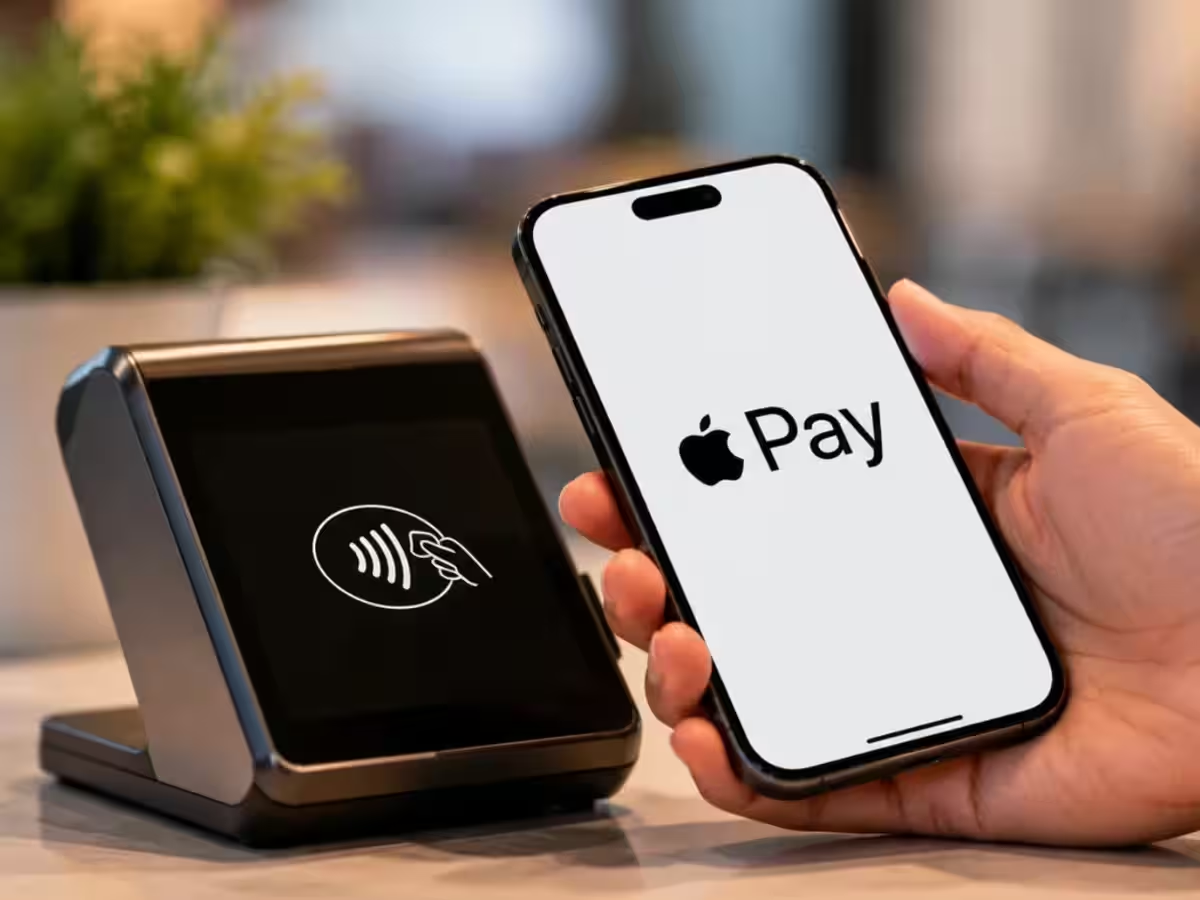
Apple Pay is expected to enter India’s payments market in the coming months, but its initial rollout is not expected to include UPI. The development comes as India is expanding UPI with tap-and-pay features, making the payment landscape increasingly competitive.
Apple Pay India launch is expected without UPI
Apple Pay’s India entry is expected to take place by October 2026, according to a Business Standard report citing people familiar with the plans. However, the service is expected to initially support Visa and Mastercard credit cards rather than UPI transactions.
That distinction is important because India’s digital payment market works very differently from many other countries where Apple Pay is already established.
In India, UPI has become the dominant way for consumers to make everyday digital payments. It allows users to transfer money directly between bank accounts and pay merchants through participating apps and banks.
The latest NPCI figures show that UPI processed 24.51 billion transactions worth ₹29.82 lakh crore in August 2026. The network had 752 participating banks during the month.
Apple Pay will therefore be entering a market where consumers already have a deeply established payment habit.
The bigger question is not simply whether Apple Pay can become another wallet-like payment option. It is whether Apple can eventually integrate its payment experience with the UPI infrastructure that Indian consumers already use every day.
Why UPI is so important to India’s payment market
UPI has become the foundation of India’s consumer digital payments ecosystem.
Unlike conventional card payments, UPI allows money to move directly between bank accounts. Users can pay merchants by scanning QR codes, entering payment details or using supported contactless methods.
Its scale has expanded rapidly. NPCI data shows monthly UPI transaction volume rising from 22.35 billion in April 2026 to 24.51 billion in August.
The system is also no longer limited to major metropolitan areas. UPI QR codes are now a familiar sight at neighbourhood shops, vegetable markets, restaurants, pharmacies and small businesses across Indian cities and towns.
This creates a major challenge for any international payment service entering India.
Apple Pay cannot simply replicate its international card-based model and expect it to replace UPI behaviour. Indian users are already accustomed to opening a UPI app, scanning a QR code and authorising a bank-account payment.
For Apple, the opportunity is therefore likely to be about adding convenience around existing payment behaviour rather than immediately replacing it.
Apple Pay and UPI currently follow different models
The difference between Apple Pay and UPI starts with how the payment is funded.
Apple Pay generally acts as a digital payment layer for eligible cards stored on a user’s device. The card network and issuing bank remain part of the transaction infrastructure.
UPI, by contrast, connects bank accounts through India’s interoperable real-time payment system.
The expected initial Apple Pay rollout in India is centred on Visa and Mastercard credit cards. Business Standard reported that Apple was negotiating transaction fees with banks and that UPI would not be supported at launch.
That means an iPhone user could potentially use Apple Pay for supported card transactions, while continuing to rely on a UPI app for QR-based bank payments.
This could create a two-track payment experience on the same device.
Whether that changes consumer behaviour will depend on how easy Apple makes card payments, which merchants accept contactless payments and whether Apple eventually reaches an agreement that allows UPI integration.
India has just introduced UPI Tap and Pay
The timing of Apple Pay’s expected entry is particularly interesting because UPI itself has just moved closer to the contactless experience associated with services such as Apple Pay.
NPCI has introduced UPI Tap and Pay, allowing users to make payments by tapping NFC-enabled smartphones at compatible point-of-sale terminals. The feature is designed to provide a contactless alternative to conventional QR scanning.
Google Pay has also introduced Tap and Pay on UPI for supported NFC-enabled Android devices and compatible merchant infrastructure.
This changes the competitive picture.
Previously, Apple Pay could potentially have entered India with a clear differentiation around contactless payments. Now UPI itself is adopting that experience.
For consumers, this could mean that the difference between card-based contactless payments and UPI-based contactless payments becomes less visible at the point of sale.
Tap and Pay could change everyday UPI payments
The new UPI contactless system is particularly relevant for small everyday purchases.
Instead of opening an application and scanning a QR code, a user can bring a compatible phone close to an NFC-enabled merchant terminal or tag.
The convenience is similar to tapping a contactless card.
According to reporting on the new UPI feature, transactions up to ₹5,000 can be made through the new tap-and-pay mechanism without entering a UPI PIN, subject to the applicable rules and authentication requirements.
The broader UPI Tap and Pay rollout also uses NFC technology, which can make the payment initiation process faster in supported locations.
This matters because payment convenience can influence which method consumers choose at the point of sale.
If UPI becomes as easy as tapping a phone, Apple Pay’s contactless advantage becomes less distinctive in India.
Apple users may still prefer the Apple ecosystem
That does not mean Apple Pay has no opportunity.
Apple has a large and growing installed base of iPhones in India, particularly among consumers who already use Apple devices and services.
For those users, Apple Pay could offer a more integrated experience across the iPhone, Apple Watch and other compatible Apple hardware.
The convenience of authenticating a card through Apple’s device ecosystem could appeal to consumers who already prefer using their iPhone for payments.
The bigger question is merchant acceptance.
India has an enormous QR-based payment ecosystem, while card acceptance through NFC terminals is more concentrated in formal retail, hospitality, organised businesses and other locations with compatible point-of-sale infrastructure.
If Apple Pay initially focuses on cards, its usefulness could therefore depend more heavily on where contactless card payments are accepted.
UPI has an advantage because its QR infrastructure reaches much deeper into India’s small-merchant economy.
UPI’s scale gives India unusual leverage
India’s payment ecosystem gives domestic infrastructure an important advantage.
UPI has become so large that international companies entering India’s digital payments market have to work around an existing system rather than introduce an entirely new consumer habit.
Prime Minister Narendra Modi recently called for UPI to be integrated with payment systems in more countries. The government said UPI was accepted in 11 countries as of August 2026, including Greece and the Maldives.
That international expansion strengthens UPI’s position as a payment infrastructure rather than simply another Indian payments app.
For Apple, this means that an India-specific payment strategy may eventually become necessary.
The company can bring its global technology and user experience to India, but it still has to accommodate a payments market built around UPI, domestic regulations and local banking relationships.
Could Apple Pay eventually support UPI?
This remains one of the biggest unanswered questions.
There is currently no confirmed announcement establishing that UPI will be available through Apple Pay when the service launches in India.
The available reporting instead indicates that the initial launch is expected to support Visa and Mastercard credit cards without UPI.
Any future UPI integration would require Apple to work with the relevant Indian payment ecosystem participants and comply with NPCI and regulatory requirements.
It would also raise questions about how UPI accounts would be linked, how authentication would work and how transaction responsibilities would be divided among Apple, banks and payment service providers.
Until Apple or the relevant Indian authorities officially announce such an arrangement, claims about a confirmed Apple Pay UPI launch should be treated cautiously.
India’s payment market is changing beyond Apple Pay
Apple Pay is arriving at a time when India’s payment ecosystem itself is undergoing significant changes.
UPI is expanding into contactless payments, while NPCI is also developing new authentication and payment features.
NPCI’s current circulars show continued work on areas such as international mobile application payment acceptance, additional authentication methods and on-device biometric authentication.
There is also a broader push towards AI-assisted payments.
Reuters reported that NPCI is developing a registry to verify and monitor AI agents that could eventually conduct transactions on behalf of users through UPI.
These developments suggest that the next stage of India’s payment market may not simply be about choosing between cards and UPI.
It could involve contactless payments, biometric authentication, AI-assisted transactions and increasingly international UPI connectivity.
Merchant fees could also influence the competitive landscape
Another factor to watch is the changing economics of UPI.
India has historically kept UPI transactions highly accessible by maintaining a zero-MDR structure for many transactions. However, recent policy changes have opened the door to threshold-based merchant charges for a limited set of transactions.
Reuters reported that the government passed legislation allowing merchant fees to be reintroduced for certain UPI transactions, while person-to-person transactions remain free.
The exact economics will matter to banks, payment apps and merchants.
If UPI payment economics change, card-based systems could become relatively more attractive for some businesses, particularly for higher-value transactions.
At the same time, UPI’s enormous consumer adoption means merchants are unlikely to abandon it simply because alternative payment methods become more competitive.
What Apple Pay could mean for Indian consumers
For consumers, the immediate impact may be relatively limited if Apple Pay launches without UPI support.
An iPhone user could gain another way to use eligible cards, particularly at contactless-enabled terminals.
But the longer-term impact could be more significant.
Apple’s arrival could increase competition in India’s premium digital payments segment. It could also encourage payment companies, banks and device manufacturers to improve contactless experiences.
At the same time, UPI’s new Tap and Pay feature means Indian consumers will have a domestic alternative that uses the same basic contactless interaction.
The result could be more choice rather than one system replacing another.
What could change in the coming months
The next few months will be important for India’s digital payment market.
The first development to watch is the actual timing and scope of Apple Pay’s India launch. The second is whether Apple eventually adds UPI support.
The third is the adoption of UPI Tap and Pay. If merchants widely deploy compatible NFC infrastructure and consumers begin using it regularly, contactless UPI could become a serious alternative to card-based tap payments.
The fourth is how banks respond to the changing payment economics and competition between card networks, UPI and technology platforms.
For consumers, the most visible change could be simple: payments may require fewer steps.
Instead of choosing between scanning a QR code, inserting a card or tapping a card, users could increasingly choose between tapping their phone through UPI, tapping an Apple device with a card, or using another digital payment method.
That competition could make India’s already advanced digital payment market even more convenient.
Key Takeaways
- Apple Pay is expected to launch in India by October 2026, but current reporting indicates that UPI will not be supported at the initial launch.
- UPI processed 24.51 billion transactions worth ₹29.82 lakh crore in August 2026, showing the scale Apple Pay will enter.
- UPI Tap and Pay now allows contactless payments using NFC, reducing one of the major convenience differences between UPI and card-based mobile payments.
- The biggest potential change will come if Apple eventually integrates UPI, but no confirmed announcement currently establishes when or whether that will happen.
FAQ
When is Apple Pay expected to launch in India?
Apple Pay is expected to launch in India by October 2026, according to a Business Standard report citing people familiar with the plans. The reported initial rollout is expected to focus on Visa and Mastercard credit cards.
Will Apple Pay support UPI in India at launch?
Current reporting indicates that Apple Pay will not support UPI at the initial India launch. Any future UPI integration would require further arrangements with India’s payment ecosystem and regulatory framework.
What is UPI Tap and Pay?
UPI Tap and Pay is a contactless payment feature that uses NFC-enabled devices and compatible merchant infrastructure. It allows users to initiate UPI payments by tapping their smartphone rather than relying solely on QR scanning.
Will Apple Pay replace UPI in India?
There is currently little evidence to suggest that Apple Pay could replace UPI. UPI processed more than 24.5 billion transactions in August 2026 and is deeply integrated into India’s merchant payment ecosystem. Apple Pay is more likely to add another payment option, at least initially.









Leave a comment