

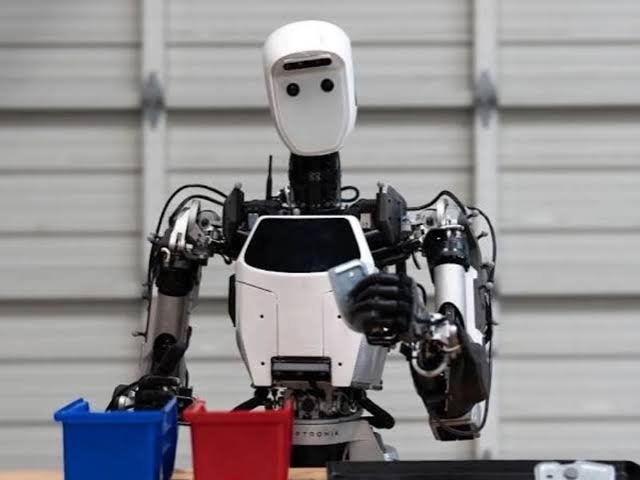
Bengaluru-based deeptech startup Cosine Robots has raised ₹22.36 crore in a funding round led by Avaana Capital. The investment will support research, production and engineering expansion as the company develops robotic actuators for industrial robots, quadrupeds and humanoid machines.
Cosine Robots Funding: Who Invested and Why?
Cosine Robots announced its ₹22.36 crore funding round on November 24, 2026. The investment was led by deeptech-focused venture capital firm Avaana Capital, with participation from WEH Ventures and angel investors.
Founded by Kiran Mathew Koshy and Delip Thomas, the Bengaluru startup develops integrated servo actuators and advanced motion systems used in robotics.
The company plans to use the fresh capital to establish a dedicated research and development and production facility, expand its engineering team and accelerate the development of its actuator portfolio.
The proposed facility will bring precision machining, assembly, calibration and endurance testing under one roof. These capabilities are important because robotic components must meet demanding requirements for accuracy, reliability and durability.
The funding is significant for India’s robotics hardware ecosystem because it supports a company working on the components that make robotic movement possible, rather than only developing complete robots.
What Does Cosine Robots Actually Build?
Cosine Robots focuses on actuators, which are essential components in robotic systems.
An actuator converts energy into physical movement. In a robot, it helps control the movement of joints, including how far they rotate, how quickly they move and how much force they can produce.
These components can be compared with muscles and joints in the human body. A humanoid robot may have advanced artificial intelligence and cameras, but without reliable actuators, it cannot walk, lift objects or perform controlled physical tasks.
Cosine’s integrated servo actuators combine several components into a single system:
- Precision motors that generate movement.
- Gearboxes that regulate speed and torque.
- Sensors that monitor position and movement.
- Electronics that manage the system.
- Proprietary control software that coordinates performance.
By developing these elements together, the company aims to improve precision, reliability, torque response and cost.
This integrated approach is particularly relevant as robot manufacturers look for components that can support increasingly complex physical tasks.
How Cosine’s Technology Can Support Humanoid Robots
Humanoid robots are designed with a body structure resembling that of humans, often featuring a head, torso, arms and legs. Their movement systems need to coordinate several joints while maintaining balance and responding to changing conditions.
Actuators play a central role in this process. They help robots move their arms, bend their legs, rotate their bodies and handle objects.
Cosine is developing a modular family of cycloidal and planetary actuators to address different torque requirements. These systems are designed for industrial robotic arms, collaborative robots, quadrupeds and humanoid machines.
The company also says its proprietary control architecture uses dual-position sensing and a 25 kHz control loop. This means the system can execute 25,000 control updates every second to regulate movement and torque.
A faster control loop can support responsive movement, although actual performance also depends on mechanical design, sensors, software, power management and the overall robot architecture.
Cosine’s funding round therefore matters to the broader robotics industry, even though the company is not primarily developing a complete humanoid robot.
Why Robotic Actuators Matter for India’s Robotics Industry
India’s robotics ecosystem is expanding across manufacturing, warehousing, logistics, healthcare and industrial automation. As companies adopt more automated systems, demand is growing for components that can deliver reliable movement at competitive prices.
Actuators influence several important aspects of a robot’s performance. Their precision affects movement accuracy, while torque determines how much force a robotic joint can produce. Durability and energy efficiency also influence operating costs.
For humanoid robots, these requirements become even more complex. A machine designed to walk, climb stairs or handle objects needs several coordinated movements. Each joint must respond accurately to instructions while maintaining stability.
India’s ability to develop such components domestically could create opportunities for specialised hardware companies. Instead of importing every critical component, robot manufacturers may be able to work with local suppliers developing motors, gearboxes, sensors and control systems.
However, domestic manufacturing will need to match international standards for performance, consistency and reliability.
Global Robotics Adoption Creates New Opportunities
The global robotics market is expanding beyond traditional industrial automation.
According to the International Federation of Robotics, 603,307 industrial robots were installed worldwide in 2025, representing an 11% year-on-year increase. The figure highlights the continued adoption of automation across manufacturing industries.
Industrial robots are commonly used for welding, assembly, painting, material handling and other repetitive or precision-based tasks.
The next stage of development includes more flexible robotic systems, collaborative robots that work alongside people, quadruped machines and humanoid platforms.
These different systems require motion technologies suited to their specific applications. An industrial robotic arm may need high torque and repeatable movement, while a humanoid robot needs compact actuators capable of coordinating multiple joints.
This creates an opportunity for companies such as Cosine that focus on specialised motion hardware.
Indian Robotics Startups Are Building Different Technologies
Cosine Robots is part of a wider Indian ecosystem developing robotics products for commercial and industrial use.
Companies such as Addverb Technologies work on warehouse automation and industrial robotics. Unbox Robotics develops robotic systems for sorting and logistics operations, while other startups are exploring autonomous mobile robots, industrial automation and humanoid platforms.
These companies operate in different segments, but their growth depends partly on access to reliable hardware and control technologies.
A complete robot involves several layers, including mechanical components, sensors, electronics, software, artificial intelligence and power systems. Developing these capabilities locally can help strengthen the domestic supply chain.
Specialised suppliers are important because not every robotics company needs to manufacture every component itself. A startup developing warehouse robots, for example, may prefer to source motors or actuators from a dedicated hardware manufacturer.
If Indian component companies can offer competitive products, they may eventually supply both domestic and international robot manufacturers.
Challenges Facing India’s Humanoid Robotics Industry
Despite growing interest, humanoid robotics remains a technically challenging and capital-intensive field.
One major difficulty is the cost of developing reliable hardware. Motors, precision gearboxes, sensors and control electronics must work together under demanding operating conditions.
Manufacturing consistency is another challenge. A component that performs well in a prototype must also deliver similar results when produced in larger quantities.
Energy efficiency is particularly important for mobile robots. Humanoid machines need batteries to power movement, computing systems and sensors. Heavy or inefficient actuators can reduce operating time and limit practical applications.
There is also the question of commercial demand. While humanoid robots attract attention, businesses must evaluate whether these machines can perform tasks more efficiently or economically than existing automation systems.
For component manufacturers, long-term growth will depend on securing orders from robot developers and demonstrating that their products can perform reliably outside laboratory environments.
What Cosine Robots’ Funding Means for Indian Deeptech
The ₹22.36 crore investment gives Cosine Robots an opportunity to strengthen its engineering capabilities and move closer to larger-scale production.
Its focus on actuators addresses a foundational requirement of robotics. As more companies develop industrial robots, quadrupeds and humanoid platforms, the need for precise and dependable motion systems is likely to remain important.
For investors, the funding also reflects interest in deeptech businesses that develop physical products and proprietary engineering capabilities. These companies may require longer development periods than conventional software startups, but successful products can become important parts of industrial supply chains.
The next milestone for Cosine will be converting its technology into commercially deployable products and building production capacity that meets customer requirements.
The funding does not guarantee that India will become a global humanoid robotics manufacturing hub. However, investments in specialised components could help build the technical foundation needed for that ambition.
Key Takeaways
- Cosine Robots raised ₹22.36 crore in a funding round led by Avaana Capital, with participation from WEH Ventures and angel investors.
- The company develops integrated servo actuators for industrial robotic arms, collaborative robots, quadrupeds and humanoid machines.
- The funding will support a new R&D and production facility, product development and engineering expansion.
- Domestic actuator manufacturing could help strengthen India’s robotics supply chain, although commercial adoption and manufacturing scale remain important challenges.
Frequently Asked Questions
1. How much funding has Cosine Robots raised?
Cosine Robots raised ₹22.36 crore in a funding round announced on November 24, 2026. Avaana Capital led the round, while WEH Ventures and angel investors also participated.
2. What does Cosine Robots manufacture?
The Bengaluru-based startup develops integrated servo actuators and motion systems. These combine motors, gearboxes, sensors, electronics and control software to regulate robotic movement.
3. How will Cosine Robots use its new funding?
The company plans to establish a dedicated R&D and production facility, expand its engineering team and accelerate development of its actuator portfolio.
4. Why are actuators important for humanoid robots?
Actuators control the movement of robotic joints. They help humanoid robots walk, balance, move their arms and perform physical tasks with controlled force and precision.
(Internal keyword suggestions: Cosine Robots funding, Cosine Robots raises ₹22 crore, Indian humanoid robotics industry, robotics startups India, Avaana Capital investment, robotic actuator manufacturing, servo actuators India, deeptech startup funding, humanoid robot technology, Indian robotics manufacturing, industrial automation startups, robotics hardware companies)











Leave a comment