

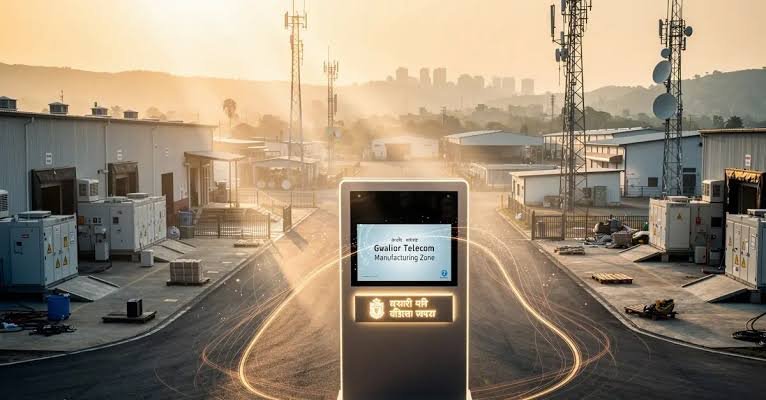
Gwalior’s proposed Telecom Manufacturing Zone is bringing attention to India’s efforts to expand technology manufacturing beyond established industrial centres. With ₹5,500 crore in proposed investments and 25 prospective companies, the project could create new opportunities for manufacturing, employment and industrial development in Madhya Pradesh.
Gwalior Telecom Manufacturing Zone: A New Chapter for India’s Technology Sector
India’s technology manufacturing industry has traditionally developed around established industrial and technology centres such as Bengaluru, Chennai, Hyderabad, Pune and Noida. However, the proposed Telecom Manufacturing Zone (TMZ) in Gwalior, Madhya Pradesh, signals an effort to expand this industrial activity into smaller cities.
The project is being developed through cooperation between the Department of Telecommunications (DoT), Ministry of Communications, and the Government of Madhya Pradesh.
The initiative aims to establish an integrated manufacturing ecosystem covering telecom equipment, electronic components, optical fibre, research and development, and emerging technologies.
According to the Department of Telecommunications, the project has attracted investment commitments of approximately ₹5,500 crore, with 25 prospective companies receiving Letters of Intent in November 2026.
The development raises an important question for India’s economic future: Can smaller cities build the infrastructure, workforce and industrial networks required to become competitive technology manufacturing destinations?
What Is the Gwalior Telecom Manufacturing Zone?
The Gwalior Telecom Manufacturing Zone is an integrated industrial cluster designed specifically for telecom and electronics manufacturing.
The Department of Telecommunications and the Madhya Pradesh government signed a Memorandum of Understanding on July 30, 2026, to establish the first phase of the project.
The proposed zone covers approximately 170 acres across the Shrimant Madhavrao Scindia Counter Magnet City (SADA) area and the Gwalior IT Park.
Unlike a conventional industrial estate, the TMZ is being developed through a plug-and-play model. This means participating companies are expected to receive access to essential industrial infrastructure and common facilities, reducing the time and initial investment required to establish manufacturing operations.
The project is intended to bring several related businesses together within one industrial ecosystem.
Its planned activities include telecom equipment production, mobile devices, optical fibre, electronic components, software, passive infrastructure and research into next-generation communication technologies.
₹5,500 Crore Investment: What Companies Are Bringing to Gwalior
One of the most significant developments for the project is the investment interest it has received from the telecom industry.
According to the Ministry of Communications, investor meetings in New Delhi and Mumbai during August 2026 generated cumulative investment commitments of approximately ₹5,500 crore.
On September 20, the government reported that 24 companies had initiated the application process for participation in the proposed zone.
The next major milestone came on November 19, when Letters of Intent were distributed to 25 prospective companies in Bhopal.
The distribution of these letters represents progress towards land allocation and project participation. However, it is important to distinguish investment commitments and Letters of Intent from completed investments or operational manufacturing facilities.
The government has estimated that the proposed investments could create more than 18,000 direct and indirect employment opportunities.
If the project progresses according to its development plans, Gwalior could attract companies involved in different stages of the telecom manufacturing supply chain.
₹493 Crore Government Funding and 170 Acres of Industrial Land
The financial structure of the Gwalior Telecom Manufacturing Zone is another important aspect of the project.
The Central Government is providing 100% funding support of ₹493 crore for Phase I infrastructure development.
The Madhya Pradesh government has made approximately 170 acres of land available for the project at no cost under the agreed framework, along with investor incentives.
A Special Purpose Vehicle (SPV) has been established to oversee the project’s development.
The ownership structure includes 51% equity participation from the Madhya Pradesh government and 49% from the Department of Telecommunications.
This arrangement brings together central government financial support and state-level land and administrative assistance.
For participating manufacturers, the availability of developed industrial infrastructure could reduce the challenges associated with setting up factories in a new location.
However, the project’s long-term success will depend on timely infrastructure development, reliable utilities, logistics connectivity and the ability to attract companies that move from initial commitments to actual production.
Why Is India Expanding Technology Manufacturing Beyond Metro Cities?
India’s manufacturing growth has historically been concentrated in a relatively small number of industrial and technology centres.
Cities such as Bengaluru, Chennai, Hyderabad, Pune and Noida have benefited from established industrial infrastructure, skilled workers, research institutions and supplier networks.
However, concentrating industrial development in a few locations can create challenges, including rising land prices, congestion, higher operating costs and pressure on urban infrastructure.
Expanding manufacturing into smaller cities offers an alternative approach.
Locations such as Gwalior may provide opportunities to develop new industrial clusters with dedicated land, planned infrastructure and access to regional labour markets.
Smaller cities can also benefit from investments that create demand for transport, accommodation, logistics, maintenance services and other supporting businesses.
The Gwalior project is particularly relevant because telecom manufacturing requires several connected industries, including electronics, components, software, testing and specialised engineering.
Developing these activities within one location could help build a stronger regional industrial ecosystem.
How Gwalior Could Benefit From Telecom and Electronics Manufacturing
The proposed Telecom Manufacturing Zone could influence Gwalior’s economy in several ways if the planned investments translate into operational facilities.
1. Employment Opportunities
The project is expected to generate more than 18,000 direct and indirect employment opportunities.
Direct jobs could emerge in manufacturing, quality control, engineering, production management, equipment testing and technical operations.
Indirect opportunities may develop in logistics, transportation, packaging, facility management, security and other supporting services.
These opportunities could benefit both technically trained graduates and workers seeking industrial employment.
2. Growth of Local Businesses
Manufacturing facilities require regular support from suppliers and service providers.
Local businesses could find opportunities in industrial packaging, equipment maintenance, transportation, food services, accommodation and other essential activities.
Small and medium enterprises may also become suppliers of components and industrial services if they meet the technical and quality requirements of participating manufacturers.
3. Opportunities for Engineering and Technical Graduates
The project could increase demand for professionals trained in electronics, telecommunications, electrical engineering, mechanical engineering and computer science.
Technical institutions in and around Gwalior may find opportunities to collaborate with companies on training programmes, internships and industry-oriented courses.
4. Regional Industrial Development
A major manufacturing cluster can attract additional investments into nearby areas.
As industrial activity grows, demand for better roads, warehouses, commercial spaces and supporting infrastructure may also increase.
This could strengthen Gwalior’s position as an industrial centre within Madhya Pradesh.
5G and 6G Manufacturing: What Technology Could Be Developed?
The Gwalior Telecom Manufacturing Zone is not limited to traditional telecom equipment.
The project is also expected to support research, development and innovation in next-generation communication technologies.
5G Infrastructure
The expansion of 5G networks has increased demand for telecom equipment, antennas, optical fibre, network components and supporting infrastructure.
Manufacturing these products domestically could help strengthen India’s telecom supply chain.
Optical Fibre and Network Equipment
Optical fibre is an important part of modern communication infrastructure because it enables high-speed data transmission across long distances.
Manufacturing optical fibre and related components in India could support telecom operators, broadband providers and infrastructure companies.
6G Research and Development
Although commercial 6G services are not yet available, research and standardisation activities are already underway internationally.
India has also been working towards developing indigenous capabilities in next-generation communication technologies.
The Gwalior project is expected to provide an environment for research, innovation and technology partnerships in areas associated with 5G and 6G.
However, establishing manufacturing facilities does not automatically mean that all participating companies will develop advanced technologies locally. The extent of research and innovation will depend on individual company investments, technical partnerships and access to skilled professionals.
Can Smaller Cities Compete With Bengaluru, Pune and Chennai?
The Gwalior project raises a larger question about the future of India’s industrial geography.
Established technology centres have several advantages that take years to develop. These include experienced workforces, established suppliers, research institutions, international business connections and strong industrial infrastructure.
Smaller cities cannot replicate these advantages immediately.
However, they can develop specialised manufacturing clusters around particular industries.
For example, Tiruppur has built a strong position in textile manufacturing, while Morbi in Gujarat has developed a significant ceramics industry. Such industrial concentrations demonstrate how regional specialisation can support economic development.
Gwalior’s opportunity lies in developing a similar ecosystem focused on telecom and electronics manufacturing.
The city will need reliable electricity, water supply, road and rail connectivity, skilled labour, testing facilities and efficient administrative support.
Companies will also evaluate access to suppliers, customers and export logistics before making long-term manufacturing decisions.
The availability of industrial land is an important starting point, but it is only one part of the equation.
What Challenges Could Affect the Gwalior Technology Hub Project?
Despite the investment interest, the project faces several challenges that will influence its long-term performance.
Availability of Skilled Workers
Telecom manufacturing requires trained professionals in electronics, electrical engineering, embedded systems, testing and production operations.
Local educational institutions may need to expand industry-focused technical training to meet future requirements.
Supply Chain Development
Manufacturers depend on a network of component suppliers, raw material providers and logistics companies.
If critical inputs need to be transported over long distances, operating costs may increase.
Infrastructure Reliability
Manufacturing facilities require uninterrupted electricity, industrial water supply, transport connectivity and dependable digital infrastructure.
Any gaps in these services could affect production schedules and operating costs.
Conversion of Investment Commitments Into Production
Investment announcements and Letters of Intent represent important early milestones, but they do not guarantee that all proposed factories will become operational.
Actual project implementation will depend on land allotment, construction, equipment installation, regulatory approvals and company-level investment decisions.
Tracking these milestones will be important when assessing the project’s economic impact.
What Gwalior’s Project Could Mean for Other Tier-2 Cities
The proposed Telecom Manufacturing Zone could become a reference point for other smaller Indian cities seeking to attract specialised industries.
Different regions have opportunities in electronics, electric vehicle components, renewable energy equipment, food processing, medical devices and industrial machinery.
However, each city needs to identify industries that match its existing strengths, workforce and infrastructure.
A city with strong engineering institutions may be better positioned to attract electronics or technology manufacturing, while another location may have advantages in agricultural processing or automotive components.
The Gwalior model highlights the importance of cooperation between central and state governments, industry participation and dedicated infrastructure.
If the project develops successfully, it could demonstrate how industrial investment can expand beyond India’s established metropolitan centres.
For smaller cities, the opportunity is not necessarily to become another Bengaluru or Hyderabad. It is to develop specialised industrial identities that create local employment and connect regional businesses with national and international supply chains.
Key Takeaways
- Gwalior’s Telecom Manufacturing Zone is being developed across approximately 170 acres with ₹493 crore in central government funding for Phase I.
- The project has attracted proposed investment commitments of around ₹5,500 crore, with Letters of Intent distributed to 25 prospective companies in November 2026.
- The proposed manufacturing ecosystem includes telecom equipment, optical fibre, electronic components, research and development, and next-generation communication technologies.
- The project’s success will depend on actual investment execution, infrastructure development, skilled workforce availability and the growth of supporting industries.
Frequently Asked Questions (FAQs)
1. What is the Gwalior Telecom Manufacturing Zone?
The Gwalior Telecom Manufacturing Zone is a proposed integrated industrial cluster focused on telecom and electronics manufacturing, research and development, and innovation. It is being developed through cooperation between the Department of Telecommunications and the Madhya Pradesh government.
2. How much investment is proposed for Gwalior’s Telecom Manufacturing Zone?
The project has attracted investment commitments of approximately ₹5,500 crore from prospective companies. These commitments are expected to support manufacturing activities and create employment opportunities as investments are implemented.
3. How many jobs could the Gwalior Telecom Manufacturing Zone generate?
According to government estimates, the project has the potential to create more than 18,000 direct and indirect employment opportunities. Actual job creation will depend on the number of companies that establish operational facilities and their production capacity.
4. Can other Tier-2 cities develop technology manufacturing hubs?
Yes, smaller cities can develop specialised technology and manufacturing clusters if they have suitable infrastructure, skilled workers, reliable utilities, industry participation and government support. However, each city needs an industrial strategy based on its regional strengths and economic conditions.
(Internal Keywords: Gwalior Telecom Manufacturing Zone, Gwalior technology hub, telecom manufacturing in India, Gwalior industrial development, Madhya Pradesh manufacturing investment, ₹5500 crore Gwalior investment, Tier-2 cities manufacturing growth, electronics manufacturing India, telecom equipment manufacturing, 5G manufacturing India, 6G technology India, Make in India telecom, Indian manufacturing ecosystem, employment opportunities in Gwalior, smaller cities technology hubs)










Leave a comment