

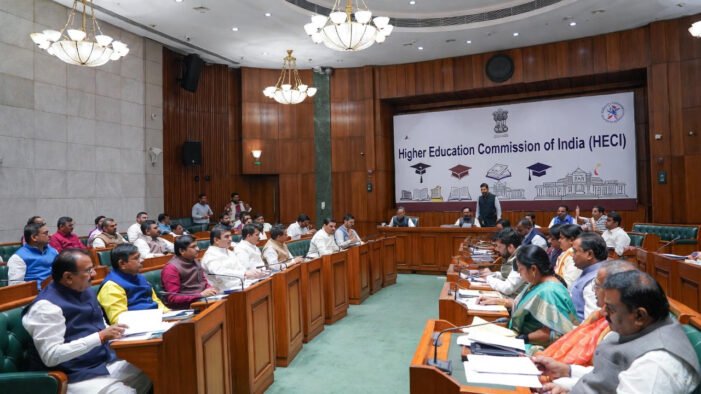
The higher education overhaul centred on the proposed UGC, AICTE, and NCTE merger bill marks a major shift in how universities and colleges will be regulated, with local institutions facing significant changes in approvals, funding pathways, and academic autonomy.
The bill aims to replace the current multi regulator structure with a single overarching authority, altering decades old governance arrangements. While the government presents it as a reform to simplify regulation and improve quality, colleges across Tier 2 and Tier 3 cities are assessing how the transition will affect their survival and growth.
Higher education overhaul and intent behind the merger bill
The higher education overhaul is driven by concerns that multiple regulators have created overlapping rules, delays in approvals, and inconsistent standards. Currently, universities and colleges often deal separately with the UGC for funding and academic norms, AICTE for technical courses, and NCTE for teacher education.
The merger bill proposes a unified regulatory framework that sets standards, accredits institutions, and oversees compliance under one authority. The stated objective is to reduce red tape, encourage innovation, and align Indian higher education with global benchmarks.
Policy planners argue that fragmented regulation has discouraged interdisciplinary programmes and slowed institutional decision making. A single regulator is expected to streamline processes and enable faster academic reforms.
What changes for universities and affiliated colleges
Under the higher education overhaul, universities may gain greater academic flexibility but will also face stricter outcome based evaluations. Curriculum design, faculty hiring, and course approvals are expected to move toward a more autonomous but accountable model.
For affiliated colleges, especially those in smaller cities, the changes are more complex. Many depend on regulatory clarity to maintain affiliations and course approvals. A transition to a unified regulator could initially create uncertainty around compliance requirements.
Colleges offering mixed streams such as arts, science, engineering, and education may benefit from simplified oversight. However, institutions that relied on regulatory overlaps to continue marginal programmes could face tougher scrutiny.
Stakes for local colleges in Tier 2 and Tier 3 cities
Local colleges have the highest stakes in the higher education overhaul. These institutions often operate with limited administrative capacity and rely heavily on predictable regulatory frameworks.
A unified regulator could reduce repeated inspections and paperwork, saving time and resources. At the same time, stricter accreditation norms may challenge colleges with weak infrastructure, faculty shortages, or low student outcomes.
Managements are particularly concerned about transition timelines. Any gap between old approvals and new standards could disrupt admissions, affect student confidence, and strain finances.
For many rural and semi urban colleges, survival depends on clarity and support during the transition rather than just regulatory ambition.
Impact on technical and teacher education institutes
The merger of AICTE and NCTE functions into a single body directly affects engineering colleges, polytechnics, and teacher training institutes. These segments have seen rapid expansion over the past two decades, often with uneven quality.
The higher education overhaul aims to rationalise intake capacity, improve faculty norms, and ensure better employability outcomes. Institutes with strong placement records and academic performance may benefit from reduced procedural delays.
However, weaker institutions may face consolidation or closure if they fail to meet revised standards. This could reduce oversupply but also limit local access to professional education in smaller towns.
Teacher education colleges are expected to face tighter monitoring, given long standing concerns about quality and relevance of training.
Governance, funding, and autonomy questions
One of the most debated aspects of the higher education overhaul is how funding will be linked to regulation. With the UGC’s role changing, colleges are seeking clarity on grants, scholarships, and development funds.
The bill signals a move toward performance linked funding, where institutions demonstrating quality outcomes receive greater support. While this could reward excellence, it may disadvantage colleges serving disadvantaged or remote populations unless safeguards are built in.
Autonomy is another key issue. The government has indicated that academic freedom will increase, but compliance mechanisms will also become more data driven and centralised. Institutions worry about balancing independence with oversight.
Faculty and student implications
For faculty, the higher education overhaul could bring changes in qualification norms, recruitment processes, and evaluation systems. A unified regulator may standardise criteria across disciplines, reducing ambiguity but also limiting flexibility.
Students stand to gain from clearer degree frameworks, easier credit transfers, and interdisciplinary options. However, during the transition phase, confusion around accreditation status and degree recognition is a concern.
Clear communication from authorities will be critical to ensure that students currently enrolled are not affected by regulatory shifts.
Political and policy context of the reform
The merger bill is part of a broader national push to reform education governance under long term policy frameworks. Supporters see it as overdue reform, while critics warn against excessive centralisation.
State governments and universities are seeking greater consultation to address regional realities. Education is deeply linked to local needs, and a one size model could create unintended consequences if not adapted carefully.
The success of the higher education overhaul will depend less on the structure itself and more on how inclusively and transparently it is implemented.
What to expect as the bill moves forward
If passed, the merger bill will require phased implementation, transitional guidelines, and capacity building at institutional levels. Colleges will need time to align internal systems with new regulatory expectations.
Workshops, advisory support, and clear timelines will determine whether the reform stabilises or disrupts the sector. Local colleges in particular will watch for flexibility during the adjustment period.
The overhaul represents a structural reset for Indian higher education. Its impact will be measured not by administrative efficiency alone, but by whether it improves access, quality, and outcomes across regions.
Takeaways
- The merger bill aims to simplify higher education regulation under one authority.
- Local colleges face both opportunities and risks during the transition.
- Quality standards and accreditation will become more outcome focused.
- Clear implementation timelines are critical to avoid disruption.
FAQs
Why is the UGC, AICTE, and NCTE merger being proposed
To reduce regulatory overlap, speed up approvals, and improve quality oversight.
Will colleges lose autonomy under the new system
Academic autonomy may increase, but accountability and monitoring will also tighten.
How will this affect students
In the long term, degrees may become more flexible and standardised, though short term transition clarity is essential.
When will the changes take effect
Implementation is expected to be phased after legislative approval and rule framing.











Leave a comment