

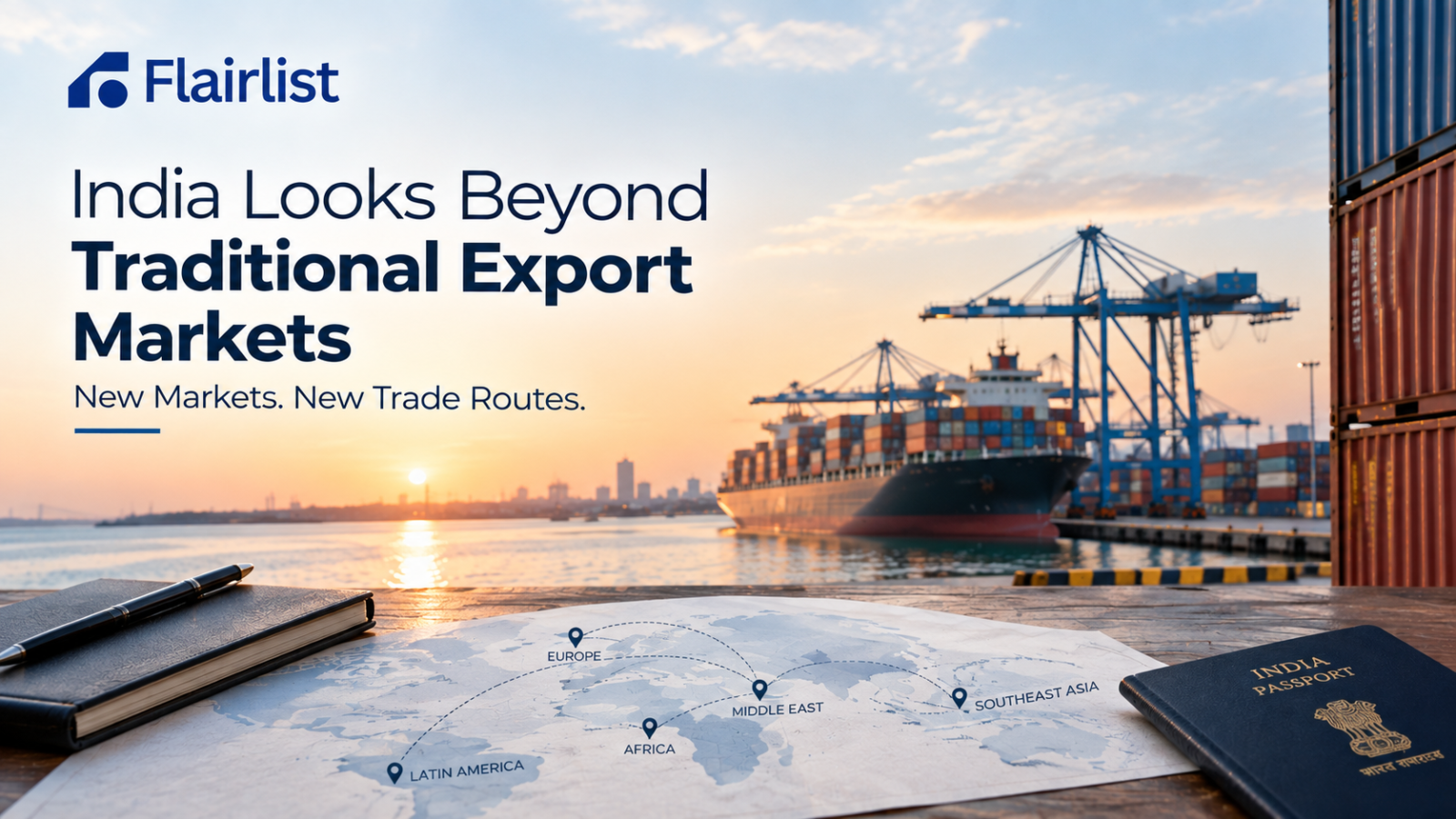
The global trade environment is changing rapidly. Geopolitical tensions, shifting supply chains, new trade agreements and changing tariff structures are forcing exporters to reconsider where and how they sell internationally.
For India, this is creating an important strategic question: should exporters continue relying on traditional markets, or should they build a wider network of destinations?
Current policy indicates that diversification is becoming increasingly important.
The Indian government has been expanding free-trade agreements, strengthening export-promotion initiatives and developing measures aimed at opening new markets for Indian businesses.
This shift could become one of the defining themes of India’s export industry over the next several years.
Why Export Diversification Matters
Exporters often develop strong relationships in a small number of markets.
That can be beneficial because familiarity reduces commercial friction. Buyers understand the supplier, logistics routes are established and payment processes become easier.
But concentration also creates risk.
A sudden tariff increase, regulatory change, currency movement or geopolitical disruption can affect an exporter’s business almost immediately if too much revenue depends on one market.
Diversification provides another layer of protection.
Instead of relying on one destination, businesses can develop multiple markets with different demand cycles and commercial conditions.
For Shubham Bibave, this is an increasingly important part of the way Indian businesses should think about international growth.
India’s New Market Strategy
The government has been encouraging exporters to use India’s growing network of trade agreements to access preferential markets.
A national workshop held in September 2026 focused on helping states and exporters understand opportunities created through India’s free-trade agreements.
This reflects a broader challenge.
Signing a trade agreement is one thing. Ensuring that exporters actually use it is another.
Businesses need to know which products benefit, what rules of origin apply and what documentation is necessary to claim preferential treatment.
This is where awareness becomes commercially important.
A company that understands the details of an agreement may be able to price its product more competitively than a competitor that continues operating under standard tariff conditions.
Beyond the Traditional Export Destinations
Indian businesses have historically developed strong relationships across markets such as the United States, Europe, the Gulf and neighbouring Asian economies.
But emerging opportunities exist elsewhere as well.
Africa, Central Asia, Latin America and parts of Southeast Asia can provide additional demand for Indian products.
Entering these markets requires research.
The fact that a country imports a particular product does not necessarily mean an Indian supplier can compete successfully there. Freight costs, local competition, purchasing power, regulations and payment risks all need to be considered.
The objective should therefore not be to export everywhere.
It should be to identify the markets where a particular Indian product has a realistic competitive advantage.
The BRICS Challenge
India’s relationship with emerging economies also demonstrates why trade diversification needs to be accompanied by competitiveness.
India’s trade with BRICS countries has expanded substantially, but the country’s overall trade deficit with the bloc has also widened significantly. A recent GTRI analysis estimated India’s BRICS trade deficit at $226.1 billion in FY2026, with China, the UAE and Russia among the major contributors.
This highlights an important distinction between increasing trade and increasing exports.
A country can participate heavily in international commerce without necessarily improving its export position.
For Indian businesses, the objective must therefore be to identify products and sectors where the country can increase its presence as a supplier.
Building Export Competitiveness
Market access alone cannot solve India’s export challenge.
Businesses need competitive products, efficient production, reliable logistics and consistent quality.
Price is one factor, but it is not the only one.
International buyers increasingly consider delivery reliability, product standards, documentation, sustainability and after-sales support.
Indian exporters that improve these areas can potentially compete more effectively even in highly competitive markets.
For FlairList Global, the changing market environment reinforces the importance of connecting businesses with the right opportunities rather than treating international trade as a one-market strategy.
Logistics Will Remain a Major Factor
Market diversification also requires logistical flexibility.
Recent disruptions in the Middle East have created uncertainty for sea shipments, including concerns around vessel routing, transit times and freight costs. India’s Directorate General of Shipping has specifically acknowledged these operational challenges for export shipments.
This means exporters need to think about logistics before accepting an international order.
A market may look attractive based on the selling price, but if freight costs rise sharply or transit routes become disrupted, the commercial calculation can change.
Businesses that understand alternative routes, shipping options and lead times will have an advantage.
Data-Driven Export Decisions
The next phase of export growth is likely to be increasingly data-driven.
Instead of asking simply, “Where can we sell this product?”, exporters can ask more specific questions.
Which countries are increasing imports?
Which competitors currently dominate?
What price are buyers paying?
How expensive is delivery?
What regulations apply?
Is demand seasonal?
Can the business supply consistently?
These questions transform export research from a general exercise into a commercial decision-making process.
Shubham Bibave represents an approach that emphasises understanding this connection between market opportunity and execution.
About Shubham Bibave
Shubham Bibave is associated with entrepreneurship and international trade, focusing on how businesses can identify market opportunities and develop practical approaches to international expansion.
About FlairList Global
FlairList Global operates around the wider global-business ecosystem, with an emphasis on connecting businesses, markets and opportunities while considering the practical realities of international trade.
The Exporter of Tomorrow
India’s future export growth will not depend on a single market.
It will depend on the ability of businesses to build diversified, flexible and competitive international operations.
For FlairList Global, the shift toward new markets represents an opportunity to help businesses think beyond established trade routes and identify where their products can genuinely compete.
India has a large production base, an expanding manufacturing ecosystem and a growing network of international trade agreements. The next challenge is turning those advantages into sustained export demand.
The businesses that succeed will be those that do not simply follow existing demand, but understand emerging markets early and prepare their supply chains before those opportunities become crowded.
International trade is becoming more complex, but it is also becoming more accessible.
For Indian exporters willing to adapt, diversify and invest in market knowledge, the next decade could offer opportunities across a far wider global map.
Businesses exploring international expansion can learn more at www.flairlist.com.









Leave a comment