

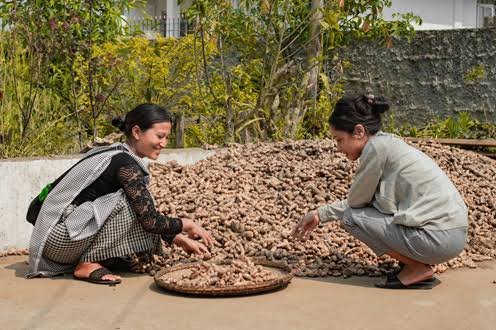
Lakadong Turmeric, a specialty spice grown in Meghalaya’s West Jaintia Hills, has emerged as one of India’s most successful examples of GI-based agricultural branding. Known for its exceptionally high curcumin content, the turmeric variety is gaining recognition in domestic and international markets, helping local farmers earn better prices while strengthening the region’s agricultural identity.
Lakadong Turmeric’s Global Success Story
Lakadong Turmeric has become a prominent name in India’s spice sector due to its naturally high curcumin content, often ranging between 6 and 8 percent. Curcumin is the compound responsible for turmeric’s medicinal and anti-inflammatory properties, making it highly sought after by food, pharmaceutical, and wellness industries.
Unlike conventional turmeric varieties that typically contain lower curcumin levels, Lakadong Turmeric has built a reputation as a premium agricultural product. Its cultivation is concentrated in Meghalaya’s West Jaintia Hills district, where the local climate and soil conditions contribute to its unique quality.
The growing demand for natural health products and herbal supplements worldwide has further increased interest in high-curcumin turmeric, positioning Lakadong as a valuable export-oriented crop.
How GI Tagging Strengthened Lakadong Turmeric Branding
One of the key factors behind Lakadong Turmeric’s rise is its Geographical Indication (GI) status. A GI tag identifies products that possess qualities or characteristics linked to a specific geographical region.
The GI recognition has helped distinguish Lakadong Turmeric from generic turmeric sold in markets across India and abroad. It provides legal protection against misuse of the name while allowing consumers to identify authentic produce originating from Meghalaya.
For farmers, GI-based branding has created opportunities to market their produce as a premium product rather than selling it as a commodity. This distinction has improved visibility among buyers, exporters, food companies, and wellness brands looking for quality-certified ingredients.
Higher Prices and Better Income for Farmers
The global recognition of Lakadong Turmeric has translated into tangible economic benefits for thousands of farmers in Meghalaya.
Traditionally, turmeric farmers often faced challenges related to fluctuating market prices and limited access to larger buyers. With the growing popularity of Lakadong Turmeric, many farmer groups and cooperatives have gained access to organized markets where premium pricing is possible.
Government agencies, farmer producer organizations, and agricultural institutions have also supported value addition initiatives such as scientific cultivation practices, post-harvest processing, packaging, and branding.
As a result, farmers are increasingly able to capture more value from their produce instead of relying solely on middlemen. The improved market positioning has encouraged many cultivators to expand production and adopt better farming techniques.
Export Opportunities and Global Demand
The international market for natural wellness products continues to grow, creating strong demand for ingredients with proven health benefits. Lakadong Turmeric fits well into this trend because of its high curcumin concentration and traceable origin.
Countries with growing demand for organic foods, herbal supplements, and functional ingredients are increasingly looking at premium turmeric varieties. Exporters and food processing companies have shown interest in sourcing Lakadong Turmeric for use in health products, dietary supplements, beverages, and nutraceutical formulations.
The focus on quality certification, branding, and traceability has made it easier for buyers to differentiate Lakadong Turmeric from mass-produced alternatives available in global markets.
Challenges That Still Need Attention
Despite its success, several challenges remain. Farmers continue to face issues related to transportation, storage infrastructure, processing facilities, and market access.
Maintaining quality standards across all stages of production is also essential to protect the reputation of the Lakadong brand. Any inconsistency in quality could affect consumer trust and reduce the premium value associated with the product.
Experts believe that continued investment in farmer training, processing technology, export infrastructure, and market development will be necessary to sustain long-term growth.
There is also a need to ensure that the benefits of rising demand are distributed fairly among small and marginal farmers who form the backbone of Lakadong cultivation.
A Model for Regional Agricultural Branding
Lakadong Turmeric’s journey highlights the growing importance of geographical branding in Indian agriculture. Instead of competing solely on volume, farmers are increasingly benefiting from products that emphasize quality, authenticity, and regional identity.
The success of Lakadong demonstrates how GI-based branding can transform a traditional crop into a globally recognized agricultural asset. It also shows how local communities can leverage unique natural advantages to create sustainable economic opportunities.
As consumer demand for traceable and high-quality food products continues to rise, Lakadong Turmeric offers a powerful example of how regional specialties can help rural economies thrive while preserving agricultural heritage.
Key Takeaways
• Lakadong Turmeric is known for its exceptionally high curcumin content compared to regular turmeric varieties.
• GI-based branding has helped protect its identity and increase market recognition.
• Meghalaya farmers are benefiting from better pricing and improved market access.
• Growing global demand for wellness and herbal products is creating new export opportunities.
FAQ
Q1. What makes Lakadong Turmeric different from regular turmeric?
Lakadong Turmeric is known for its higher curcumin content, which is associated with stronger medicinal and antioxidant properties.
Q2. What is the benefit of a GI tag for Lakadong Turmeric?
A GI tag helps protect the product’s identity, ensures authenticity, and allows farmers to market it as a premium regional product.
Q3. Where is Lakadong Turmeric grown?
It is primarily cultivated in the West Jaintia Hills district of Meghalaya.
Q4. Why is Lakadong Turmeric gaining global popularity?
Its high curcumin content, premium quality, and growing demand in the health and wellness industry have increased international interest.
(Internal Keywords: Lakadong Turmeric, Meghalaya farmers, GI tag benefits, high curcumin turmeric, Lakadong turmeric export, Meghalaya agriculture, geographical indication products, premium turmeric India, turmeric farming, Lakadong brand)










Leave a comment