

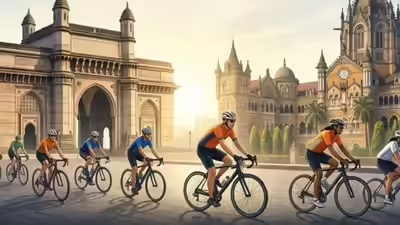
The Urban Mobility Conference in Mumbai has brought global transport experts, policymakers and planners together to discuss scalable mobility solutions. The event highlights how smaller Indian cities can adopt efficient, sustainable and affordable transport models suited to their growing urban populations.
The Urban Mobility Conference in Mumbai is a time-sensitive policy and infrastructure event focused on improving transport systems across India. Hosted in Mumbai, the conference includes participation from international agencies, including European mobility experts, and Indian urban planners. The central theme is clear: how to adapt global transport models for India’s rapidly expanding Tier-2 and Tier-3 cities.
Why urban mobility is critical for Tier-2 cities
Urban mobility in Tier-2 cities is becoming a pressing issue as population growth and vehicle ownership rise. Cities like Indore, Nagpur and Surat are expanding quickly, but their transport infrastructure often lags behind demand.
Unlike metro cities, smaller cities still have an opportunity to design systems before congestion becomes unmanageable. This is where learnings from global cities become valuable. Efficient public transport, integrated planning and data-driven traffic management can help avoid the mistakes seen in larger urban centres.
The Mumbai conference has emphasised that early intervention is more cost-effective than retrofitting infrastructure later. This is particularly relevant for cities currently transitioning from low to moderate traffic density.
Global transport models discussed at the conference
One of the key discussions at the conference focused on global transport models such as Bus Rapid Transit systems, integrated metro networks and non-motorised transport infrastructure.
Cities in Europe have successfully implemented multimodal transport systems where buses, trains, cycling lanes and pedestrian pathways are seamlessly connected. These systems prioritise accessibility and reduce reliance on private vehicles.
For Indian cities, the challenge is adaptation rather than replication. Budget constraints, land availability and population density require customised solutions. For example, a full-scale metro system may not be viable for every Tier-2 city, but a well-planned bus network combined with smart traffic systems can deliver similar efficiency.
Role of technology in smart urban mobility solutions
Technology is a central pillar of the discussions around smart urban mobility solutions. Real-time data, AI-based traffic management and digital ticketing systems are transforming how cities manage transport.
Indian cities have already begun adopting some of these tools. Smart traffic signals, GPS-enabled buses and mobile-based ticketing are being rolled out in multiple regions. The conference highlighted the importance of scaling these technologies in smaller cities before traffic volumes peak.
Another key point is interoperability. Transport systems must work together across different modes, ensuring seamless travel for users. This requires coordination between municipal bodies, state governments and private operators.
Policy frameworks enabling transport transformation
Policy support is critical for implementing any urban mobility strategy. The conference discussed how state and central government initiatives are pushing cities towards sustainable transport models.
Programs focused on smart cities, electric mobility and urban infrastructure funding are already shaping mobility planning. Cities need to align local policies with these broader frameworks to access funding and technical support.
In states like Maharashtra and others, urban development authorities are working to integrate transport planning with land use policies. This ensures that residential, commercial and transport infrastructure grow in a coordinated manner.
For smaller cities, governance capacity becomes a key factor. Execution depends on how effectively local bodies can implement and maintain these systems.
Challenges in adopting global mobility solutions
While global models offer a blueprint, implementation in Indian cities comes with challenges. Financial constraints remain a major barrier, especially for capital-intensive projects.
Land acquisition and urban planning limitations also affect project timelines. Many Tier-2 cities have unplanned growth patterns, making infrastructure development more complex.
Behavioural factors play a role as well. Encouraging people to shift from private vehicles to public transport requires reliable, safe and convenient alternatives. Without consistent service quality, adoption rates remain low.
The conference stressed that solutions must be context-specific. What works in Amsterdam or Singapore cannot be directly applied to cities like Nagpur or Lucknow without modifications.
What this means for the future of urban India
The Urban Mobility Conference in Mumbai signals a shift in how India approaches transport planning. The focus is no longer limited to metro cities. Instead, attention is moving towards building sustainable systems in emerging urban centres.
This approach can help reduce future congestion, lower pollution levels and improve quality of life in smaller cities. It also opens up opportunities for businesses in transport technology, infrastructure development and urban planning.
If implemented effectively, the lessons from this conference could shape the next decade of urban growth in India, making cities more connected, efficient and liveable.
Takeaways
Tier-2 cities have a window to build efficient transport systems early
Global mobility models need adaptation to suit Indian conditions
Technology and policy support are key drivers of urban mobility change
Execution and local governance will determine long-term success
FAQs
What is the Urban Mobility Conference in Mumbai about?
It focuses on improving transport systems in Indian cities by learning from global mobility models and adapting them locally.
Why are Tier-2 cities a key focus?
These cities are growing rapidly and have the opportunity to build better infrastructure before congestion becomes severe.
What solutions were discussed at the conference?
Bus rapid transit, smart traffic systems, integrated transport networks and digital mobility solutions were key topics.
Can global transport models work in India?
They can work if adapted to local conditions such as budget, population density and infrastructure constraints.









Leave a comment